What is your favorite “Fallen Flag” (railroad that is no longer, has gone defunct, been bought or absorbed through merger, whatever) ???
If your favorite “Fallen Flag” were still in existance today, what do you think it would be like? What motive power would it run? Would it have changed its livery? If so, how (speculate) ? What would it have done, or be doing, in order to survive? How is that different from its actual real era?
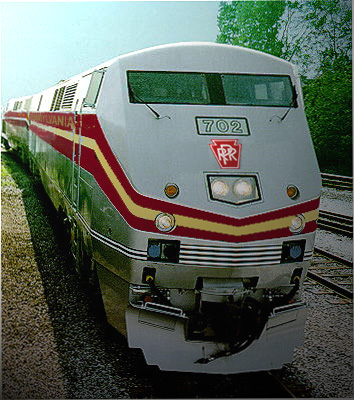
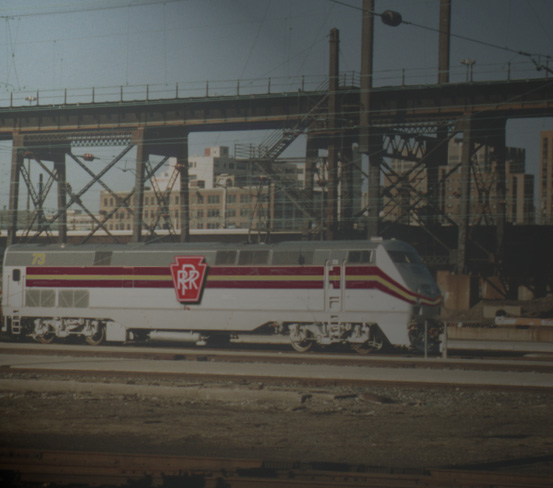
my favorite “Fallen Flag” is the PRR - the “Standard Railroad of the World”.
Why? I like the “family” look of the PRR steamers, setting own standards and creating that distinct PRR look. I guess, if they´d be still around and changed Altoona to building Diesels, the PRR Diesels also would have their own look - different from the rest of the US roads.
Probably the DL&W since my freelanced New York, Binghamton, and Western is based loosely on it. My railroad is a composite of several lines that extended from the west bank of the Hudson across northern New Jersey into upstate New York. The others being the NYO&W and the Erie. Had the NYO&W survived and been part of the Erie-Lackwanna merger, the combined railroad map would look very much like my NYB&W. No single railroad had all the elements I wanted so I chose to freelance a composite railroad.
If the DL&W or even the Erie-Lackawanna survived on their own, I’m sure there would have been several changes of livery over the years. Since it was eventually absorbed into Conrail which was in turn carved up by CSX and NS, my guess is that it would run pretty much the same equipment as those two lines. I am not familiar enough with the Conrail break up to know which parts went to CSX and which were taken over by the NS.
Instead of white stripes and horses on black locos, I figure that N&W would likely have gone with their traditional block NW. So nothing flashy on those special order high hood wide cabs… [:D]
My diesel road power for the Late Transition Era is from the Milwaukee Road. I’d imagine they’d look about the same today, since the fundamental mission of the railroad hasn’t changed that much. The simple orange-and-black or orange-and-dark-gray paint scheme has always looked good to me.
I’d love to see the Hiawathas revived as high-speed rail, by the shores of Gitchee-Goomee, by the shining big-sea water, once again carrying passengers in comfort around the Great Lakes region.
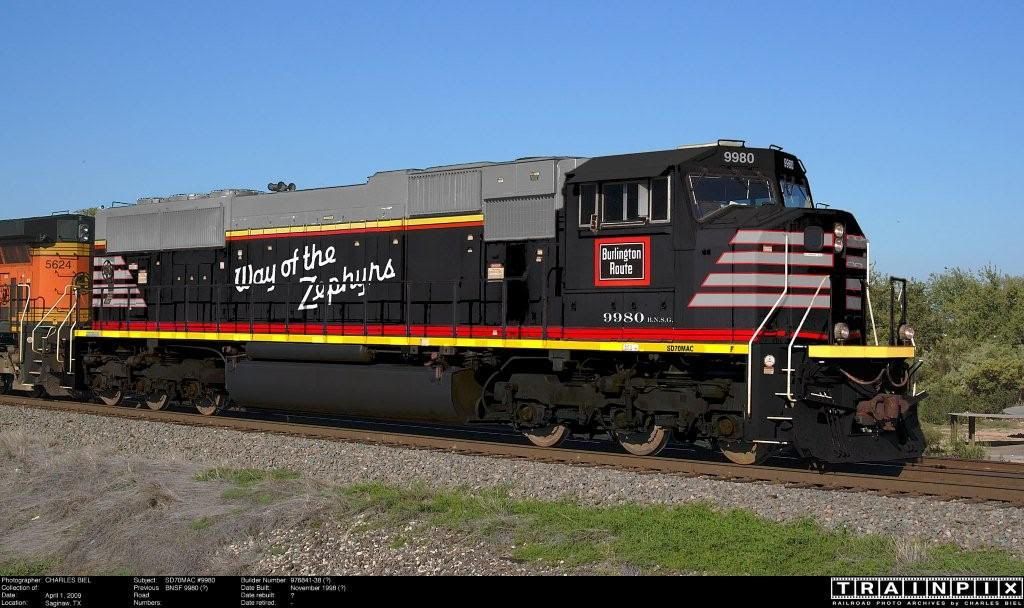
Favorite “fallen flag” is the CB&Q. Although I am a diehard UP fan, I grew up in a CB&Q town. The variety was always fun for a young model railroader.
I doubt CB&Q could have survived as an independent road. They were fated to be absorbed. I was not much inspired by BN for several reasons. BNSF isn’t bad once you get used to orange
Add my name to the list of SPF (Slobbering Pennsy Fanatics)!
I think if the Pennsy were around today its outward appearance wouldn’t have changed much. The locomotives would still be Brunswick Green, big and represent both major locomotive builders. I think we would see the use of a big keystone logo on the sides of the long hood rather than the small keystones Pennsy used on its locos towards the end.
I think any radical departure in the form of paint schemes of the past would be with how freight cars were painted.
I think we might even have seen more freight trackage put under wire…
Perhaps. I think however that the Pennsy had pretty much already decided to stop electrifying prior to its merger with NYC. Although I’m with you, I would have liked to have seen more juice jacks running around. I especially like the E44’s (and of course the GG1’s).
I have been extremely tempted to electrify the Pennsy portion of my South Penn RR-- I may still. I can easily see that run having been electrified. It has all the right elements, a la the “Virginian RR”…
2). Some of don’t have to wonder too much what it would look like:
As for what it would be like today? I figure all I have to do is look at the Providence & Worcester RR. The P&W was one of the many 19th Century RR’s that the NH leased and merged to form their empire in Southern New England. The NH never did get around to fully merging the P&W into it’s corporation, and the P&W existed as a paper RR for almost a century until the Penn Central was force fed the NH in 1969. The PC wanted to abandon the P&W, and in defiance, the P&W B.O.D. voted to resume independant operations. After a long legal battle with PC, the P&W triumphed and restarted train operations in the mid 1970’s with 2nd-hand D&H RS-3’s. Since then, they have grown from their original mainline between Providence and Worcester to owning many of the NH’s secondary lines in Rhode Island and Connecticut…and what they don’t own, they have trackage and haulage rights over most of the rest. Today’s P&W is, for all intents and purposes, the mo
I totally disagree with that statement. I believe if any road existing in 1900 could make it on their own it would have been the Q. First is must be remembered that the CB&Q was purchased by the GN and NP way back in 1910. If that had not happened the CB&Q would have probably built through the rockies and on to the Pacific on their own. They were instrumental in getting the D&RGW to build the Dotsero cuttoff to the Moffat Road. This moved major transcontenental traffic from Pueblo & Colorado Springs up closer to their East-west line in Denver. They had their own line from Denver south and at one time controlled the Colorado Midland.
In addition even in the 1910 purchase scenario the CB&Q managment certainly were the leaders of the Hill lines as far as how to make a railroad work. Many of the future chief executives of other railroad companies started and learned how to manage a RR with the Q. The CB&Q management was put in charge of dealing with railroad traffic for both WWI (officially USRA) and WWII generally. It was CB&Q’s management that convience the government that the railroads could self manage themselves.
So my philosphy would say the CB&Q would have gotten their own line through to the coast (possibly by using the Midland). This would have changed the entire way Jay Gould leveraged the D&RG and Western Pacific. I would have to check the real time lines but because of the Q’s excellent money management and leadership they may have ended up with both lines. So in that scenario they could abandon the less desireable lines across the mountains an
I think the CB&Q would have done well on its own without all the mergers taking place. In particular, the Powder River basin was on the Q exclusively. Utilities preasured the ICC for competition and the CNW and UP obtained access to Poweder River as a result. It would be nice if Q would have returned to the “blackbird” scheme intead of continuing with Chinese red.
I don’t have a “favorite” but a most interesting alternate history comes from the Canon City & San Juan. For those who don’t know, a simplified history is that Canon City & San Juan was a Santa Fe subsidiary for buiding in the Arkansas Valley. It is the railroad that really built the hanging bridge of the Royal Gorge over the Arkansas River in Colorado that is always credited to the D&RGW.
So if it were in existance today that means the “Treaty of Boston” would have favored the Santa Fe rather than the Denver & Rio Grande or at best (for the D&RG) it would have given them trackage rights over the bridge. The railroad would then have had to fight the D&RG for Tennesse Pass or would have diverted to one of the passes to the south either taking over Hell Gate Palasades from the Colorado Midland or actually building the Monarch Pass Tunnel, or possibly going through Cottonwood Pass. Once through the mountains it would have a “Northern Main” all the way through to San Francisco. Since “today” in my modeling world would be 1947-1955 there would be war bonnets running passengers through the Royal Gorge on such trains as the San Francisco Chief, Reno El Capitan, and Las Vegas Chief. The motive power would have been similar to that used over Raton Pass by the Parent road: heavy 4-8-4, 2-10-2, 2-10-4, FT-F3s, Alco RS4-5, Alco PAs on the through passenger.
Well, it’s pretty apparrent that my fallen flag of choice is Indiana’s own Chicago, Indianapolis, and Louisville. The Monon was a plucky little railroad that survived longer than its limited tonnage sources should have dictated.
Had the line’s late-19th century ambition to expand east and south into Kentucky not been shot down in the 11th hour by boardroom shenanigans, the Monon might have eventually gobbled up the L&N, instead of being ultimately absorbed into it, as it would have provided the most direct route for Kentucky & West Virginia coal into Chicago. My fantasy future history of the line has it ultimately acquiring the Chessie System, with the new locomotives painted solid black with big block gold “MSX” on the sides in the Monon’s signature large-serif lettering.
I miss the GN. Sky blue was OK when it was clean, but orange and green are compatible colors. Luckily I can see that combination every day on modern units.
GN would have suffered in modern times. They would not have shared significantly in the western coal boom like Burlington and NP would have and would be largely limited today to intermodal and general freight. Their crown jewel would have been the iron ore traffic, but that is a shadow of what it once was. I shudder to think they may have suffered the fate of the Milwaukee.