Please critique my idea for a layout. It is 8 ’ x 8’ x 3’ x 3’, N scale, with hidden staging, 15" minimum radius squared boxes show elevation from the top of the table, 2% grade, 4 axle locos in the Transition era, just in case I get a hankering for some steam. I tried to put a 2" line around the edge of the table. Probably it will be mountainous, a road in the East, have a coal mine, logging, a town, and a few stations. The sidings are just sketched in for now, but my plan is to build the table and then layout the track and move it around until I like it. Someone told me I should take 6 months to contemplate a layout design before I build it.
I thought the picture would show up better when I uploaded it.
I think it looks fine, it’s bigger than my layout so more power to you. The hidden staging should help you, I have to admit that even though my staging areas aren’t hidden they come in handy.I don’t know about waiting six whole months, you might start to lose interest. Remember you can always change things as you go along. If you are going to run sizable trains with that 2% grade, be ready to run multiple. I have a grade on one end of my layout (not originally planned) and believe me N scale engines don’t like going up them, especially if it leads into a curve. You have a good radius so it might not be a problem Good luck with it.
Thanks for the complement. 2% really? The only area the grade would be of concern is from under the bridge to on top of the bridge. Well, I hope to run mostly short trains, about 6 to 8 cars. Probably do DC with blocks, maybe run 2 trains at a time at most.
But like you said, 6 months is a long time, once I build the table I will play with the track and levels and other things before I start to glue things down.
Conceptually, this looks good to me. However, I do see a number of things I would recommend tweaking.
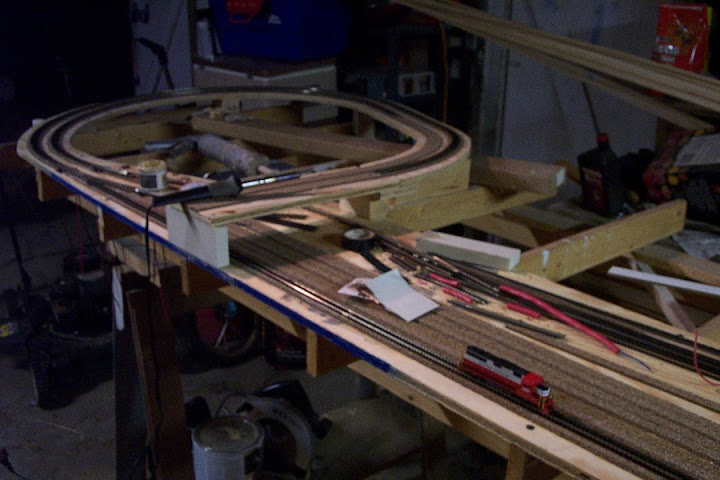
First of all, consider how you will be building your benchwork. You have a lot of hidden track, and a lot of elevation changes, which to me says that a solid plywood tabletop is not the way to go. By cutting plywood to just a bit wider than the roadbed and supporting it on risers anchored to joists, you leave most of the rest open and thus accessible from below. This will be all the more critical for staging tracks, since it appears these will end up located towards the rear. If you are going to build a solid table first and then elevate off of that, then you probably need to redesign in order to minimize hidden track as well as make sure that any hidden track is towards the front, so that it can be accessed from the side. Or you could plan on cutting out access holes in the base plywood later.
Still, hidden track for staging is great… as long as you can access it. I’ve made the mistake in the past of burying a staging track where the access was limited, with the end result that I ended up not using it! You need not only space for the trains, but also space for the hands (the 0-5-0 switchers as some call them) that will manipulate those trains. I’m currently working on a set of staging yards that are stacked, and I left 6 inches between the two decks - 2 inches for the trains themselves, and another 4 inches for my grubby mitts to get in there and do stuff. To achieve that much vertical separation here probably means introducing a couple of turns of helix at each end of the staging yard… but that might be good in another way, in that the staging yard could be more towards the front of the layout by spiraling down to it.
The length of mainline between the two industries, which you’ve labeled as Pulpwood and Mine, ought to have a passing siding that stretches the full distance between those two spurs. That w
Thanks! That is some great advice. I hadn’t thought all that much about the sidings, but I like your ideas, especially about the run arounds. I thought that maybe I would have a local freight that would do a turn and then pick up the sidings that were on a facing point on the return trip. I need to think about that some more.
On the portal, after looking at the plan again, I can see your point. You are talking about the portal next to the “0” elevation marker. Come think about it, it would be better if the mountain would continue on towards the lower corner where the portal is located and in doing so I would then move the upper portal to be near the lower portal, just like you said.
The more I think about it, the hidden staging in the location it is is now, is going to be a royal pain! Espcially since the two 8’ sides will but up against a wall. I will look at what it would take to spiral it down to be underneath the station at the “3” elevation. That way it will be right in front of me. That shouldn’t be too hard to change.
I haven’t given much thought to the benchwork yet.
I bought the software Anyrail, but haven’t used it much. I am an old fashion guy and still like to use paper and pencil. Oh by the way, I used to be a aircraft designer and have 8 years of experience sitting in front a CAD screen.
In addition to WP&P’s suggestion of turning your sketch into a scale drawing, make sure you draw the turnouts accurately (i.e. a #4 turnout will diverge 1 unit for every 4 straight units). Some turnouts in your sketch are pretty optimistic as to how quickly they diverge, and where the tracks actually end up may necessitate changes to some of your ideas.
Since your layout is against walls on both sides, I would consider the reach distances front to back, especially when you need to couple/uncouple/re-rail cars on trackage in the back with scenery up front. Depending on how long the reach is, you or someone might need to lean over scenery or trackage in the front and cause damage/derailments.
I think the 6 month design time that someone quoted you involves iterating to make sure that the design you come up with fits your vision of what you want out of the model railroad. A crucial part of that, of course, is figuring out that vision to begin with. This “navel gazing” will help you avoid investing and building something that doesn’t please you in the end. It may take 6 months, or it may be shorter, or it may be longer. It all depends on how far you want to go, and if you’ll be happy with the results.
Just in case you missed them, here are some links to essential reading for trackplanning:
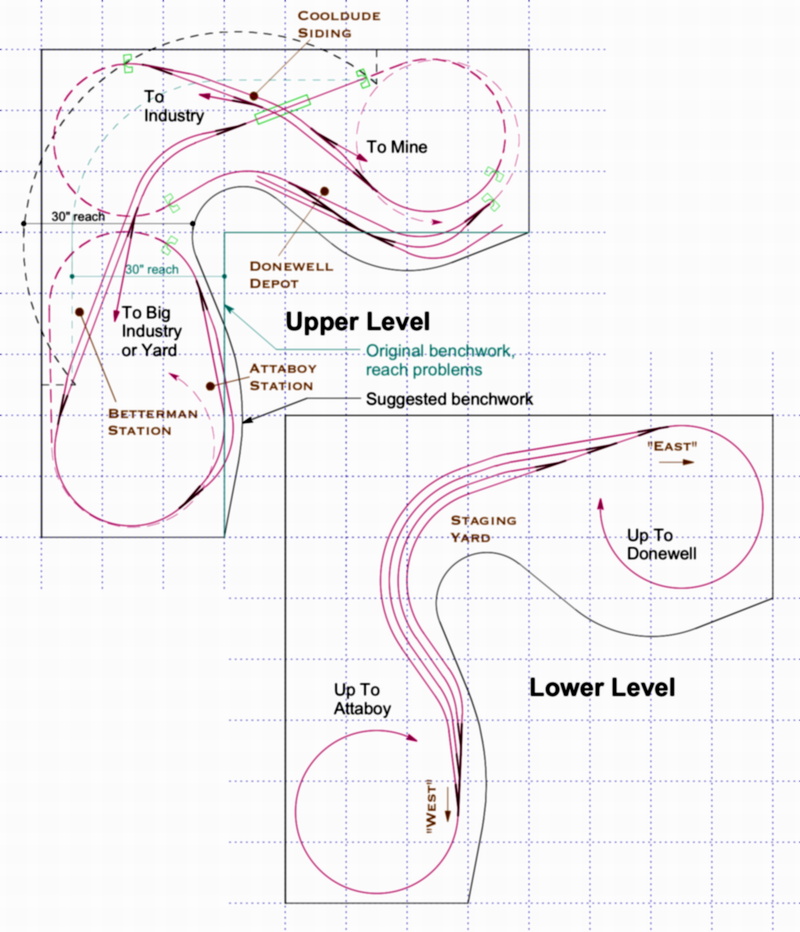
Here is my take on your plan, I went ahead and drafted it up with my suggestions incorporated:
I assigned arbitrary names in alphabetical order, just making up funny names. Obviously, if you pick out a prototype or a region, you’ll probably want to select more meaningful names, but it helps when talking about the planning to have at least a placeholder name. So, proceeding “west” out of staging, one arrives at Attaboy, then Betterman, then past Cooldude Siding, and finally to Donewell, then back to staging.
Attaboy is where the problem siding was, and in this version I think it is still undersized. There’s about three feet of clearance, so maybe enough for a short passenger train.
I adjusted the front edge of the benchwork to address an issue, in that the practical reach range (figured as 30" back from the edge) left a lot of the back corner inaccessible. By carving into the crotch this reach range can cover more of the layout, but doing so suggests a more free-form benchwork method like L-girder. So, I went with this, and let the front bulge inward a bit too, which created much-needed real estate to help the track configurations at Attaboy and Donewell.
I opted to pair the tunnel portals at Donewell/Cooldude so that they can both penetrate a nice big mountain. The upper line’s portal sits further back due to the slope of the mountain face.
The industries at Donewell would occupy the aisle, and basically be represented as foreground flats. This would allow you to represent much larger industries than you really have the space for.
I designed this with #6 switches used throughout; I wouldn’t use a tighter switch than that, since you’re sticking with a decent 15" radius. Also, I set the helice
WP&P did a great job; my first thoughts were, seeing your design, hey this could be an old (50’s or 60’s) design from Germany; only done in N in stead of HO. But there still are reach in or view in problems; the pulpwood industry behind the viaduct for instance. I admid; so many designs are sincere (only one line through a scene) or more shelf-like to day , I am wondering if you have ever tried out a different kind of design.
At stake is the footprint of your plan; but for a discussion about it you will have to make a drawing of your room as well, with all the obstacles like doors drawn in.
Professional designers always come up with a long list of questions. Someone else gave you some names allready (Armstrong, Henderson, Mindheim). My suggestion is to find out about their list of questions. If you want sound advice from this forum the very same questions should be asked too, before even giving you hints to do this or that.
More and more I am convinced that Modelrailroad Planning and Great Modelrailroads, both published yearly by MR-magazine, are prime study material. Just because it is far more then plans only and because the plans are so differently. Don’t look at the size; look at the two urban plans in MRP-2009 for instance. See the differences between the double traked Memphis layout and the single track Miami layout. My advice is to buy as many of these magazines as you can and try to find out which kind of pike you would like to have the very most.
WP&P did a great job on your footprint, my question however is: is your footprint the right one? ( given your room and wishes; both still rather unclear)
WP&P did a great job; my first thoughts were, seeing your design, hey this could be an old (50’s or 60’s) design from Germany; only done in N in stead of HO. But there still are reach in or view in problems; the pulpwood industry behind the viaduct for instance. I admid; so many designs are sincere (only one line through a scene) or more shelf-like to day , I am wondering if you have ever tried out a different kind of design.
At stake is the footprint of your plan; but for a discussion about it you will have to make a drawing of your room as well, with all the obstacles like doors drawn in.
Professional designers always come up with a long list of questions. Someone else gave you some names allready (Armstrong, Henderson, Mindheim). My suggestion is to find out about their list of questions. If you want sound advice from this forum the very same questions should be asked too, before even giving you hints to do this or that.
More and more I am convinced that Modelrailroad Planning and Great Modelrailroads, both published yearly by MR-magazine, are prime study material. Just because it is far more then plans only and because the plans are so differently. Don’t look at the size; look at the two urban plans in MRP-2009 for instance. See the differences between the double traked Memphis layout and the single track Miami layout. My advice is to buy as many of these magazines as you can and try to find out which kind of pike you would like to have the very most.
WP&P did a great job on your footprint, my question however is: is your footprint the right one? ( given your room and wishes; both still rather unclear)
Paul
Thanks for you advice. Unfortunately, that is all the space I can afford. Not sure why I bought a house without a basement. I have looked through many of the yearly MR design books. Good books.
If you go with this design, try to set the layout height such that servicing, using, and maintaining the staging & helix tracks will be comfortable. This may involve a tradeoff with reach on the upper level, so you may want take some scrap wood and mock up a couple of shelves with the necessary widths to help find the “sweet spot” for the height.
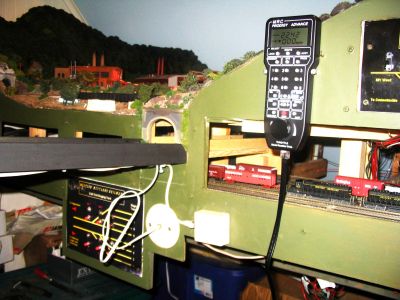
WPP’s drawing is very nicely translated from your original sketch. The main thing you’d have to worry about would be some sort of detection for the staging, as it would be completely out of view. One solution might be to move it closer to the aisle so you can see the yard throats. I used a similar design on my staging, and short of adding a bunch of electronics, being able to eyeball where the engines and cabooses end up below decks is very much necessary.
You can see the staging access at the front of the fascia. I’ve added lights below decks so I can verify switch point alignments, track occupancy and so forth.
Funny you should mention that, this month’s MR has an article about detection in hidden staging. I will have to read this article. I do like your idea of having it close to the outside and having detection. I run on Dave Holl’s HO scale Penn Valley, Oct 08 MR, and he has 4 videos camera, but I don’t think I need that.
Next question…DC or DCC? I already have some MRC DC transformers and a Digitrax DCC throttle.
I’m a strong advocate of DCC. If you have a Digitrax throttle, I assume you have some familiarity with it. I would think a Zephyr system would be just right for this layout.
One thing to think of Hansel is you don’t have to wait untill your layout is completely built before you run trains. Get the plan straightened out (if it needs to be), build the benchwork, lay the track, wiring, power (DC w/blocks or DCC) and turn out controls. As soon as all that’s done you can start running trains. Well, actually once the main line is done you could run trains, but I digress. Buildings could be mocked up with cardboard or paper untill the real structure is in place.
I also have to agree with Digitrax. They do seem to be the top of the line, I’ve messed with the Zephry, UT4, and DT400 throttles and all were pretty easy to figure out, and they also seem to be the most commonly recommended. Just do a search in forums for DCC. Then spend the next few days reading through the different messages.
Thanks, I will look into what else I need to run DCC besides my throttle.
Lee, what is your grade in the first picture of your picture of your layout?
Yes, my plan is to build the benchwork, or at least a base and then start the trackwork. When I build my first layout, an HO switching layout, I laid out the loose track parts before gluing things down, just to see how it would look. After a few iterations of moving turnouts and the like I got to the point where I like it. I would like to stick with a maximum grade of 2%, so I will plan around that and see what happens.
be careful, you will need vertical easements also and the subroadbed add even more heigth. The grades in the helixes, between Bett and Cool and between Cool and Done will be 4% or a little bit less. Between Bett and Atta it is 3%; unless you want to have your stations on the grade.
You could have figured this out yourself. Someone talked about a six month planning time; because to him it meant going back to the drawing table, trying a different layout and maybe month’s later accepting the grades.
When you plan you know what happens; if you don’t plan properly you will see what happens.
The grade coming up out of my staging yard is pretty stiff, probably between 2-3% on the helix, then when it straigtens out, there’s a short section where it exceeds 3%. You would need at least two turns of the helix to put your staging at a level that would allow for a modicum of access.
Got lots of advice from the members of my club. The most surprising advice with that I should only build with code 80 track and not code 55. I like the looks of code 55 quite a bit, compared to code 80. But the guys at the club said if I want reliable running that the code 80 is the way to go.
Comments?
The other suggestion was that Cooldude siding would be below and behind the mainline and the siding going into Betterman Station, which might be a problem to see. So they recommended that I have the bridge mainline go straight and follow the edge of the layout and then have it come out at Betternman Station.
The other suggestion was to make Betterman Station a yard instead of a town. Something to think about.
 Please critique my idea for a layout. It is 8 ’ x 8’ x 3’ x 3’, N scale, with hidden staging, 15" minimum radius squared boxes show elevation from the top of the table, 2% grade, 4 axle locos in the Transition era, just in case I get a hankering for some steam. I tried to put a 2" line around the edge of the table. Probably it will be mountainous, a road in the East, have a coal mine, logging, a town, and a few stations. The sidings are just sketched in for now, but my plan is to build the table and then layout the track and move it around until I like it. Someone told me I should take 6 months to contemplate a layout design before I build it.