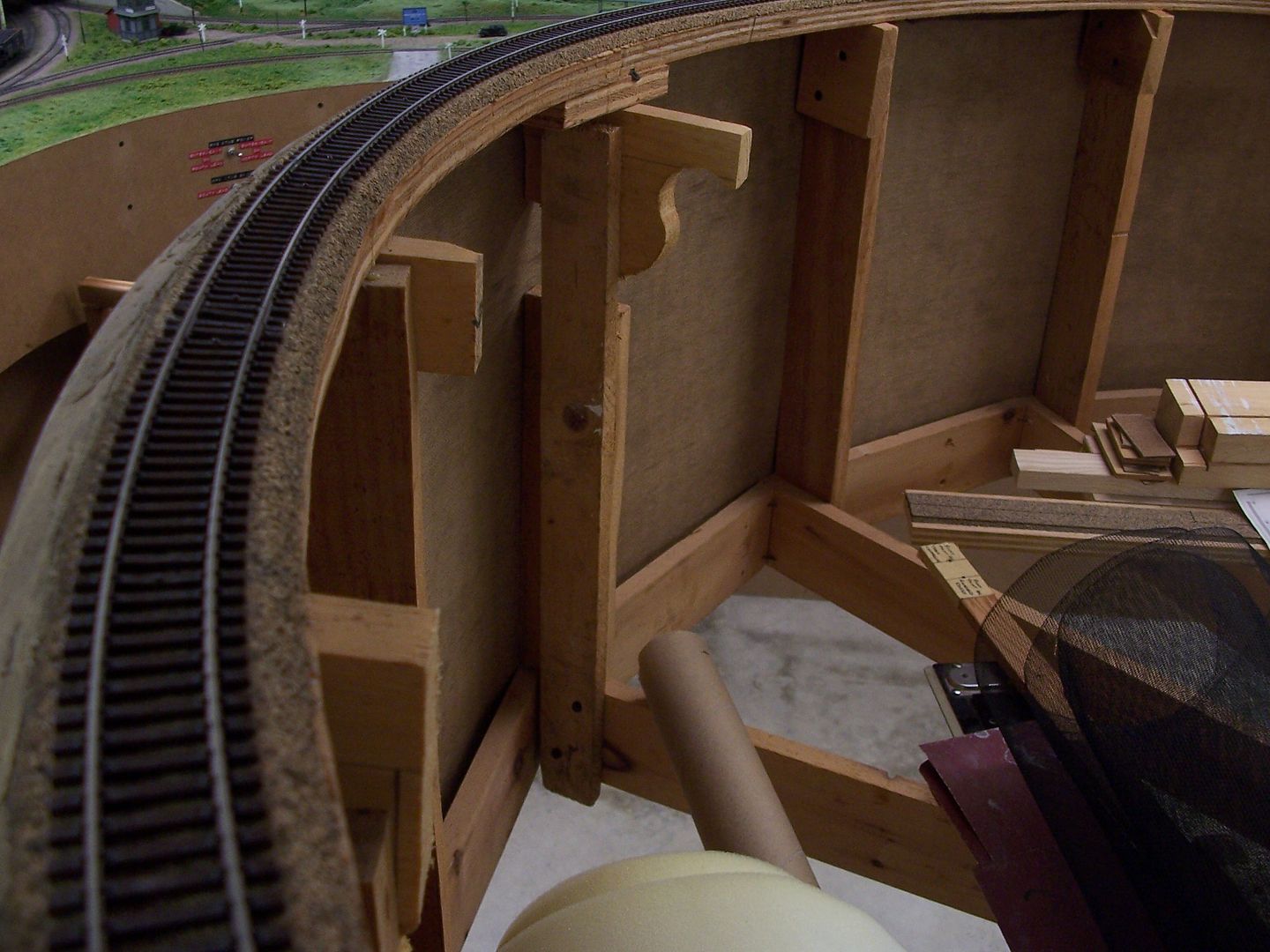
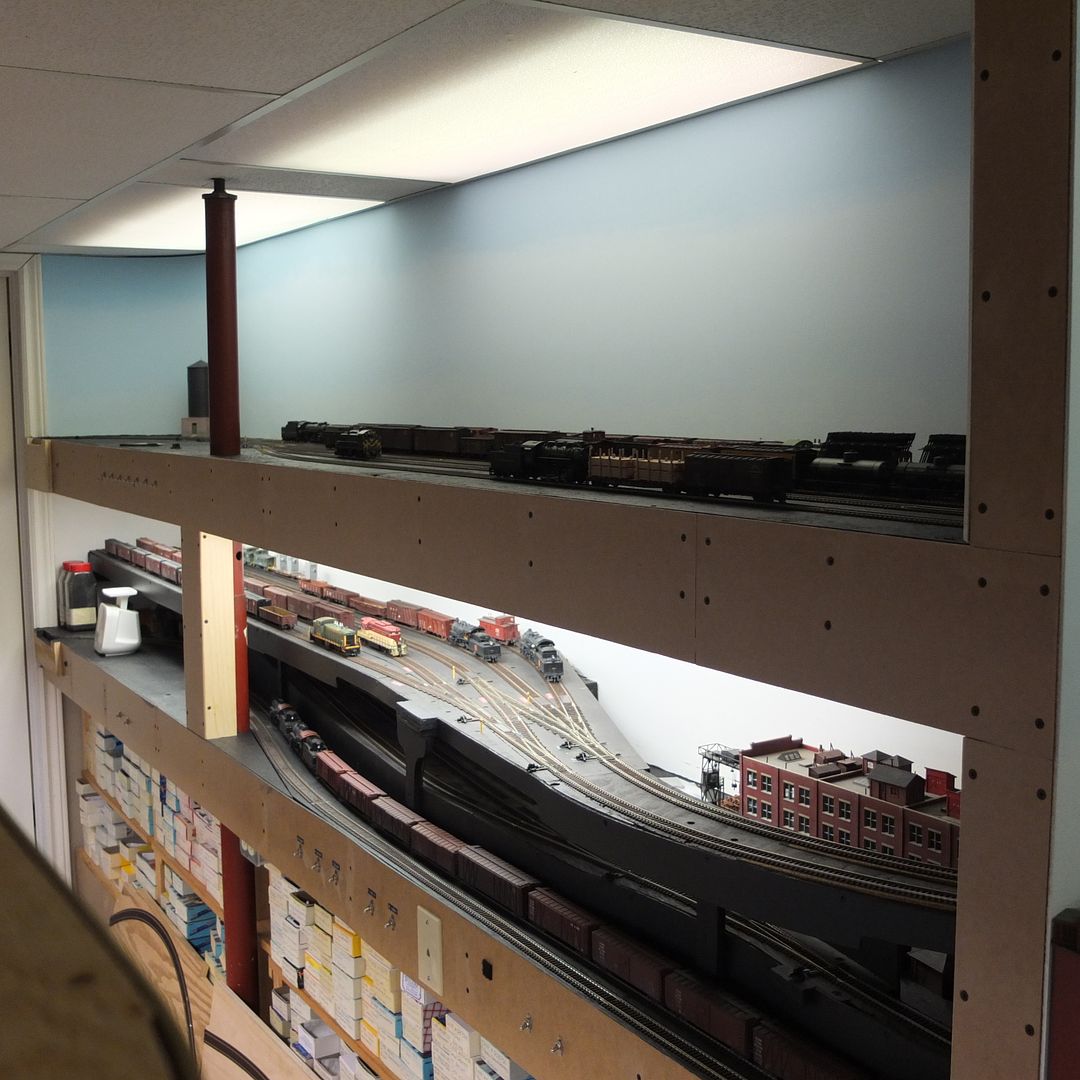
There are some portions of my new layout that I would like to construct the subroadbed of plywood. But what sort of plywood these days is worthy?
I had thought this ‘blondewood’ at Lowes looked like pretty good quality. But I just ran across this posting that gave me pause.
[quote]
Below is the best explanation I’ve seen as to why Blondewood is nowhere near the quality of Baltic ply.
The writer below is correct, the glue layer for veneers is way more susceptible to delamination than the regular plies. I suspect that is the effect of absorbing humidity more easily and water content breaking down the glue.
I’ve used blondewood from Lowes for cable cadillacs and didn’t
like it much. It DOES NOT have water resistant glue, the wood
itself is very porous because trees near the equator grow VERY
fast, definately not “Old Growth” dense like the cold climate
Russian, Baltic birches; hence it warps quickly. It also has a
veneer ply, unlike 13 ply birches. This is signifigant because
when I tested 90 degree wood joints before I started this
project, EVERY glue failure WAS a veneer failure! Even good
old Titebond glue held better than the veneer glue. The only
two glues to fail the plywood laminations were Gorilla glue
and Marine grade epoxy. Also worthy to mention, blondewood
failed miserably compared to birches. 35 ft lbs to break a
blondewood joint compared to a whopping 335 ft lbs to break a
Russian birch joint. This was all done with a calibrated
torque wrench with a peak hold feature.
If all the layers are hardwood, my rule of thumb may be broken but anything that is very heavy implies lots of resin and chips rather than wood. MDF is the perfect example, excessively heavy and no structural strength to speak of. Plys gain their strength from alternati
“Furniture grade” has more to do with how smooth and defect free the surface is rather than how strong it is. Any reasonable BC grade plywood is fine for subroadbed. Look for 7-ply if you can find it. Don’t buy 3-ply.
I’m not sure about 1/2" though - especially since you mentioned 24" centers for support in one of your other posts. Are you making a table top type structure or are you cutting out “ribbon” subroadbed just wide enough for the track? 1/2" might be ok for a table top application, but I’d use 3/4" for ribbon.
I started building my current double deck 10’ by 19’ layout around 2007. At the time, Lowes sold a 1/2" plywood product they called “hardwood plywood.” This product was smooth sanded on both sides, had seven (7) plies, and no voids. I used this product to construct all of the single and double cantilevered open grid benchwork. Ten years later, all of this bechwork is still perfectly square with no sagging or warping and, best of all, rock solid.
About two years ago, I wanted to add a small yard (about 1’ by 7’) off one side of the layout. I went back to both Lowes and Home Depot only to find that their plywood quality had dropped to abysmal levels. Since the yard needed to be supported only by its ends to fit the available space, this meant a 7’ free span. There was no way I was going to trust the current big box crap to do that. Instead, I went to Ganahl Lumber and picked up a sheet of 1/2" Baltic Birch plywood (at three times the price of the “hardwood plywood” I had previously used). I’m glad I did!
Bite the bullet and shop “real” lumber yards to make sure you get decent plywood. The investment is well worth it!
Ordinary plywood, 1/2" and even 1/4" is just fine for subroadbed on a flat table type surface, particularly if you screw or nail it in place. Only important thing is for the smoothest surface to be facing up assuming cork roadbed is going to be nailed or caulked into place. Of course this assumes it is flat and not warped when you get it, or that you do not introduce your own warp by improper storage before use. I have not tried this blondewood product but even fairly utilitarian plywood is OK for subroadbed, again so long as one surface is smooth.
I agree that 1/2" is likely too thin to be self supporting with 16" joists or centers. BUT … I have seen it done with seeming success. But I know nothing about the type or quality or pre-treatment of that plywood in question. The problem with rolling the dice on that is that you won’t see a failure or problem until after it is just so painful to do anything about it.
Some years ago when my mother passed away I had to dismantle my childhood 4x8 “train table” circa 1960, which she had been using for storage. That 5/8" plywood was amazing (and yeah, a bit thicker than today’s 5/8" plywood): after 40+ years in rather damp conditions it was flat as a pancake and no separation between plys. Ditto for the 1x4s my dad used to frame it (and again they were larger than today’s 1x4s) – straight as an arrow, and virtually knot free. Plywood and dimensional lumber was different stuff circa 1960 that is for sure.
1/2" G1S should be fine over spans of about 18", provided you are changing grades and need a slight sag or hump. However, I would support that type of plywood over about 16" if possible…or less as seems reasonable to do.
In my current build, I found I had a clearance problem with a track that was to pass below one rising. Instead of continuing to use the 1/2" sub-roadbed, I resorted to a good quality 1/4", but now supported no more than 11" between risers. Meant more work getting the butt joints to align vertically, but shims solve that problem.
Notice I said sub-roadbed…the cookie cutter stuff. For roadbed, itself, and as opposed to cork or foam products for roadbed, I would look for 3/8 for height, but see no reason why a decent quality 1/4" couldn’t make the fall of ballast look good.
These days they size the plywood down to 32nds of an inch, so instead of 20/32 for 5/8, you get 19/32. Instead of 1/2" you get 15/32"
For subroadbed, as long as it has one halfway decent side, it will be fine. It’s going to get covered by roadbed, ballast, ground foam, dirt, etc., it’s not something that needs to be stained and look like fine furniture.
I actually used 7/16th OSB on my last layout and the main staging yard had open grid framing with cross members 24-inches apart. I had no problem with sag between. The OSB was sandwiched with 1/2 inch Homasote on top to which I spiked my track.
I used 5/8" for my cookie-cutter 2-level layout, with 1x4 supports at 16" centers, adjusted as desired for planned locations for Tortoises on turnouts. I wanted more conservativism than 1/2" but that may have been overkill if a good quality 1/2" were used.
I forget the specifics of the plywood, other than I can see it is 5-ply. Probably B/C but I can’t see a stamp underneath. I passed on the lower priced 3/4", regarding extra weight and not trusting that I understood the quality aspects regarding warping, etc. (It was made on Oct 11th, so I can recommend that vintage if you can find it). [:)]
I used mostly 3/4" firply, good-one-side, for my cookie cutter sub-roadbed. It cuts nicely with a jigsaw, takes screws well, and hasn’t fallen apart in the 25 years-or-so that it’s been in place…
I used carpenter’s glue to affix cork roadbed for the mainline tracks, while industrial sidings and staging are nailed directly to the plywood or pine boards on which it’s laid…
Framing is open grid, 1"x4" select pine on 16" centres, and the grids are all supported on dimensional lumber…2"x4"s, 2"x6"s and some 2"x8"s, all of it “left-over” from building my house.
For the partial second level, added a couple of years ago, I used 5/8" t&g spruce sheathing plywood - it doesn’t have a discernible “good side”, but I opted for the tongue & groove to better utilise the sheets. With careful planning, any longitudinal joints took advantage of the t&g feature, so ballast, scenery foam, and the glue and wet water used to hold it all in place doesn’t run through onto the portion of the layout below, which is fairly close to being “finished”.
This plywood is supported on open grid framing, too, but only the front face and ends of the segments utilise 1"x4"s, while the rest is 1"x2"s, all, as on the lower level, select pine. The upper level framework is screwed to the wall studs, and also supported by several custom brackets welded together using 1"x1" and 1.5"x1.5" angle iron - these are lag-bolted to the wall studs. Again, the mainline tracks are on cork roadbed, with industrial track and staging spiked or glued directly to the plywood. All gluing involving track and cork w
I bought 1/2" AC grade plywood from the local lumber yard, then had them ripped in to the widths I wanted, which was either 24" or 30". I use it all for subroadbed. However, I’ve built my frames on 12" centers regardless of width. I let the wood acclimate to the room for at least a week, then painted it to seal. I painted the C side white so when I need to work underneath and use some lights, the white helps to increase my view of what I’m doing. I did look into the Home Depot ‘Sandeply’, but the reviews were not stellar. I don’t mind spending more for quality. The room that I have my layout is climate controlled and I have no issues. Also, with the way I have built my layout, I can lean or lay on it (I’m 200 lbs.) with no issues.
Yeah, although I can’t remember what the heck I made that would leave scrap in that shape. Most of the risers are made from scraps, and almost all of the layout is supported by risers, due to the constant up and down track profile necessary to allow two-level operation without overly steep grades.
Plywood is structurally manufactured the same. Same adhesives same laminating process.
The only difference. AB, AC, BC. Nothing really. An A Graded side of plywood has a beautiful hardwood face that can be stained used for furniture like Randy said. It looks pretty, but you don’t need pretty.
BC, a lower grade, even has little football cut outs to fill defects in the face of the sheet. As long as it’s smooth it’s just fine.
Pick through the stack and find a good B face. Spend less money and you’re all good.
From that original quoted passage in my original posting that opened this discussion,…
Younger trees, and less time to allow them to properly dry before turning them into today’s plywood probably accounts for a lot of this substandard stuff we have available these days.
I haven’t bought any plywood in a long time. When I did buy plywood I always bought the exterior glue plywood. It does better in my basement. No warping at all. Is the exterior glue ply not available any more?
How about random strand board? Or particle board? ( the stuff that looks like sawdust glued together ) Maybe pressure treated plywood. Has anyone tried any of these alternatives to regular plywood?
Be picky when you select your plywood. I bought some recently, and they replaced it because the plies weren’t consistent from side to side. I use 2 1/2" wide strips for my subroadbed, and couldn’t figure out what the problem was until I looked at the strips lengthwise; from side to side, the plies varied from 3 to 5 plies.
Yes. OSB. Oriented strand board. I used this on my third layout 37 years ago. I had mentioned this layout on my first thread on this forum. It had way too tight radiuses and way too steep grades, it was a barn burner and ended up being stored in the garage rafters for 35 years. When I took it down it looked exactly the same as when I put it up there with exception of being faded in color. The garage had extreme cold and dry Winters also extreme hot and humid Summers. It’s certainly stood the test of time.
HDF high-density fiberboard used for subfloors. MDF medium density fiberboard used for furniture. Either one would be a way better choice than particle board. Particle board expands and bloats from moisture and water. MDF and HDF is a very rigid, smooth and a perfectly flat straight product. It’s very heavy but I think would work well. I would put an oil-based sealer on it though. Water from ballasting isn’t exactly it’s friend either.
Treated plywood I’d stay completely away from. It comes with 60% moisture. It definitely can warp and does. I have hand nailed the stuff and actually been splashed in the face.
Take care
Edit. I need to add this comment as I just thought of it. I don’t know about MDF as I’ve never tried it but HDF is so hard and dense it’ll laugh at those little track nails bending every one of them as you try to drive them in. You would have to pilot drill. HDF is the same product as 1/8 inch Masonite used for backdrops. It’s called Ma