I’m putting down the sub-roadbed on the layout now. I’m using 1/2" ply but can’t decide what to put on top of it; 1/2" homasote or some thickness of foam (pink or blue).
I’m not planning on spiking the track (HOn3 code 55 by ME) but using latex adhesive. Since I model narrow gauge there isn’t going to be any sort of traditional cork roadbed.
What’s your guys’ preferences to the roadbed material?
-G-
If you mean sub-roadbed as in just where the tracks will go with open space on either side versus a table top, I would use some kind of roadbed material on top of it. Either WS foam roadbed or cork, or other ballast shape roadbed material. Now I’ll tell you why. My last layout was TT narrow gauge using N scale track and I used homasote for sub-roadbed where the tracks ran with no ballast profile roadbed material. When it came to putting in the hard shell scenery between the sub-roadbeds, the plaster scenery base strips (plaster soaked paper towels) were laid up and slightly over the sub-roadbed. This essentially made the landform slightly higher than where the track was laying. I made it work, but I sure wish I had put down a ballast profile roadbed first. You can always fill it with scenery material to make the track look like it was laid on the ground if the ballast profile is too high.
Me, I took a little different approach that has worked well. It may offer some food for thought for you.
When building my current layout I was looking for a cheaper alternative to the foam roadbed I used last time and with none of the drawbacks associated with cork (it dries out and gets hard and brittle as well as acting like a noise amplifier when it gets that way). As I was walking through the local home improvement store I spotted something that might work, and even better, it was out of season so it was on sale!
I use a foam base with my roadbed and track secured by the latex caulk. For roadbed I use rope caulking. It comes in a roll about 15’ long, and it’s perfect width for HO scale track right out of the box. Since I model N, I just tear it along the already formed centerline and I get about 30’ of roadbed per box with no waste. The advantages are that it never dries out, so it’s always soft and pliable (absorbs sound!), it can easily be molded to any curve radius you want, it’s easy to cut with just a xacto knife to form turnout pads, crossovers and such, or you can use a wallpaper roller on it to flatten it and make trasitions in rail heights or lower passing sidings in just a few seconds. As if that isn’t enough, the latex caulk holds well to it, but you can still slip a putty knife in there and take up the rails without damage if you need (Spread the caulk very thin with a putty knife when you lay it down and then lay the tracks and use some canned goods laid lenthwise along the tracks to hold it while it sets up). If you get it in the off season like me you can often find it for a buck or two a box. It comes in gray and brown that I’ve seen, though other brands may come in other colors.
Here’s what I bought…
http://i83.photobucket.com/albums/j319/pcarrell/Autumns%20Ridge/Picture016.jpg
Subroadbed is what goes under your roadbed. Plywood is very stable, and will not ‘sag’ like Homasote. I use 1/2" plywood with Homabed roadbed on top of that. Cork will work fine as well.
I do not understand why you feel roadbed under NG is not right. Usually there is some roadbed under NG, and I have seen/ridden the Colorado and EBT lines several times. N scale cork roadbed may be just about right for your NG trackage.
Foam will work, but it seems you are going to a lot of expense & work after you have built your subroadbed from 1/2" plywood. I would save it for scenery. Myself, I would use standard HO cork roadbed(glued to the plywood). Sand it with a ‘Sureform’ tool to round off the edges and them glue the M-E flex to the roadbed with the latex. A very good combination for smooth running and no sound/noise.
Jim
I prefer plywood with white foam on top. The plywood for it’s stability and the white foam for it’s low cost and sound absorption qualities.
Don’t use homasote for a “sub-roadbed” it has little strength used that way. But if you are looking for a very low profile roadbed then Homabed comes in 1/8" thickness in HO and NG widths.
1/8" scales to 11 inches of balast in HO and of course you can still work the scenery up around it.
Good luck,
-John
I edited my subject line…I meant the actual roadbed.[:I]
The sub-roadbed is 1/2" ply. I’ve been studying many photos & DVD’s of D&RGW and C&S trackage and have not seen any noticeable raised roadbed. I understand what’s been mentioned regarding the hardshell scenery. It would be easier to build up to a somewhat raised trackage rather than what would happen when the scenery starts to “pile up” against it.
I checked out the homabed and it looks neat. How does it form around curves?
-G-
My right-of-way, from the track down, is flex caulked to a posterboard template the exact size of the flex track, fastened to pink foam (fan-fold underlayment, about 10mm thick) with caulk. The foam is caulked to plywood, or to the inside of a steel stud. I use grey caulk under the track and template, and white, clear or whatever is handy under the foam.
The foam isn’t shaped like cork roadbed. For visible track, I cut ballast shoulders where they would be appropriate, but the total width is that of the cookie-cut plywood. Also, I cut the shoulders after the template is in place, but before the track is fastened down. (Yes, I work with a shop-vac nozzle in one hand…)
So far, the combination seems to be a very effective noise-reducer. Whether that will be true after installing ballast remains to be seen.
Chuck (modeling Central Japan in September, 1964)
I don’t use either plywood or homasote for my roadbed, I use masonite spline. It’s fast, inexpensive, sturdy, forms natural curve easements … giving you a very nice flowing roadbed.
Just look at the photos from Electro’s thread on his layout to see how nice the stuff works. Great looking, flowing roadbed.
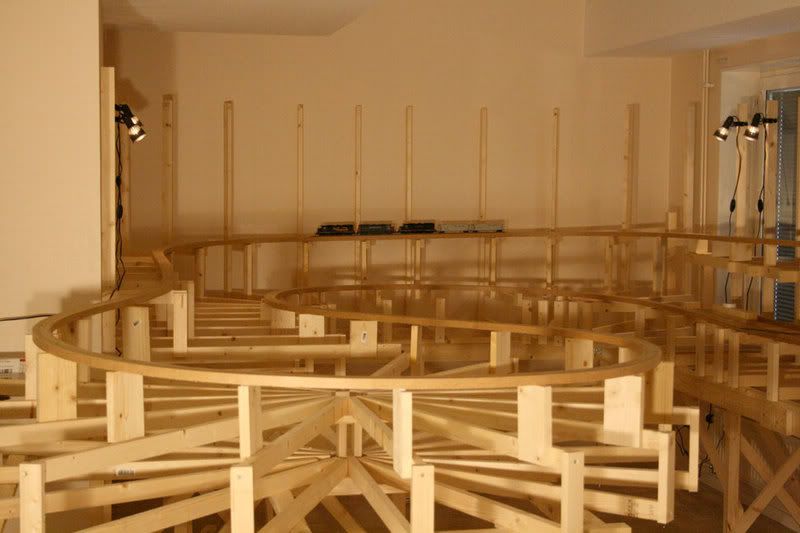
That’s maybe $10 worth of masonite spline roadbed in the photo, and with almost NO waste. How much would it cost you to do that with plywood or homasote, and how much waste would you have?
Once you get the hang of it Homabed installs just like cork. Since homasote does not compress (for curves) like cork does, slots are cut in the Homabed product to allow it to curve. Homabed is offered for N scale so it should be able to handle the tight curves that you may have in narrow gauge.
Here is an installation picture:

The outer curve it 1/4" thick HO Homabed transitioning to a 28" radius curve. The inner curve is 1/8" Homabed transitioning to 24" radius. The easiest way to install is to:
- Draw track centerlines.
- Lay down a thin layer of glue (I use adhesive caulk) along the outside half of the centerline.
- Put in pins along the centerline of the track around curves (as seen in the inner curve above).
- Lay the outer half of the Homabed in the glue along the centerline. The centerline pins allow you to easily “wrap” the Homabed around the curve without having to fiddle with placement. This results in a smooth curve.
- Pin the Homabed in place as you go. The slots in the Homabed allow easy pinning if you are working on foam and using a “T” shaped pin such as available from WS. The thin edges of the Homabed are also easily pierced with a conventional pin.
After I have layed 3 to 4 pieces of the outer roadbed (10’ or so), the adhesive caulk that I use (Polyseamseal) has set up enough so that I can remove the centerline pins and start laying the inner half of the roadbed. Just spread your glue and push the inner half up against the outer half, pinning as you go. The whole process is quick and painless once you get the hang of it.
1/8" Homabed is somewhat fragile due to the slic
Homa-bed comes in either straight sections (solid), or curveable sections (with cuts crosswise at an angle). Each of the pieces is half a section of roadbed cut lengthwise so it can be laid on a centerline drawn on the sub-roadbed, just like when using cork. N scale Homa-bed may be one piece. I think they have a web site but I can’t seem to be able to find the link right now. I used the HOn3 size for my former TT scale standard gauge layout.
By the way. Half-inch Homasote can be used for sub-roadbed in smaller scales if it is supported every foot or so. I know it’s not recommended, but I like to try different things sometimes just so I don’t get used to taking everyones word for something all the time. That layout lasted for 15 years and ran well with no problems associated with warping or flexing track. As a mater of fact, the track didn’t require any maintenance at all other than the normal cleaning.
Philip (pcarrell)
Wow! I’m impressed. I’m getting ready to lay track and will try your method. It sounds better than anything else I’ve tried or read about.
blueridgehobo
Joe, (or electro) for this newbie, could you please explain the fanned, rectangular bracing under electro’s upper level roadbed? Is this for a lower level to pass through later or just for fascia?
I’m familiar with L girder open grid and boxed construction but haven’t seen this type before. Gorgeous work!
(I’ve only used Linn H. Westcott’s “How to Build M.R. Benchwork”) and haven’t seen anything like this in that book…Thanks.
I’d recommned homasote spline roadbed. You use 2" wide homasote strips on edge laminated with drywall screws (no glue to come apart). The largest, best running layout I have ever seen uses this type of construction, even for the yards (homasote on edge 30" wide).
Thanks John.
I found the homabed website and will give them a call today. It looks like what I want. I’ve already started cutting and installing the 1/2" ply sub-roadbed. My trackplan has more curves than straight sections so I’ll probably get the “curvable” type. I saw they make a version for HOn3 without a bevel so it looks like I’m good to go.
-G-