Interesting, the FRA is further along than I thought on the NY to Boston segment.
http://wpri.com/2016/12/23/charlestown-residents-sound-alarm-over-surprise-federal-railroad-plan/
Interesting, the FRA is further along than I thought on the NY to Boston segment.
http://wpri.com/2016/12/23/charlestown-residents-sound-alarm-over-surprise-federal-railroad-plan/
When Amtrak previously showed an alternative direct line to Boston, bypassing Providence, the Rhode Islanders seem to have killed that option. Maybe it’s time to dust off that bypass plan.
Typical NIMBY BANNA stuff - and then they will complain that the US doesn’t have any REAL High Speed Rail
Someone with the math skills needs to figure how much time will be saved. Figure base line present speeds, 160 MPH including reasonable acceleration when on segment and slowing before leaving segment. Then 220 MPH when on segment then slowing before exiting segment.
Look at this in common with the Cross Harbor Tunnel thread.
Most of the people – presumably, voters – who live in the vicinity of HSR rights-of-way derive even less benefit than they would if an ‘Interstate runs through the front yard’. Chinese wall (with draconian penalties in the 21st Century for ‘trespassing’; noise, the every-present possibility of neighborhood disruption in the case of incident or accident. If the tracks were ‘upgraded’ from regional, they may even have lower or worse rail service than before, as they might well have to endure local stops to get to wherever they can board the high-speed train effectively. It would take far-sighted and altruistic people indeed to wish such a thing on their backyard rather than some other body’s. And it isn’t too surprising that their local elected representatives would represent their voters’ “best interests” rather than those of, say, the likely beneficiaries of American HSR service.
Compare the Brooklyn and Queens ‘victims’ of the approach and connections to the Cross Harbor Tunnel. The amount of ‘benefit’ they would derive from diversion of road traffic is comparatively slight; the amount of increased exhaust and noise likely considerable’; the construction impact immense and the neighborhood presence … I can’t imagine it would be much different from the Alameda Connector all the way out of the boroughs … an ongoing annoyance. And as an added annoyance, very little if any of the traffic through the tunnel would be ‘local’ freight quickly available for local delivery; it would far more likely move through to the ‘nearest’ convenient intermodal point and be backhauled or transshipped/warehoused for local truck delivery, far slower than just running the freight by truck on existing roads across the Hudson and then Manhattan.
If you go back to the earliest days of railroads, or pipelines, you
Didn’t they say 45 minutes?
Yes, but even if someone figures out Mrs. Todd’s Shortcut for trains, you couldn’t possibly save that time in Rhode Island.
That number looks a bit like the putative time saving for the whole Boston-New York segment for one of the 220mph-capable projects. You need to examine these very carefully to see how the ‘time saving’ was calculated. Avoid any that simply substitute speed for distance instead of using the kind of detail analysis that was, say, in the 1967 United Aircraft proposal for part of the Water Level Route – that was an engineer’s way of looking at the thing. Slow sections, net of deceleration and then reacceleration, eat dramatically into achieved ‘average trip speed’ and hence the associated trip time reduction of nominal higher speed.
For a good step-by-step illustration of what approaches might be involved in fast running on the north end of the NEC at higher peak speed might be like, read the Classic Trains account of one of the Super C trips (I think by Jack Elwood in special issue 7 on ‘fast trains’).
A closer comparison would be the electrified passenger trains on German Rail: an ICE Hamburg to Munich: 381 miles, eight intermediate stops, most around 6 hours.
Do we have a comparable curve-by-curve analysis of that run that could be compared with Elwood’s (granted, there is probably as much computerized ‘cruise control’ on the ICE as on the TGVs, but it would be possible to see what the computer is commanding for throttle and brake applications, and the signal-system settings)
I am lamentably unaware of the topo between Hamburg and Munich, or if the line has been substantially ‘improved’ in profile since steam days. Are there sections similar to the Shore Line ‘as it would be improved’ (or the likely way the ‘preferred Hartford alternative’ would be routed?) and aren’t the dwell times much, much shorter at those intermediate stops than Amtrak’s? Something that would be interesting would be a tabulation of the mileage (of the 381 total) that is run at particular ranges of speed, and in particular the percentage of miles run at the nominal ‘high speed’ for the equipment design.
I must say I like this proposal better than the last one that had a totally new NEC going to/from Boston via Hartford, CT. I think this realignment is more reasonable as far as costs are concerned and it has the incrementalism vs all at once that Amtrak seems to be better at managing. I hope they get the money they need from the Feds. Hopefully the NY to DC alignment changes are also kept modest and the costs lower than these grandiose schemes first proposed.
Several stretches have been realigned and improved to reach 280-300 kmh limits since steam days (50-60 years ago, I guess), notably Uelzen to Hannover and Nuremberg south through Ingolstadt. Dwell times are typically very short - 2-3 minutes - because all doors on trains open without conductor assistance. You really owe it to yourself to make some journeys into the 21st century, RME.
I rode Bremen to Munich back when I was stationed in the Army using the train as a rolling hotel. Boarded Friday night around midnight or 12:30 a.m. Train was in Munich about 7:30 or 8:00 a.m. Just in time to wake up, and get off the train. The whole trip was 2nd class…and I never did that again. Had to share the sleeping compartment with 4 other strangers (it slept 6 total in 2nd Class…3 tiered bunk bed on each wall) Departed Munich around 11-12 p.m. Saturday night after a full day at Ocktoberfest then back in Bremen the next morning. Full day at the festival, no hotel bill, just the price of transport.
Interesting it is down to 6 hours now.
Remember one time riding the train via Nuereumburg to Munich and seeing the huge World War II era Nazi built stadium next to the tracks, where they had the mass rallies we frequently see on old newsreals from that time…that thing had to be at least a mile or mile and a half long…TV did not do it justice as to the real scale of the structure.
That is the truth – I have done all the tech, but haven’t ridden any of the modern trains since the second-generation TGV.
There are a couple of YouTube videos that give me some of the flavor of the newer German construction - probably more than if I rode in a regular seat looking out. Makes me more than a little irritated that we have so little opportunity or incentive to build comparable services.
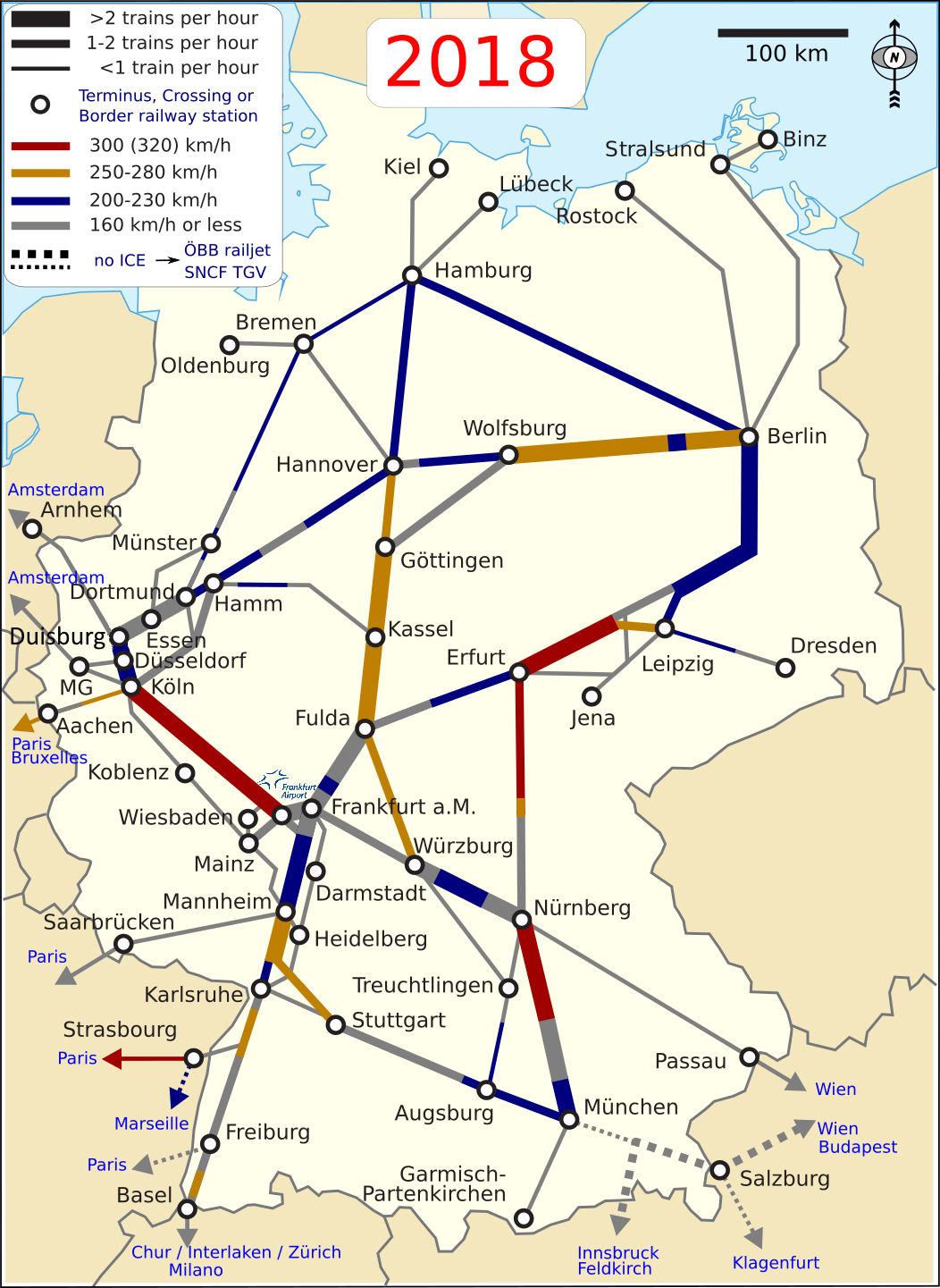
I can’t help with a curve by curve analysis.But here is some additional information. The linked map shows the speeds in km/h (0.621 mph) the sections were designed or upgraded for. https://upload.wikimedia.org/wikipedia/commons/e/eb/ICEtracks.png
The ICE Hamburg to Munich runs via Hannover, Goettingen, Kassel-Wilhelmshöhe, Fulda, Wuerzburg, and Nuremberg. The shortest run time is 5-3/4 hours. In the 1980s it was about 8-1/2 hours.
From Hamburg to about 19 miles behind Hannover we are on the relatively flat North German Plain.
The high-speed rail line Hannover to Wuerzburg has minimum curves of 23,000 ft in exceptional cases 16,700 ft. As the line is used by freight trains too the grade is limited to 1.25%. The height lies between