I have a Lionel Polar Express Berk Jr. which I purchased new (in the PE set) in 2004. It has always been a dependable, smooth runner up till about a week ago. At that time, it began to not respond to the direction button. If it was going forward and I pressed the button, it would go to neutral as expected, but would stay in neutral with the next push and the next, etc. I suspected the e unit, and put it up on rollers with the shell off. The e unit seemed to work fine, but then a “funny” thing happened. While running forward on the rollers at a moderate to fast speed, the motor started slowing all by itself until it just stopped. I tried turning the flywheel and could feel a bit of resistance, but could not get it to spin again. Now if I put it on the rollers or track, it just sits there with the light on. So I’m wondering “What happened?”.
I presume that it had the same symptoms (before quitting altogether) when you throttle the transformer all the way down, as well?
Hello Mark. When it first started refusing to shift out of neutral on the track, I would give it a push and it would start moving again and seem to be normal again for a while. But then maybe the next day or so it would start “stalling”, for lack of a better word, again. Eventually, when the pushing failed to work, I decided to put it on rollers with the shell off to see if I could spot anything amiss. It was at this time that it seemed to work o.k., both using the direction button and using the transformer handle, for about two or three minutes. I decided to let it run for a while, in forward I think, and while I was just sitting watching it, not touching the transformer at all, the speed of the wheels slowed to about half, then some more until they just stopped altogether. I can see no loose wires or electronic components nor has there been any overheating that I can detect.
Tin whiskers?
Interesting. pennytrains may be right; here’s an article on tin whiskers–it really is quite a curious phenomenon.
Do you by any chance happen to own a DC transformer? Such as for those cheap DC train sets Lionel once sold or for HO trains?
Yes.
Okay, if I recall this correctly, then you can check to see if the motor itself is fine. I’ll have to go check on one of my locomotives to make sure that I’m right and I will get back to you this evening, hopefully.
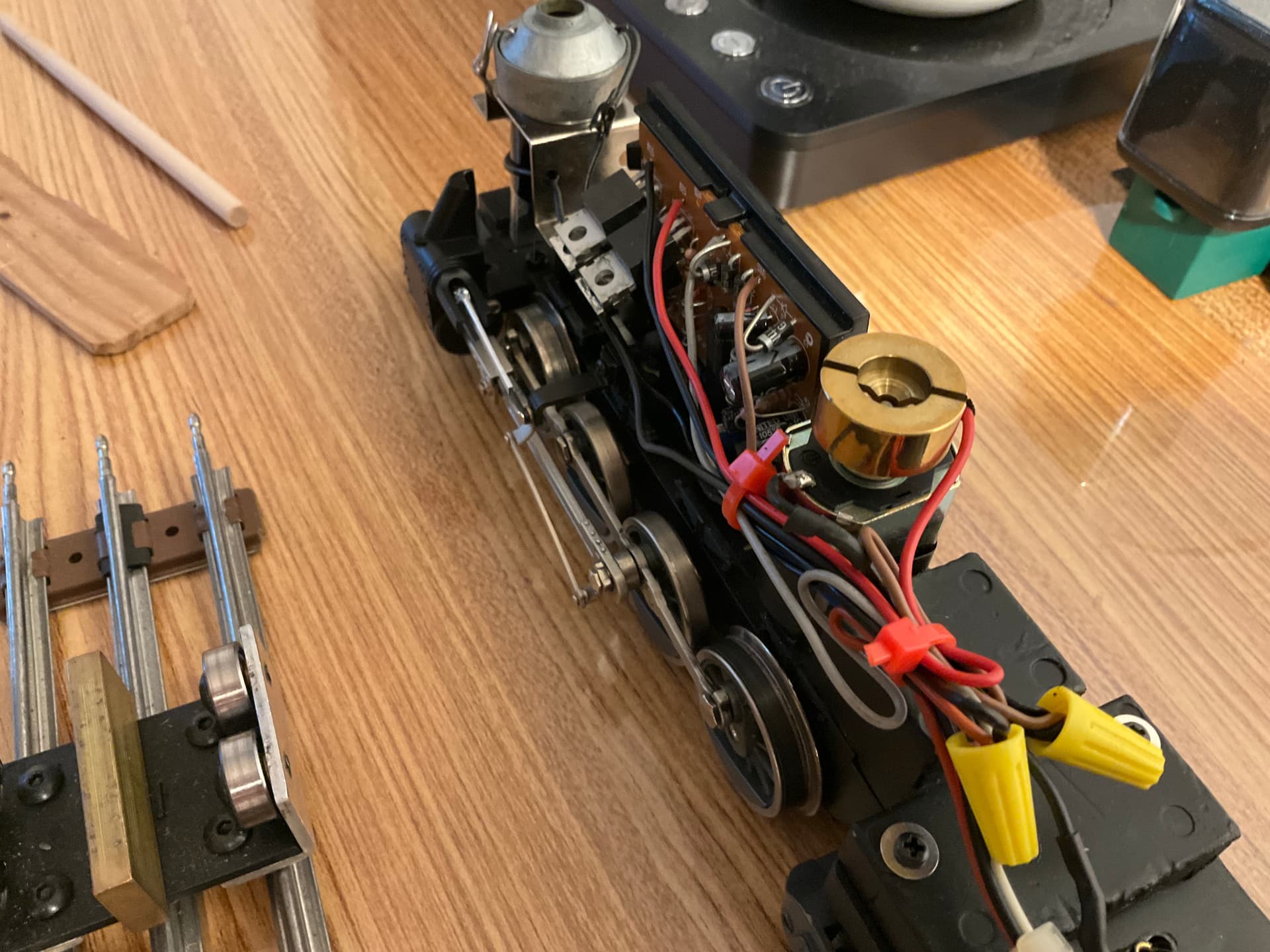
Oh, I don’t need to go check my loco. Use the DC power pack and see if the motor works by touching the leads directly to the motor’s connections. Be VERY careful to ensure that the locomotive does not go flying off your test track at Mach Stupid (but since you appear to have rollers then that shouldn’t be a problem) and be VERY VERY VERY careful to ensure that the track is not powered.
I’m afraid the motor must be gone. I did not get any response with the dc power pack. I made sure the power pack was working and that I was making good contact to the engine leads, but received absolutely no response from the motor. Oh well, I’m not getting any younger either.
It might be worth pulling the motor from the chassis and seeing if it will spin on the bench that way.
If you’ve truly experienced a stalled motor, the e-unit is probably suspect also. Lionel used those units for a long time(like 1980s up into the 2000s) and I’ve personally never had one fail out of several locos with them, but the big triacs without heatsinks can only take a finite amount of abuse.
If the motor’s dead, Lionel does fortunately have the complete replacement available, I think it would be cs-6208616103-p but take a close look at yours to make sure that’s actually the motor(that PN is for the IGARASHI brand motor, apparently somewhere along the way it switched to a Mabuchi motor, which is probably a better motor but I have no idea if it would be a drop-in fit or not).
Unfortunately too, the original E-unit is no longer available. Lionel does stock a “high current” E-unit, cs-691EUN2A01-p . It looks like it should physically fit the old mounting bracket and there’s no separate bracket listed, but it will need some work to fit as all the connections are JST type plugs, not just loose wires as on the old one. I don’t see that they stock harnesses for it, but the connections are well labeled and it wouldn’t be a terrible job to build harnesses yourself with a pre-crimped connector kit, or just solder directly to the board.
To say “no response at all” is not quite accurate. With the DC power pack leads connected directly to the motor, I tried spinning the fly wheel to try to get things moving. When I spun it in the direction opposite to what it actually should be spinning, I did get a bit of a kickback but not enough to keep it moving in the direction it should be moving. Still, I think the fly wheel would have started spinning on its own if the motor was o.k.
This is why I suggested removing the motor from the chassis. If it’s bad you’re going to have to do that to check it anyway.
Removing from the chassis will let you do two things-the first is that you can power the motor truly unloaded and see if it’s dead.
The second is that you should be able to spin the wheels by hand and feel if they move freely or if there’s any binding.
Of course that doesn’t rule out binding between the worm and drive gear, but if the chassis spins freely and the motor spins fine out on the bench, that’s probably where the problem is.
I’ll just put in a plug too that I consider a bench PSU a very valuable tool in all of this. It gives you very exact control over voltage, and you will be able to read voltage and current in real time. I would not want to do repairs on modern trains without having a good dual mode constant current/constant voltage PSU nearby.
Yeah, it would be helpful to take the motor out.
Thanks, everyone, for all of the information. I will take the motor out and test it and the engine wheels separately. I will then decide if I want to pursue things further.
Well, the results are in! I removed the motor and first checked the engine’s wheels. They spun easily and smoothly. So far, so good. I then attached wires from the DC power pack to the motor with about 4 volts coming from the pack. Nothing happened. I increased the voltage to about 8 and began spinning the flywheel with my finger. It reminded me of when I used to start small gas powered engines to fly model airplanes or tried to start a gas powered lawn mower with a pull rope. Back to the train motor. The motor actually responded. At first, only for a few seconds. I turned the pack all the way up (16v DC) , gave the wheel a spin, and the motor started running albeit at hardly enough rpm’s or hardly enough power to drive the engine. So it seems the engine “ist kaput”, and I will have to decide what, if anything ,I want to do about it.
Yep. Likely the motor. It could potentially be salvageable, but that seems unlikely, and a new motor isn’t much more than $20. Take a look at item number cs-6208616103-p. Looking at the flywheel in the picture, you probably have the Igarashi motor. If your loco does have the Mabuchi motor, you may have difficulty replacing it, though, since Lionel does appear to be out.
Perhaps one of the usual parts stores has it for less money.