Hi everyone, this is my first post here so please let me know if I’m breaking any rules.
I have a question about grain elevators and grain loading/unloading.
As I understand it, most grain elevators exist as a place for local farms to bring their grain for it to then be stored and transferred to railcars. My question is, what happens at the other end? Are there grain elevators that receive covered hoppers full of grain and then distribute it locally? And do these grain elevators look the same as the ones where the cars are loaded?
I’m looking to model New England and so I presume it would be much more likely for hoppers full of grain to arrive here from the Midwest than for hoppers to be loaded with grain here.
Any insights anyone has as to how grain is unloaded and what HO scale kits might be appropriate would be much appreciated!
Wheat is generally routed from the receiving elevator to a flour mill. There the wheat is ground into flour. and then either bagged for retail sale, or bulk truck to bakeries.
It is also often moved as wheat to ocean ports and loaded unto bulk carriers for overseas shipment. Unit grain trains leave Winnipeg Manitoba and run to either Montreal, or Halifax for transhipment.
Being Canadian I am more informed about our operations than yours, but the same principles must apply.
More or less yes, there are elevators or what look like elevators on the other end. A large part of grain is taken to ports, either on major rivers or on the coasts and transfered from rail ro barge or ship. Other grain is unloaded at flour, feed or food products companies. Others are sent to feedlots and poultry farms. Finally some grain goes to seed companies. Depending on era, some of the grain is sent to smaller feedlots and companies that use grain. Older eras, more grain goes to smaller dealers, unt train era, less grain goes to smaller dealers.
…would accept grain (often various types), originally by horse and wagon, and later by truck, then ship it out in railway cars, to either much larger elevators for shipping it by boat, or in many cases, ship it via rail directly to industries that processed it into food.
Originally, most of the grain moving by rail was loaded into boxcars (usually equipped with “grain doors” which limited product-loss during transit), but later, covered hoppers became a more popular choice, due both to their larger capacities and also the better loading and unloading processes.
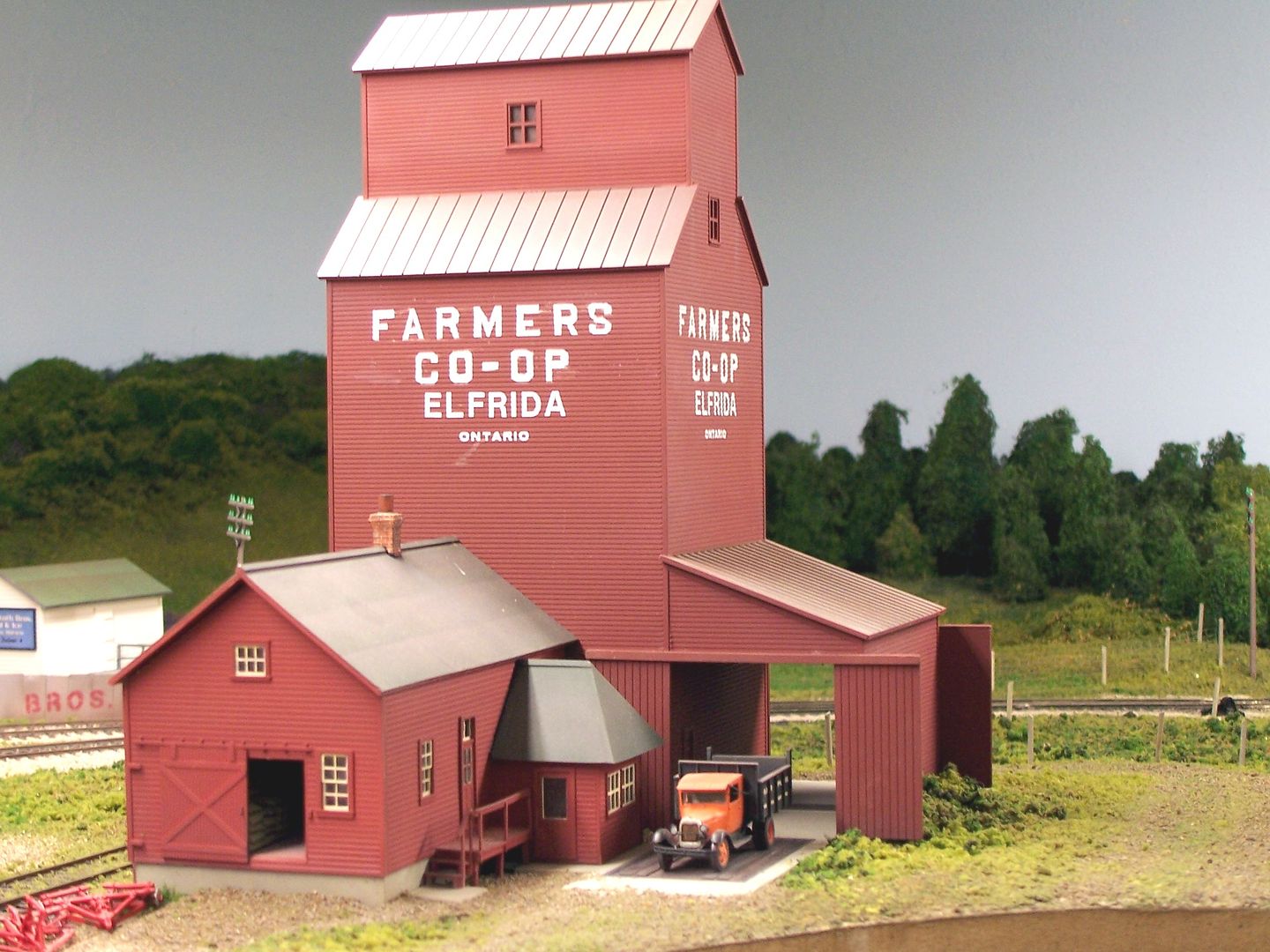
The structure shown above was a Walthers kit, but I later added a scratchbuilt addition as a store catering to the needs of farmers in the region.
Much bigger grain elevators are also available from Walthers…I have a bunch of them, but they have little connection to grain…at least on my layout.
This is one of many terminals on the West Coast of Canada.
I remember snooping around the port on our bikes when I was a kid. No one paid any attention to you back in those days. Along with the huge terminals in the photo, there were a couple of small elevators that were meant to distribute grain to local businesses. Usually, one track and room for a truck or two to load. Of course, larger manufacturers had railcars delivered to the door.
I live in Central Ohio and will explain in general terms the operations I am familiar with.
Grain elevators buy grain from local farmers, farmers will haul in grain typically by truck directly from the field during harvest and throughout the winter and springtime. The elevator will then sell that grain and ship it by rail to much larger grain terminals.
The grain elevator is not the only place that buys grain, we have two local dog food factories where farmers can sell grain to, one of those factories is in an old elevator.
Also multiple grain elevators locally compete against each other for business, some elevators only take certain grains.
We also have a large Cargil elevator that not only takes in corn from farmers but also receives corn by rail which then is transferred by conveyor over to a Valero ethanol plant. So that Cargil elevator brings in corn by rail and only ships out soybeans by rail.
The Valero plant does not take in corn from farmers, only direct from Cargil by conveyor.
Not to confuse matters but lots of smaller elevators are now privately owned by the larger farmers for their own storage, rail road tracks may still exist but most farmers have no interest in rail service so those tracks may no longer connect to an active railroad.
Brought back memories of when I drove grain trucks to the elevators and remember the machinery seen sitting around the farm of those types which were not used any more when I was helping at our family farm.
One other question I have is about how the cars are unloaded. I might be interested in modeling something with a smaller footprint such as a flour mill or feed mill like you guys mentioned. Would smaller businesses like this that are only receiving a few carloads at a time typically unload using augers? Vacuums? Something else?
Also the idea of something like an Agway fertilizer or feed plant interests me because I know there are several of these around New England. Would they typically receive or ship any other product by rail other than inbound grain? Perhaps chemicals in tank cars?
Fascinating video. At minute 1:08 ff., I don’t intuit the purpose of that helicopter blade whirling around on the back of the machine at about the height of a child’s head, unless it is to discourage horseplay?
The unloading of the grain boxcar at the end is amazing, how the hydraulic arms push the grain door INWARD against the load. Didn’t see that coming.
I note with curiosity the writing stenciled on the side of that boxcar “To be used exclusively for newsprint paper flour and sugar or high class [something]”. I can’t make any sense of that.
Great video Batman. Massey Harris farm machinery and no air conditioning!! I got to drive my Granddads Massey Harris tractor briefly before he sold it for a Massey Ferguson 165. And “headers,” as they were known as here, still had open cabs when I was young.
Gidday Matt, the whirling blade is not there to decapitate errant children, but to “spread” the leftover plant material. We only grew enough wheat and or oats as supplemental animal feed for our own animals, (though if an extra plentiful crop was grown, the surplus would be sold.) So, the straw would be raked up, bailed, and used as floor covering in the wintering shed. The left-over stubble would be ploughed under. I do not know what the North America common practice was.
If you think about it, it makes sense, The grain doors were wider than the door opening and were installed on the inside of the car so that the pressure of ther load just made a better seal. Easier to push them back rather than have to burst them (IIRC the RR’s wanted consignees to return the grain doors). Ya just gotta hope that the nails securing the grain doors to car sides didn’t drop out into the grain and end up going into somebody’s machinery. Maybe they thought of that and had magnetic filters to catch any stray ferrous metal in the load before they attempted that. BTW, speaking of Churchill, I can remember seeing a picture of an NdeM boxcar sitting in deep snow on the team track in Churchill. I know the North American rail network boasts any freight car can go anywhere from the Yukon to the Yucatan, but ya gotta wonder what was in the boxcar and whether it was really a move all the way from someplace in our southern neighbor to the sub-Arcrtic
Yes they do, but train travels a bit faster, and also you get more unit train shipments in the winter season when the seaway locks shut down for the winter and ships can’t travel between the great lakes and St. Lawrence river.
So you get occasional unit grain and potash trains in the summer, and more in the winter when shipping is shut down on the lakes.
I do remember a couple of location that had grain facilties here in New England from my time railfanning in the 1970s.
One was on the Central Vermont, I think between Willimantic and New London. I remember watching the CV 1776 switch grain hoppers there it seemed quite busy likely switched every day.
Anothe rlocation was on the CP in Richford Vermont a lot of grain hoppers and 40 foot box cars there. This wasBlue Seal FeedsTheCP had a switcher, an RS2 that did 1 or 2 shifts every day. The Central Vermont had a branch from St. Albans. A local ran 2 SW1200s back to back and brought 30 to 40 cars every day during the week. I think both facilities were large for New England but can’t compare to the Midwest grain facilities, I thnk these two operations were mostly wholesale feed that sent grains that went to retall grain dealers in New England. There were likely more operations like these in other New England locations
As far as retail grain locations I can remember a brick building in Oxford Mass on the NH that received box cars of bagged grain it was also a small independent hardware .I don’ recall any grain elevator there.
Another was in Southbridge Mass on the NH . There was a small grain elevatorand again maybe hardware sales the siding was short enough that all that would fit was one box car. If they were using the elevator maybe it was to mix bagged grain from the box cars to sell to local farmers. There were small grain dealers all over New England in those days Some locations had elevators some did not.
here was a typical grain elevator located in New Hampshire from BEST Scale Trains. http://www.besttrains.com/premium_ho_1028.html. Plans for this elevator were actually in a series in Boys Life Magazine and there were instructions for scratch building this. This article in Boys Life in the 1960s I did build this back then using cardboard ,Balsa wood and printed asphalt siding paper. I may do another one soon,using the
Ron wrote: “One was on the Central Vermont, I think between Willimantic and New London. I remember watching the CV 1776 switch grain hoppers there it seemed quite busy likely switched every day.”
You’re thinking of the K&L feed mill in Franklin.
Back when I worked on CV territory (when Amtrak’s Montrealer was running that way from New London north), we’d pass by there, at night both ways. But that was 30 years ago.
I found this archive online Today I did a search for this series of model railroading articles long before this archive was online .This series was sometime in the mid 1960s. This was a series with a how to build an HO layout and there were several articles about scratchbuilt buildings. Give me a few days and I will see if I can find the printed copy I have.
That was the mill I was thinking of,Franklin Ct . One time I caught up with the local as it was switching .As I said the CV Bicentennial unit 1776 was switching.