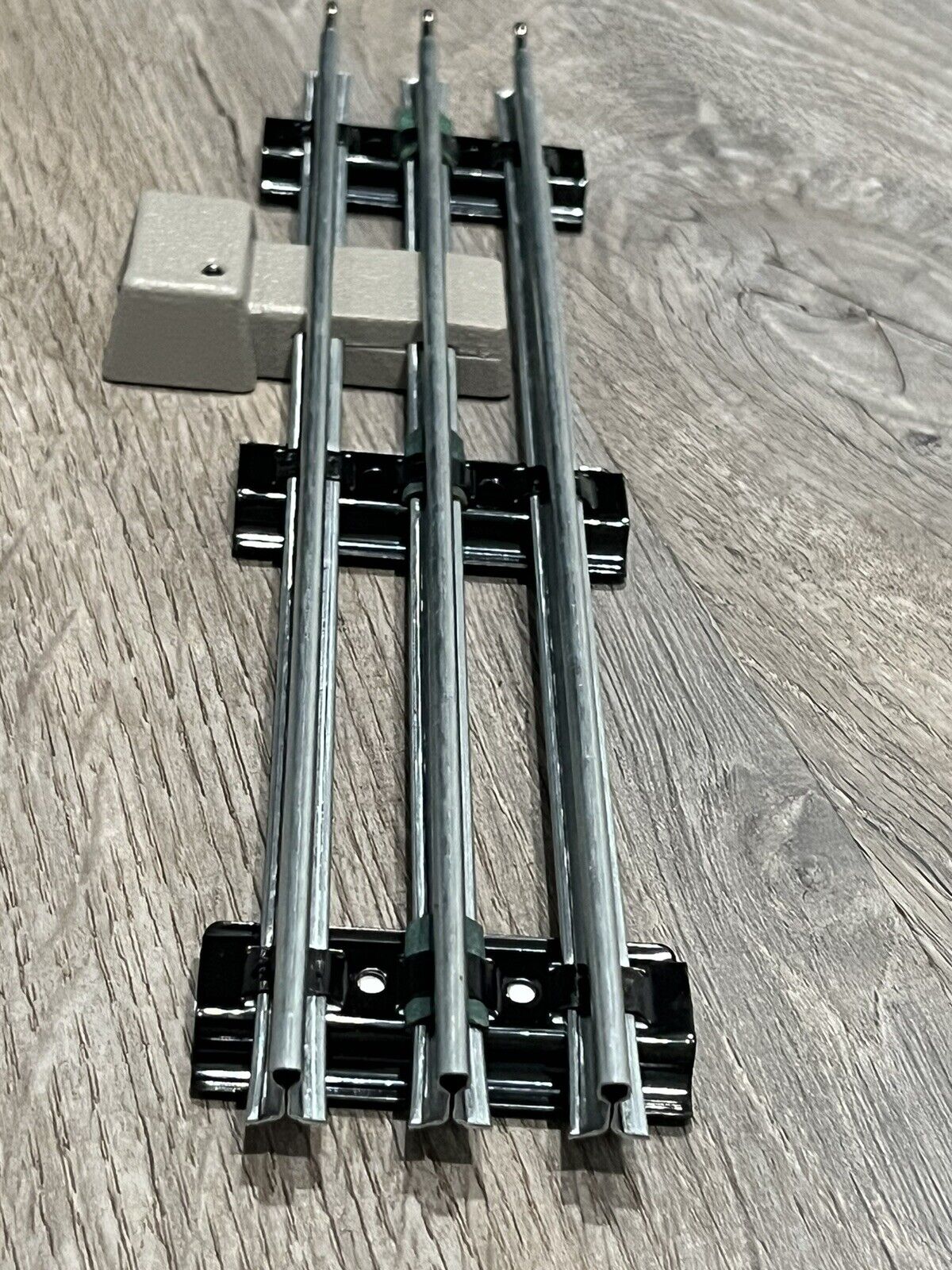
wondering if u guys think this will help to keep extending the power in my layout
10" Straight O Gauge Tubular Track with Power Lock-On Menards Train Layout 18V
Ignore, I didn’t realize that little thing was actually a DC power supply. However, as others have said, it’s not suitable for the task!
i ment with the cord cause it just shows a house plug and wire that plugs directly into this
All materials have some resistance value- that is, to some degree, all materials resist the flow of electrical current through them. For some, this resistance is very high- generally deemed insulators. For some it is lower, generally deemed conductors.
Now, just because something conducts electricity, doesn’t mean it doesn’t have resistance. Copper is generally pretty well regarded for its conductive properties, and has a very low resistance. The steel from which most tinplate track is constructed, on the other hand, has a significantly higher resistance. As a result, the farther you get from where you’re inputting power to the track, the more of a voltage drop there will be.
Running feeder wires will help with this issue, but you’ll need to select appropriate wire for your feeders, to avoid having voltage drop issues. I’m not really an expert at it, but I believe that you need to calculate how low the resistance needs to be, for there to be an acceptably low voltage drop between the start and end of your feeder wire. The gauge and type of wire you want to use will be determined by this. If your wire needs to run for 500 feet, and you need a voltage drop no higher than around 2 volts, you’ll need a certain size gauge of wire to achieve those results. Hope this makes sense.
I’m sure somebody else can probably articulate this concept better than what I just did.
-El
The most important question here is if you are intending to use this Menard’s product with the post war New York Central F3 set you have been talking about and showing in other posts.
As you mentioned on one thread, you were going to get a tested/refurbished KW from somewhere. (glad to see you got the one you had checked out). You would NOT want to use this Menard’s product at the same time on the same loop of track as a KW!
Anyway, the post war F3 needs something to vary the voltage at the track, such as the KW (or any other post war or even modern transformer that will vary the AC voltage applied to the track).
The Menard’s item you pictured does exactly what the description says, it applies a constant 18 Volts to the track. It is also 18 Volts DC, not AC like a KW! This Menard’s item is also NOT a controllable variable voltage like the output of a post war transformer when you move the handle.
It is also NOT advisable (even if not for the issue of having AC for one source and DC for the other) to put 2 voltage sources to the same loop of track if it is not broken down into insulated blocks (meaning if you do insulate the center rail of the track into “blocks”, it prevents the transformers outputs from being applied to the same continuous piece of metal of the center rail of a single loop). Without insulated center rail sections, this results in what is called putting the sources (transformers) in parallel, which is a major no-no for 99% of how O Gauge AC powered trains are run.
The bottom line is in simple terms, that Menard’s product is meant for the type of trains they sell, which are designed to be run on a constant DC voltage supplied by the power “brick”, and then the remote that comes with the engines takes care of controlling that voltage with electronic circuitry to change the speed of the train.
You need something that varies the voltage to the track itself with that post war F3 set, so this is not a good match.
For addressing power drop outs, you can use multiple lock-ons. The traditional Lionel style ones (I think you had one shown hanging on the wires in your original pictures of your stuff), but also were made by MTH and probably other companies if you can find them. You would install them at various places around the loop of track. Using wire and your choice of splicing methods (barrier strips, wire nuts, etc.) you would tie all of the center rail feeder wires together to go to one post of the transformer (A or B on a KW) and tie all of the outer rail feeder wires together to go to the common post (U on the KW). I’d probably recommend using 18 gauge or larger, so 16 would be OK, something like 12 is probably way overkill for your intended use, most likely, and 22 gauge is way too small. (wire sizes get bigger as the wire gauge number gets smaller)
3 Likes
A dual horizontal motor postwar F3 can pull close to 5 amps when fully loaded.
The conductivity of tubular track isn’t great, but Menards may be the worst of what I’ve used(aside from really old, nasty rusty track). You can help this some by using track pliers to shape the rail ends up and crimp the pins into place securely, but it’s still not going to be perfect.
My permanent layout, built with a mix of Lionel and K-line branded tubular, a lot bought new, has no more than 3 feet between power connections. That’s probably overkill, but I’m also pretty particular about voltage drops(and when I built it, I connected a voltmeter on a flatcar to the power pick-ups on a postwar F3 to test for voltage drops).
BTW, you don’t need lockons, and for a permanent layout I avoid using them. Soldering the wire directly to the track gives a much more secure connection, especially since it sounds like this will be outside.
In more general terms, I’d actually reconsider using tubular track outside. I’d lean more toward Atlas O or Gargraves Stainless. Both of these should hold up better than tubular. When new, tubular is pretty rust resistant, but as you use it arcing from the tracks burns the zinc plating off the surface and kills its rust resistance over time.
2 Likes
i got 1 acre of length to run the track on
technically 2 but i dont need to go that far