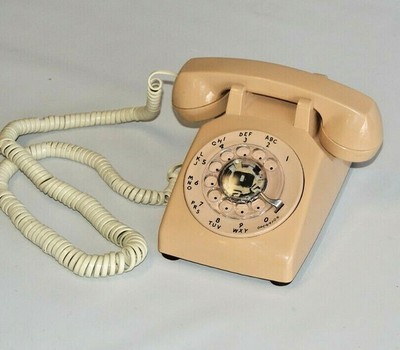
Yes I do. Our First number was 985-W. The letter was the ring code for a party line. After Korean war finally enough copper wire for private line 1396 . Our town was late converting to dial but for the life of me cannot remember the number. But it was 7 digits even though the city was small.
About touch tone. Worked for ATT a while. Some of you may remember that dial tone had to change to allow touch tone to work! I found out the phone company actually wanted everyone to use Touch because it was faster so not as many of the incoming registers were needed. You should have heard the screaming when I told our PSC that. BTW my dial phone still works.
I remember how overjoyed I was to find that you could dial without actually using the dial, by quickly tapping the hook switch in the pattern of the dial interrupts. We had the usual college problem with roommates not paying for the (then very expensive) long-distance calls they made, so I was delighted to be able to install a dial lock but still be able to make calls.
(That was when there was still just one telephone mandated for each line and supposedly dire consequences would ensue if you made any changes to the premise wiring, let alone added your own extension phone. That alone seems like a whole other world now…
Our “number” was Woodland WO5-5125 when I was a kid. My grandmother was a telephone pioneer, with Ma Bell as an operator. In retirement she had free long distance from her phone. There are days what with telemarketers and being hogtied to smart phones that I could go back to earlier times.
There used to be something more associated with this – I think involving capacitance that ‘resonated’ the ringer or some other associated inductance, perhaps at the AC frequency of the ring signal? Before I learned about practical electronics we had someone ‘operate’ on the two suite phones in my sophomore-year college room, which involved removing the ringers and hooking them up in some way not associated with the position of the actual handsets. I’d have thought this involved a black-box-like method of avoiding tolls, but I had one of the accounts and was certainly paying long-distance charges that year…
A roommate then discovered not only that you could wire up ‘ringerless’ extensions using ordinary two-prong plugs and outlets, but also that it didn’t matter which way was ‘up’ (this was the era before mandatory polarized plugs. As part of the final “People Magazine Ten Best College Rooms” prospective room, pity that was never published, we had Tap-A-Lines wired around most of what remained of the furniture to simplify conversation, a kind of early version of the ‘cordless phone experience’…
One of the funniest moments came at some point that year, when the roommate had an extensive cable of interconnections running between his room and mine to access the Strowger switch I had running many of the ‘smart-home’ features like curtains and lighting control … another story. I was fast asleep in my raised bed when I heard knocking on the door – when I went to answer it, there stood the Bell repairman in full regalia, saying there was something wrong with the phone. I turned around, and the first thing I saw was the two phone carcasses with various wires and components sticki
Back to the RPOs…my dad’s first job with the US Post Office when he started in 1943 was going from the downtown Minneapolis main post office to pick up mail coming in on mail trains at the nearby Great Northern and Milwaukee Road depots. In the 1980s we bowled together on a team in the Minneapolis Post Office bowling league with a teammate who was a retired RPO clerk.
BTW part of the reason my dad, who pretty soon after starting working for the Post Office became a Letter Carrier, never became a supervisor was that when the mail was taken off of the rails, all the RPO clerks were assigned to regular postal jobs. Because of their high pay scale, usually the only job they could be assigned to would be as a supervisor at a station (post office), even though they usually knew nothing about how a regular station worked.
Give the man a gold star. All a person had to do was not connect the yellow wire to either the red or black terminals. Cannot remember which for private lines. For 2 party lines one house was connected to the red and other house to black. That way only called house telephone would ring.
The central offices could ring about 4 or 5 phones using the 105 volt AC ringer signal. Once electronic companies began selling their phones they would post on the boxes their REN ( ringer equivalence number ). A REN1 was the equivalent of a regular phone company 500 phone. But many of the aftermarket phones had a REN of either 0 or 0.1. Phone companies could not detect those phone at that time. So phone companies slowly sold their phones to subscribers.
How to get free long distance calls in 1966 without having a grandmother who previously worked for Ma Bell? Here’s how one college student (not me) accomplished it:
From a Bell Telephone truck garage and a friendly repairman he had obtained the pay phone mechanism of three coils that each made a different sound when the appropriate coin fell on them. Using a cigar box, he housed that mechanism. He had discovered that operators could not actually see the coins being deposited; they could only count the different sounds (nickels, dimes, quarters) and total them up. Therefore, the same three coins could be used over & over again to simulate the sound of many coins being deposited at the pay phone. Result: free long distance calls. In 1966 a long distance call was 35 cents for the first three minutes or $2.86 today, and 10 cents or 82 cents today for each additional minute. Thus a 20 minute phone call to one’s loved ones could cost $16.80 in today’s money. Before taxes.
Today one can call everyone anywhere in the USA for free, no matter how long one talks. Utterly amazing to this boomer
Btw, ever watch an old movie (think Cary Grant in “An Affair to Remember”) on TCM and think how the entire (bad) situation the chartacters find themselves in could have been avoided if only cell phones had been invented?
And here I thought I was so damn clever using my Advent 201A (that I made portable to record the sounds of MP-54s in hi-fi, but that’s another story) to record the dings from an actual phone that was ‘temporarily out of service’ and splice them into little endless-loop shells so they could be played back a la Mellotron. In college I rigged up an 8-track shell (with a short little piece of tape “mastered” on my Sony HP-238) to give me selectable dings with a progressive button push and little lights to identify ‘denominations’ – there was a better solution involving old radio-station cart machine mechanisms, too…
There was another system that used one DTMF pair repeated at a fixed interval to represent different coins: one for a nickel, two for a dime, five for a quarter if I remember correctly, and you could simulate this with a suitably-kludged tone dialer (although I never did).
But it literally never occurred to me to steal Bell System property to actually make the dings. (Like there was some ethical difference between that and ‘theft of services’!!) And equally strangely I never went in for ‘phreaking’ with a blue box to synthesize the line-access codes. I’m beginning to realize some of the ways I was raised and remember weird contradictions in how we behaved in those days…
One of the delightful little details in the movie “Real Genius” was their method of making free (well, relatively low-net-cost) calls on the lab pay phone…
On the old black pay phones with the 3 coin slots on top, you could take a strip of paper you could get from cutting it from the cover of the phone book that all phone booths had. Slide it into the nickel slot and drop 2 pennies in it. It recognises them as nickels so you could make a call for 2 cents. I’ve done it back then.
In the Navy at the end of the piers in Norfolk there was a shed with about 20 pay phones in them. They didn’t have dials, you’d pick up the receiver and the operator would ask for the number, you’d tell her and then she would say how much money to put in. If you talked over the limit of that money, she would come on and tell you to drop in more. Several times I didn’t do that so I would ask if I could pay later. She asked my name and I would make something up or give the name of someone I didn’t like. I would say, Warrant Officer Roland Bagley (I hated that bas@@@@) Worked like a charm.
If I had done either of your capers, I wuld really regret it today, and certainly would nut boast of it. Yes, there are things I did when i was young that i am ashamed of today, but if I wished to discuss technology, I’d use anonmous souls.
Was the crime of trying to pass a counterfit $25 bill any more seious than the capers you posted above? And you are, of course, not the only one. I did object to apublished story inovling theft of edible-drinkable (and delicious and cooling on a hot day) freight.
Dave, I have to say, I resemble that remark. (wink)
If you look again at my post, I pointed out I wasn’t the person who did this. In fact, the thief lived down the hall in my dorm.
You raise a great issue, though. First, in principle, the theft of a long-distance phone call worth $2.25 is no different from any other kind of petty theft. It’s no different from using a counterfeit $20. By the way, that $2.25 phone call in 1966 would cost $16.80 today…close to the $20 Mr. Floyd lost his life over.
Now, in my post I wasn’t boasting, so much as I was recounting. At the time, I found the situation hilarious, even though I knew it was theft. After some 50 years I no longer find it hilarious, but I don’t see it as a big deal, either. It’s a sin I’m sure the Ancient of Days has forgiven a long time ago, even if he hasn’t forgotten it.
I said this morning – although it didn’t post – that it was amusing that having built the device, I never once actually used it to make a toll call ‘for free’. (And that included testing to be sure it worked on a suite phone as well as a regular ‘pay phone’ line!)
Having said that, there is the same sort of cachet attached to making free payphone calls that there is to speeding. Both are nominal crimes, both clearly contrary to applicable law and morality, but often engaged in and sometimes a bit glorified. In a sense this is because the individual ‘exploits’ are so small, and often nominally victimless as things turned out. But of course that’s little excuse in fully moral argument…
Something I learned 60 years ago is also applicable. When I was a sophomore in AP chemistry, I was probably far from alone in investigating certain chemical syntheses and experiments, such as filling lab drawers with Bunsen gas through the sockets for the overhead glassware supports and lighting it through the socket hole, to produce ‘drawer experiment’ critical-mixture surprise, or bubbling gas through soapy water to produce ‘Hindenburgs’. One thing I thought was clever was that if you filled a beaker with a mixture of carbon tet and alcohol, stuck in a paper towel, and lit it, you had a nifty and cheap gas weapon. Fun to describe it to your lab neighbors, too…
…until one who thought he was brighter than he actually was decided to build one and test it out in the open lab. My first inkling of this was when I turned around and saw sheets of translucent gas pouring up from a beaker with a flaming towel sitting in it. Best I could do was to hold my breath and go back to the rear corner of the lab to turn the exhaust fan on, and dump the beaker in the sink – strange the culprit couldn’t be bothered to do that before running away. To this day it’s a wonder nobody else i
I also had a day of guilt when shortly (in 65) after moving into my first house, I wired an extension bootleg phone (with ringer disabled) into our basement. My wife objected saying that this sent the WRONG message to our children. I agreed and that phone was put in storage. Later when we moved into our 2nd house in '78, I had the Bell installer wire it for phones in each room. He advised me that by paying for a leased phone in each room and then, after a month, return those I didn’t need and for the cost of an extenion for a month, a room would be wired for a significantly lower cost than just wiring an extension jack. I think he got points for selling extra extension phones. Of course, after the Judge Green split up of the AT&T monopoly, Every changed. I’ve got some stories of working with the telephone companies in Illinois and the time I filed a complaint with the Illinois Commerce Commision on them. But pm me if you are interested.