Passenger railcar construction in North America included clerestories almost immediately upon departure from stagecoach bodies on flanged wheels. Even single-truck horsecars had them. But thery were rare in Britain and Europe. Wagons-Lits sleepers had arched-roofs. Why the difference?
Since I know little to nothing about trains in Britian or Europe, I will not even venture a guess.
Sheldon
Very rare in Israel or surrounding areas also. If any.
Fiest Israeli-operated train after Independence:

British Nandate era, 1920s:

Pre-WWI narrow gauge original line:

Manx Electric, Isle of Man, an exception:

Maybe Europeans did not mind being hot and uncomfortable?
Maybe they doubted the value of the technology?
Maybe taking an idea from the “colonies” was beneath them?
Come on, they still hook freight cars together with chains, over 100 years after the perfection of the automatic coupler?
Yes, today I am the arrogant American…
Because I know so little about Euopean trains and fail to understand why they are so seemingly backward?
Sheldon
European passenger cars generally had fully opening windows and lots of roof ventilators. I believe that in the interest of security DB postal cars had celestory roofs if the equipment on my N scale layout is anything to go by.
That makes sense.
And “Harriman” UP, SP, and RI coaches had lots of roof ventilaters.
As I mentioned much earlier in this thread, there were arch roof cars in North America other than Harriman cars.
In particular many heavyweight baggage and RPO cars, as well as commuter grade coaches.
And yes they had lots of roof vents.
Many roads, like the B&O for example, had a mix of both types of roofs on head end equipment.
The reason for the mixture is obscure at best.
In the era that heavyweight cars were built, generally pre 1930, North American passenger cars also all had operable windows.
Only after cars were modernized in the late 30’s or 40’s were windows often sealed up.
This thread started out with some bizarre tone/assumption that there was something defective, substandard, or outmoded about the clerestory roof, not realizing that it generally disappeared from new railcar construction about 1930 as streamlined designs and air conditioning took over.
Maybe that comes from a lack of knowledge of the typical life span of a passenger car in the 20th century.
Heavyweight cars built in the teens or twenties underwent numerous rebuilds, many times making them unrecognizable from their original form, but none the less often retaining their frames, floors, trucks and core body structures while making their exteriors match newer streamlined equipment, and bringing their interiors into the latest Art Deco styling.
For examples, just research the B&O name trains of the late 30’s and 40’s.
And many also received rebuilds that modernized systems but retained their classic heavyweight appearance, typical of many private office cars that are still around today.
From the little I know, European passenger equipment bares little resemblance to anything in North America, then or now.
So, it does not surprise me that the clerestory roof was not common there.
Sheldon
Very informative post, Sheldon. An example of arch roof cars was the CNW aluminum 80’ hi-capacity commuter cars of the 20s. 4 or 6 wheel clerestory equipment was seen in Germany, built prior to 1920, but seen even in the 1950s.
Lots of PRR P70s, all originally bujlt with cleristiory roofs, were rebuilt into what anyone would assume were lightwieght, streamlined, picture-window, air-conditioned, arch-roof cars. Indeed, they made up most of the NEC NY - Washington fleet before and into Amtrak. Of course, there were variations. A sizeable number kept small, but sealed, windows, and there were even a few with cleristory roofs and picture windows! All had their original P70 frames. Some received new drop-equalizer trucks, while others kept their PRR pedistal-arrangement original trucks.
Most long outlasted the all-new 44-passenger long-distance coaches, some of the most comfortable long-distance coaches ever built, but suffering from rust early-on.
The lightweight era did not begin with streamliners. Stillwells were essentially light-weight, with the whole carbody, including the distinctive roof (neither cleristory nor arch), contributing to buff strength. Hudson and Manhattan black cars, BMT steels, NYW&B, Erie, London and Port Standley. Erie’s commuter version were built for conversion to electtric mu, which never happened.
Gibbs cars, IRT and LIRR, P70s, P54s and MP54s, NYCentral MUs, H&M-PRR Newark cars, used the side sheets, the sides below the belt rail, as part of structural strength, essentially a gondola with superstructure. Note that Levin’s PRR 120 office car, used by Presidents, was rebuilt from a P70 and still has 4-wheel trucks, unusual for an office car.
And Santa Fe Budd diners, both single-level and El Capitan, had/have six-wheel trucks.
A question. Original LIRR DC MP-54s had cleristories. But after about ten years later all new LIRR MP-54s and P54 steam-hauled, had high arch roofs. But combines were exceptions, new ones had cleristories. Both MU and steam-hauled. And the new AC PRR MP-54s, starting with the first Philadelhia-aria suburban electrification, all had cleristories.
Maybe th LIRR wanted to save money. Also they wouldn’t have the worry that a low wire would snag roof vents.
On the NYC, were the (non-EMU) arch roof cars of the Putnam unique to that Division?
They were identical in every respect to those in Boston South Station Boston and Albany service, except for the New York Central, instead of Boston and Albany, lettering.
Interestingly, Illinois Central’s original MU cars, both power cars and trailers, had clerestory roofs but South Shore’s Insull-era MU’s, which had the same clearances but shorter length (61’) had arch roofs.
I know some of the B&A locos migrated to the Harlem Division. I wonder if the Putnam cars also migrated from Boston.
CIWL dining car, pre-WW I (France)
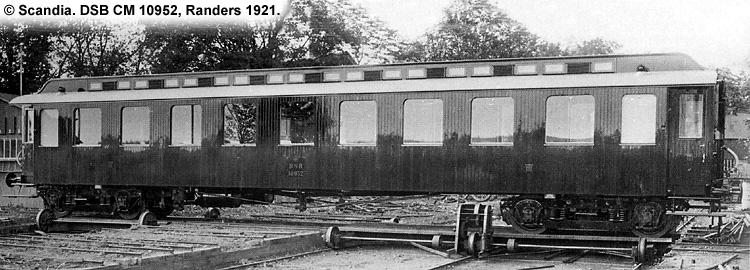
Passenger car, Denmark 1921

Prussian (German) passenger car, built circa 1910

Queen Victoria’s Saloon Coach, Great Britain, 19th Century
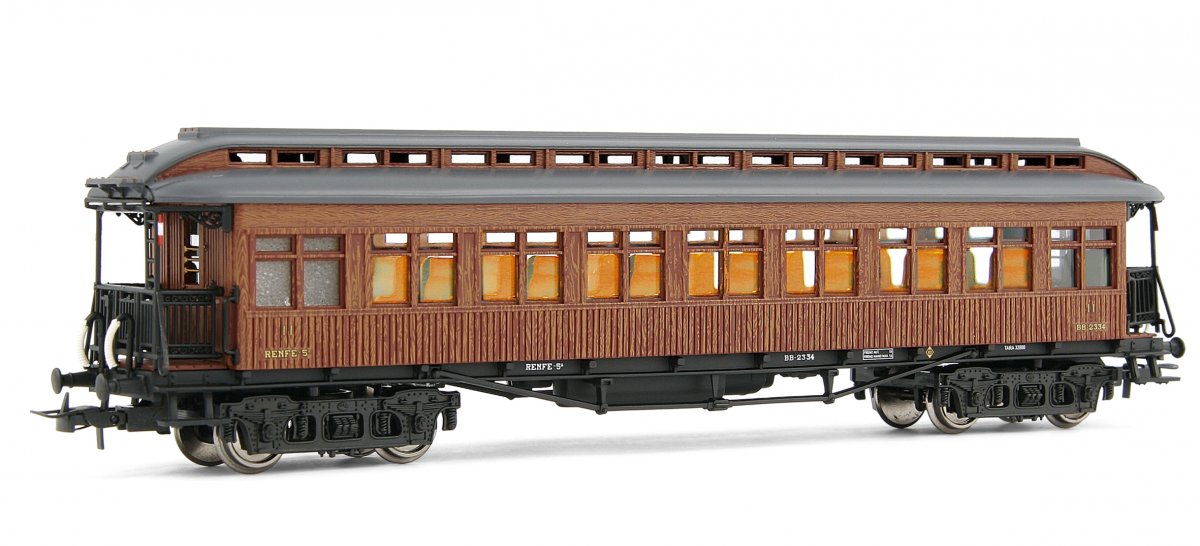
Spanish passenger car model
Norwegian 1st Class car, built pre-WWII
These are just some examples. I still saw the occasional passenger car with clerestory roof running in Denmark back in the 1960’es.
Kai Willadsen
Daveklepper - Small correction - PRR 120 was built new in 1928 as an office car, class Z74d, and had six wheel trucks until rebuilt in 1953. At that time four wheel trucks were applied, with very large journals (2FP-1, 6 1/2 x 12).
I think Mr. Klepper may have gotten this car mixed up with another 120, the ex-“Chicagoan”, which was built as an S70. Here is some information on the Pins/Levin 120 from Britton’s pennsyrr site; it is not fully ‘up to date’ but contains information relevant to this issue:
[quote]
Built at Altoona as part of 1927 program of six cars on February 23, 1928; un-named and assigned to V.P. Eysmans, based in Philadelphia. Named Pennsylvania on July 1, 1935. Ice-activated air-conditioning installed at Altoona on August 22, 1935 and reclassified Z74DR. Renamed Baltimore at West Philadelphia on September 7, 1939 and assigned to President W. F. Franklin, based in Philadelphia. On August 23, 1951, 2F-P1 trucks installe
In the Victorian Period certain British railway companies such as the Midland Railway and Great Western Railway did operate a fairly large set of clerestory roofed carriages, as did the GNR and NER on a somewhat more curtailed basis, usually for observation or private saloons, although some coaches were built. Bluebell has saloon 43909, and the NRM has NER 1661 as far as saloons. Beamish has NER coach 818, and the NER Railcar is a clerestory deign. The GER built very few clerestory designs and to my knowledge none survive intacr. Surviving GWR examples including West Somerset’s sleeping car No 9038, Didcots compartment coaches 1941 and 1357 and dining car 952
Hi,
Although I am not a railway engineer and as a common rail fan I am not an expert for European and German passenger coaches, I would like to contribute some information and thoughts. In case I am wrong, I ask for your indulgence.
Also in Germany and other European countries, there used to be many types of passenger coaches with clearstory. Also, other roof ventilation systems were used. Many of the coaches with clearstory were built in the 19th century. Modern passenger trains of today are equipped with AC.
This link leads you to pictures including many old German passenger coaches; the more modern ones are easy to recognize:
I’ve seen that Prussian railway car- its in a museum in Dresden and it is as finely restored as a vintage Mercedes. It was locked up and I couldn’t go inside it, gosh dang it!