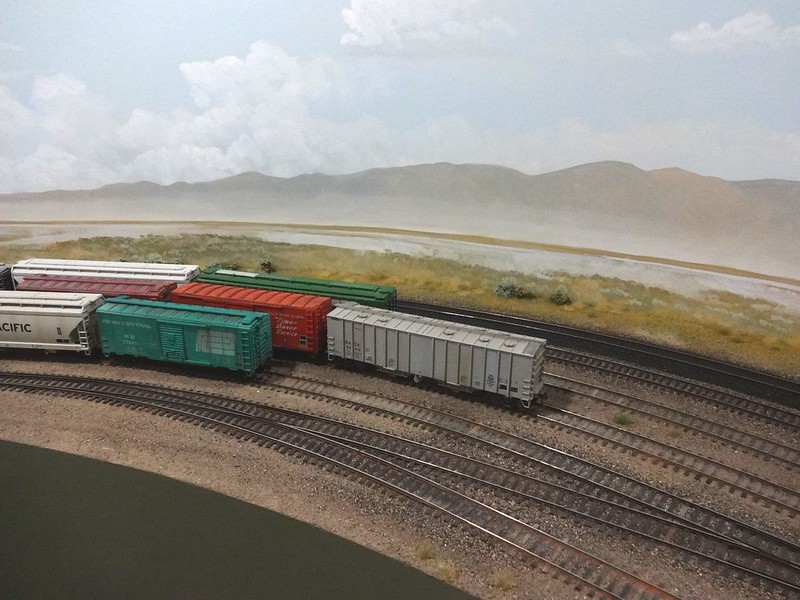
I’m designing an HO scale, pin wheel style yard for an L shaped area and was wondering what the minimum radius might be for reliability in coupling and uncoupling. For the most part, the uncoupling will be by hand as all tracks are within reach. I model the transition area so the longest freight cars will be 50’ box cars. At this point, it looks like the sharpest body track will be about 28" radius with all the other tracks a larger radius. I use Kadee couplers.
My transition era curved yard has a minimum radius of 29" and I have had no problems. I doubt 1" sharper would be a material difference but you might layout a piece of flex track on a spare board at 28" and then test it.
This end of the above yard is set up with a “pinwheel” ladder, with tracks of about 30" radius and up. It works with no real coupler issues. I do all uncoupling with skewers.
In an article in RMH they did a fairly extensive study of radius vs car length for both operation and appearance. Their recommendation for reliable coupling was 5 X car length. In HO that works out to roughly 28" for 40’ cars or 42" for 60’ cars.
Of course, coupling on a curve is the issue, not really uncoupling. I’m surprised that some have reported that they have no problems coupling on 29 and 30 inch radius curves. Based on my experience, I would have thought that a broader radius would be required.
Experience has shown me that coupling on curves (I have nothing sharper than 30"r) is pretty much dependable if the two pieces of equipment are about the same length and have about the same wheel base, king pin to king pin.
A 40’ car will not match up to 60’ very well because the couplers are different distances from the centerline of the track.
Agreed. I think that’s why a very broad curve is required for reliable coupling in all circumstances. The circumstances envisioned should be considered when designing the yard.
For instance, if you were to design a marshalling yard to hold 40 foot coal hoppers, a sharp-ish radius might be fine, but it will present problems if the oddball 62 foot tank car gets into the mix.
Do you mean you use skewers to line the couplers up so they will couple? I have some locomotives that require me to hold the drawbars over sometimes in order to get them to couple up to a car.
If all the cars are of approximately equal length (and coupler offset from track centerline) your cars should couple reliably on the radius specified. You might have to use your shish-kebab stick to ‘encourage’ the occasional recalcitrant.
If cars are of unequal lengths, problems come with the territory. A short four wheel car coupled between an auto rack and a ‘new in 1964’ high speed reefer will literally pop off the outside of my 24 inch radius mainline curves. I have to have an intermediate length car between. That’s why I pull my new, long cars with a C58 class 2-6-2 or a DD51 diesel-hydraulic. I reserve my smaller and older steam (with short three-axle tenders) for short-car trains.
My pinwheel yards are back-in hidden staging. Nothing couples or uncouples there.
Just for the record, I’m talking about coupling by just bumping one car into the next, not using any type of intervention to close the couplers or even line things up first.
Thanks for all your replies. I roughed out the yard with my CAD program yesterday and was pleasantly surprised that my largest radius in the pin wheel style yard is 61-1/2" and the smallest 47-1/2". I shouldn’t have any coupling or uncoupling problems with my 40 and 50 ft. boxcars. (I did discover, however, that I had to shorten the turnouts to make the pinwheel work.) In 3D, it looks awesome and all the yard turnouts are on the aisle side with a reasonable reach into the yard if necessary. The corner gives me enough room to add a roundhouse and turntable with two engine leads. And the yard has a good lead and arrival and departure tracks with an escape to the engine facilities. Sometimes it works.