I have a first gen model (I think), it runs almost flawlessly besides one problem. Even though it is basically “brand new” and all the contacts and my track are very clean it stops pretty often.
The drive rolls perfectly, but the motor’s magnets seem very strong maybe too much. How does one fix this?
The conventional wisdom over the years has been some form of remotoring. See in particular Mel Perry’s version of repowering Rivarossi cab-forwards for pointers.
When you run long enough that it slows down and stops, is the motor hot to the touch?
Old Rivarossis only pick up up power from one side on the tender, and one side of the engine. That can lead to frequent power interruptions. You could try increasing the number of power pickups on the wheels. Or try finding an alternate tender that has all-wheel power pickup.
Simon
1 Like
Either i was not correct about the year it was made or they simply just dont have tender pickups, but this one is not equipped with them.
This has awakened a new idea of sorts because it just turns out that a few years ago I was a flea market and found a Rivarossi cab forward. It was probably the worst purchase I have ever made, one side of the shell-engine and tender was melted somehow, had some kind of rot in the metal weight and it was missing half of it’s parts. Because it was in a nice bottom half of an Athern box though, the only problem I could spot was that it was missing only some parts, so I happily took it home for a “low” price of $45. After discovering how bad it was it immediately went into my storage cabinet (the most surprising part was that it ran quite well).
My point is that I’m going to use the motor from it and put it in the big boy.
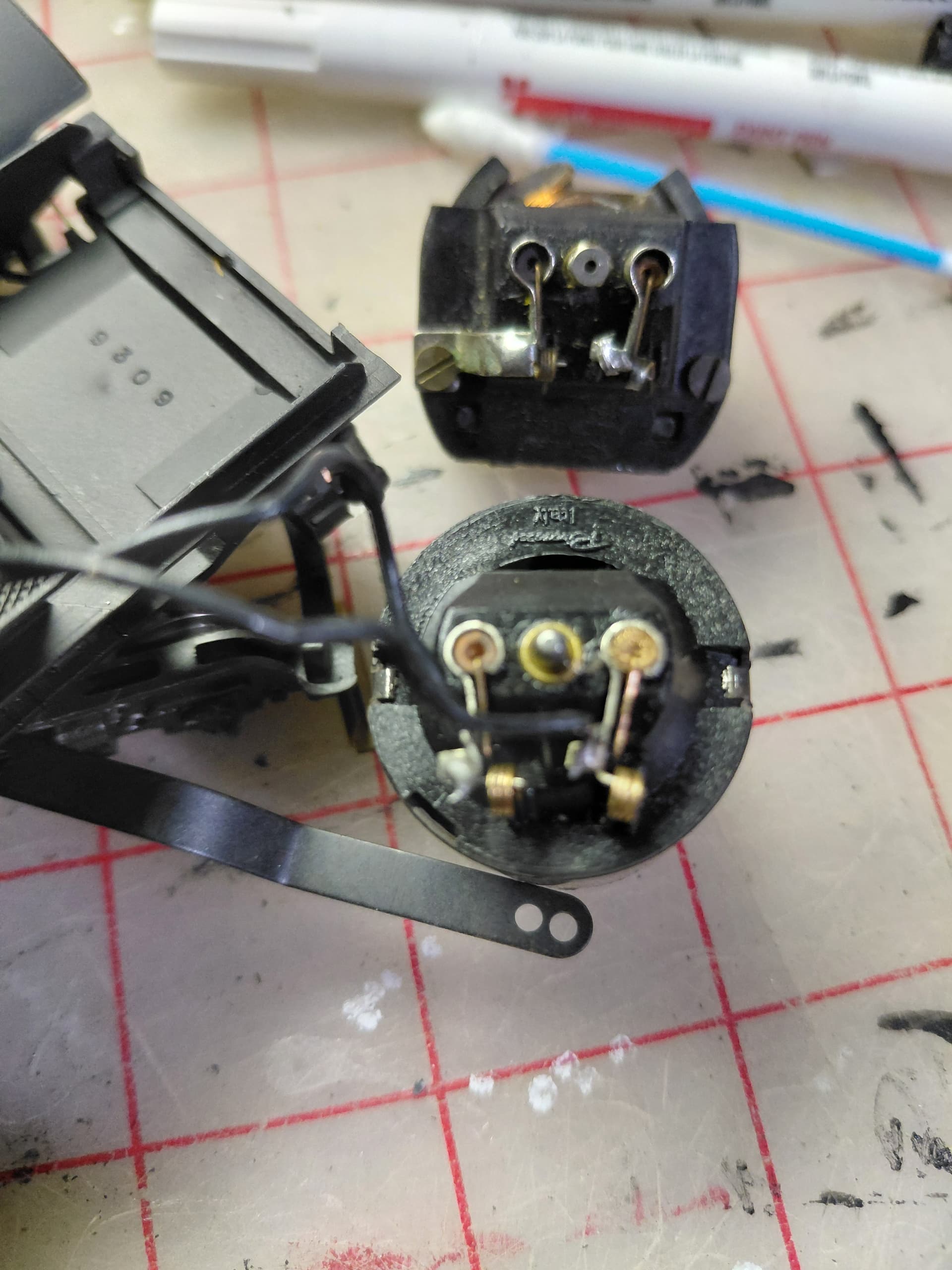
After some testing, the original motor has low torque even at high speeds and randomly ramps down. The cab forward motor has much better low speed, maintains a steady speed and does not produce many sparks. The only problems are that they don’t bolt up to each other (the drive shaft does though) and because it now has a ball bearing motor I don’t know how to grease the bearings.
You don’t need to grease ball bearings in this small an application, any more than you would in clocks with them.
The micro bearings I’m familiar with did not have dust seals, so a hypodermic oiler would serve to get a small quantity of oil in if you wanted to relieve a little running noise. You could in theory ‘thin’ a good bicycle-type grease, with or without additive like PTFE, and then let the solvent evaporate as the motor runs and distributes the lubricant as a film. In either case a very, very small dab’ll do ya.
Whatever you do, don’t get lube on the commutator or brushes, or into the air gap between the field and armature…
What about LaBelle 106, would that work? I need to oil them because it has a high-piched whirring sound when the motor runs.
I’d try 108 with PTFE first. You’re going to have trouble getting the 106 into the actual rolling element part of the bearing without a relatively narrow-bore syringe – a toothpick might not be ‘sharp’ enough to get a blob from the tube down in there either. Whereas the 108 should go in with capillary action.
The old Rivarossi Big Boys did not have tender pickups. My three do not.
Hmmm… I read that some did. If they don’t I see an opportunity to add wipers.
Simon