Trying to improve an area of my layout by adding some operational elements. In the specific area I’m redoing, I could add in two turnouts and Tortoise machines to create a run around. Or I could have a switcher waiting nearby to come in and take over after the primary locomotive has uncoupled and moved on.
So, would one or the other be the better way to achieve my goal, or does it really matter?
Note - obviously, using the switcher and not to cutting into the existing tracks to add in the turnouts and Tortoises would be the simpler way to go, but I would do necessary work to put them in if that would give me a better, more realistic scenario.
No pics, (yet) , but I can provide some if it’s felt they are necessary. For now, just take me at my word when I say that I know that I can create the run around, just wondering if that, or the switcher would be the better choice?
Thanks,
Dan
This would be an operational question. Obviously switching with the road power would be quicker and far less expensive than arranging a separate switcher and crew. In some cases, comparatively heavy road power can ‘spot’ and retrieve cars from frail or twisty sidings by using part of the train to reach.
On the other hand, it may pay to run peddler/drill trains with smaller or older road switchers (with suitable trucks for the needed work). Some railroads equipped ‘switch engines’ with road trucks so they could be operated in that kind of service.
The age of dedicated small locomotives exclusively to switch cars basically ended long ago – see the date EMD built its last end-cab unit. There have been attempts to revive the idea (with hybrids like the Green Goat, electrics like the original Joule, ‘critters’ from places like Republic that perch new running gear on a war-weary C Flexicoil truck, etc.) but they really only do well in specialized niches. Your railroad might easily have such a niche, but you’ll have to decide if it’s more effective than letting the road-engine crew do the other stuff with the engine they already have.
Depends upon the area of operation. Yard, head-on passenger tracks?
In the Dearborn Station segment of my layout, passenger trains arrived head-on into stub end tracks. Switchers pulled the passenger car consist to the coach yard for servicing. The locos headed to another part of the coach yard for servicing. The coach yard switcher then pushed the passenger car consist back to the station and the road locos backed in to connect with the passenger car consist.
In my freight yard, road locos used an arrival-departure track, and switchers moved the freight cars around, using an escape track to avoid being trapped.
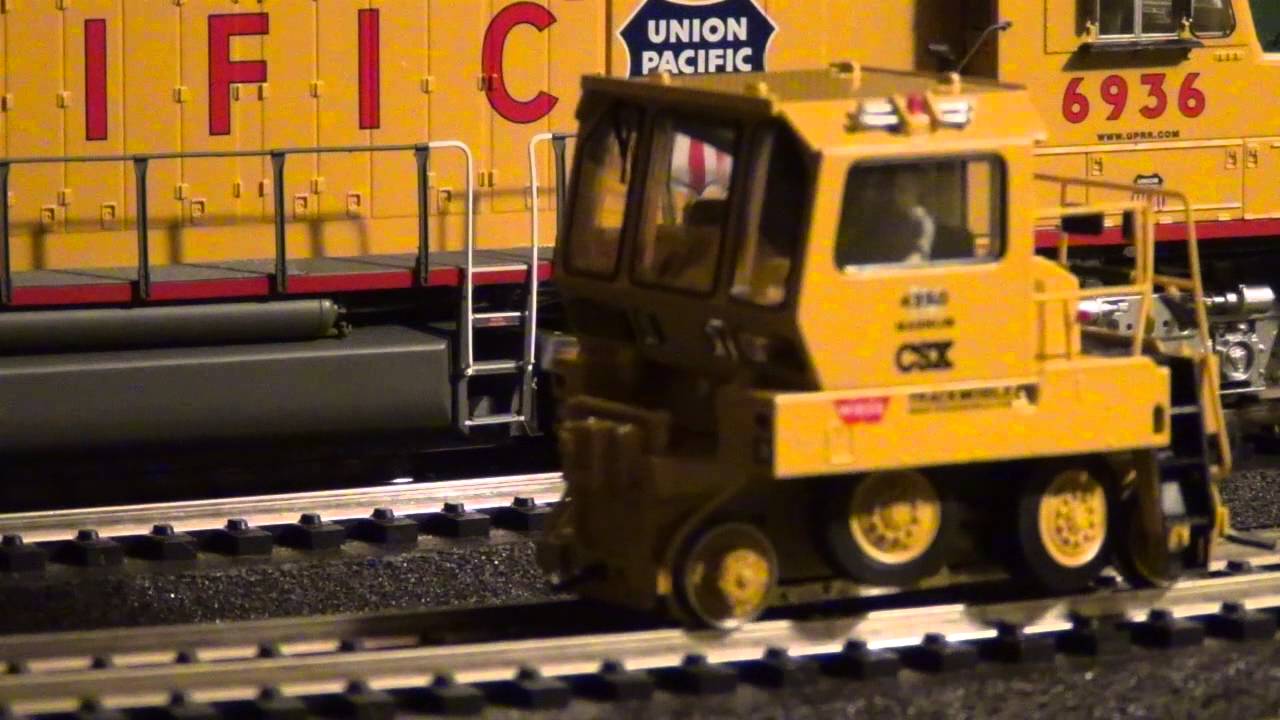
A real world solution would be to utilize a trackmobile. That is not practical, or desirable, in a model railroad. I live in Dodge City, KS; land of lots of grain elevators. I can think of three big grain elevators in the area that have 1st or 2nd generation power as switchers (one set includes a rare GP-9B unit). There are also several trackmobiles.
Having said all that, I like the variety of a dedicated switcher; I would put in the switches and run a dedicated switcher. On my layout, I have several Bachman 44 ton locomotives set aside for this purpose.
I’m not so sure you couldn’t model one. For many years there have been small-scale (~1/64 or smaller) RC cars – admittedly control is a bit primitive, but for a track mobile it really wouldn’t have to be) and all you would need to add is functionality to raise and lower track wheels (with power or charging pickup connection)
I actually purchased some 1/87 scale RC cars for my kids (and me) to play with years ago. Batteries lasted a couple of minutes. I am not sure if they would have created enough torque/tractive effort to move a freight car. I’m sure someone could design a mechanism to raise & lower the rail wheels, but way beyond my scope of possibility. Would be really, really neat to see such a thing.
In a situation where there are both facing and trailing sidings that must be serviced, a runaround helps the switcher get to the proper end of the train.
I have been reading and weighing my options. Also ran it past some guys at the club. Like here, opinions were more or less split on having the run around versus having a stand-by switcher.
But at this point I’m leaning towards the run around simply because it can be done now with less hassle than it would if I decided a year from now that I really want (or need) it.
If it’s all your railroad, I’d go with the runaround. If there are several spurs that are all part of one large industrial complex, it might make sense to have them have their own company switcher. Cargill still has an SW-1 (IIRC) in company colors that they use to move cars around their large grain terminal on the Minnesota river in the southern Twin Cities area. Cars are dropped off and picked up by UP (former CNW) line.
FWIW I grew up on a dead-end spur line of a shortline (Minneapolis Northfield and Southern, now Progressive Rail) that ended with a run-around connected to several industry tracks branching off. MN&S usually used back-to-back EMD switchers on the trains, so the crew could just move from one engine to the other for the trip back down the line.