This has probably been discussed before, but does anyone know, what the pros & cons, ins & outs of scale HO wheels versus commercial HO wheels are, including price?
Define Scale vs Commercial Wheelsets.
If you mean tread thickness, I’ve read that there could be issues with scale treads with some turnouts.
If by, “Scale wheels,” you mean Proto-87 wheelsets, be aware that they are a LOT more sensitive to minor tracklaying irregularities (and commercial specialwork compromises) than RP-25 wheelsets. Also, if your track is built ‘Proto-87 friendly’ it may not be so friendly to RP25 wheels. As for cost, if you’re converting from plastic or pizza cutters to quality metal wheelsets there may not be much difference. OTOH, if you have no reason to convert other than to get the (admittedly) better appearance…
Will it be worthwhile to convert? The only person who can answer that question for you is the one who ties your shoelaces.
Chuck (Modeling Central Japan in September, 1964)
You will have to bring your track standards to P87. That means tighter guard rails and P87 frogs. If you hand lay track then do not spread rails on curves. Two point track gauges instead of three point. P87 has tighter tolerances then NMRA RP25. Locomotive wheels in P87 will be hard to find if darn near impossible for your steam locomotives. There are diesel locomotive wheel sets available in P87 but not much in steam. Cars with end mounted trucks like hoppers and tank cars will have a large gap between the journal box and wheel that will look out of place. Therefore some of the trucks will have to be modified or replaced. From what you have heard is myth that RP25 will not work in P87. Good quality RP25 wheels will work great in P87 track work. Older pizza cutters will not. The NMRA gauge will tell you if they are RP25.
I am currently building and super detailing a contest quality hopper that will have P87 trucks and wheels.
P87 is one of those things that you either jump both feet into or stay away from.
Pete
It will take a few minutes to digest what you all say.
Any websites or publications that explore the subject from square one?
I’m just considering “scale appearance”, but if these scale wheels cause so much trouble, operating and other, then it seems they are not worth the trouble, but I really don’t understand all the parameters yet.
Howabout price? No one mentioned price.
Just a few more words to Proto87.
With Proto87, rails and wheels are exactly to scale. The flanges of Proto87 wheels are hair thin - much smaller than the standard NMRA RP 25 wheels. Laying Proto87 track requires utmost care and a lot of effort - also in terms of cost. There is no out-of-the-box equipment available, and all of your locos and rolling stock need to be rebuilt to accept Proto87 wheel sets. The looks is fantastic, but is it worth the trouble? If you build a small layout or a diorama - yes, but I personally would shy away from building a larger layout according to Proto87 standards. A layout is for operation, so you need to focus on a reliable performance of your track and rolling stock. That´s not an easy task with regular tracks and wheels.
I am quite happy with code 83 rail and NMRA RP 25 wheels.
Let’s start from the beginning because not all the information you have been given is correct. First critical point:
- Railroad rack and wheels - both model and prototype - form an interrelated engineered system. You can’t change one without impacting the other.
There are 3 commercially supported wheel standards in HO:
-
NMRA Standard S4.2 (http://www.nmra.org/standards/sandrp/pdf/S-4.2%202010.02.24.pdf). Included in this standard is RP25 (Recommended Practice) (http://www.nmra.org/standards/sandrp/pdf/RP-25%202009.07.pdf. The RP25 sets up a set of wheel codes. Code 110 wheels are the normal for HO, and commonly referred to as RP25 wheels. They work well for track built to NMRA specs (http://www.nmra.org/standards/sandrp/pdf/S-3.2%202010.02.24.pdf). In fact, the S-3.2 specifically cites code 110 wheels for HO.
-
Within the RP25, there are code 88 wheels which have historically been made with the same flange, but narrower tread, than code 110 wheels. These are now the defacto and recommended standard for HOn3 because the smaller wheel diameter emphasizes the oversize tread width. Code 88 wheels are often referred to as semi-scale wheels in HO and are commercially available in some trucks and wheel sets.
-
Proto87 is track and wheels reduced as exactly as possible. The NMRA version of P87 is here - http://www.nmra.org/standards/sandrp/S-4_1ProtoWheels.html. A lot more technical reading on the subject
Well you sure got a lot of info to read, so here’s a picture that shows a comparison of the different wheels that are being talked about:
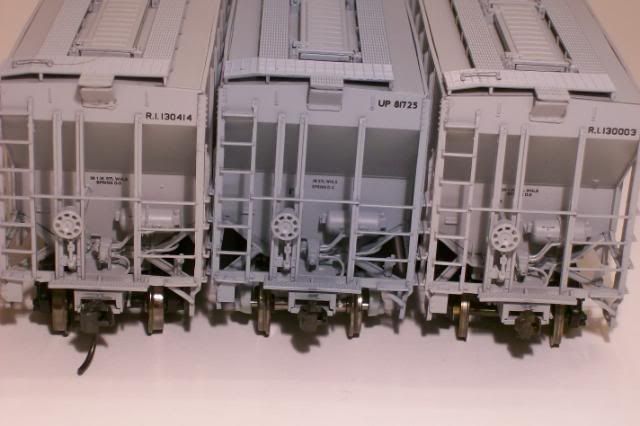
These are all Proto 2000 covered hoppers with 36" wheels:
Left - P2K code .110 wheels with Kadee #5 coupler
Middle - Semi-scale Intermountain code .088 wheels with Kadee #58 semi-scale coupler
Right - Proto:87 Scale wheels with Sergent Engineering coupler
I have my equipment set up with semi-scale wheels (.088) and Sergent couplers, I find that to be a good balance for me.
Looking at that pic I think I’d prefer the middle but with the atlas turnouts I’ll be staying with the fat stuff. [;)]
Go over to the Northwest Short Line/Oso Railworks website > wheelsets > HO scale – they have a photograph there showing the difference between 110 point/88 point/P:87 64 point wheelsets. We have a modeler here in town who has equipped all his rolling stock with NWSL 64 point wheelsets . . . . . they look fantastic but they also add 8-11 smackers to the price of each car.
Northwest Short Line/Oso Railworks makes 72 point/64 point/50 point wheelsets for N-Scale . . . . . I would love to have all of my rolling stock with these 50 point wheelsets but these add about $10.00 to the price of each car.
. . . . . . . . . . one of these days! . . . . . . . . . . maybe! . . . . . . . . . .
Why not put a set on a caboose or the car w/ the EOT devise. That is where the difference will show up the most, also it will give you an idea if your trackwork is good enough…jerry
Not a bad idea [tup]
Proto87 belongs on museum dioramas. Not on model railroads.
Mark
It works.
We have at FREMO a group who operates modules and roster in 1:87. But every steam engine must be rebuilt, with true to scale parts. Model engines have other distances for wheels, axles and pistons than 1:87 engines.
But you get a much better view.
But you have to do most work by yourself or pay (a lot for the engines). Too much for me.
Wolfgang
This is not true. P87 operates just fine. No need to make this kind of broad judgment.
Proto 87 operates just as well as regular HO. But it’s not for everybody. Your trackwork has to be ultra precise. You must be willing to shell out extra $$ for wheels–which can add up FAST if you have a large stable of cars.
For steam modelers, there are extra difficulties, and as a previous poster stated, wheels for locos are darned near impossible to come by. For diesel modelers, it’s much easier. Commercial products are available. However, six-axle locos require much more tinkering than four-axle locos.
For a small to medium layout, P87 is an option. But yes, it’s more work to get things up and running. You have to decide what you’re willing to invest–in both time and money. It’s all about personal choice. I am currently building a 13x21 shelf layout in Proto 87. It ain’t easy, but I have made the choice to go this route because I like the look of the scale wheels and turnouts (keep in mind that scale wheels require tighter clearances on the turnouts, not to mention everywhere else.) Others may not give a hoot. Or their prototype choice may not be a good match for P87. If I were interested in mainline modeling with lots of six-axle diesels and hundreds of freight cars, many of which were 89 foot auto racks, I might think long and hard before jumping into P87. But I model a backwoods branchline that only saw 4-axle units. And my stable of freight cars isn’t that big. So the choice works for me.
But don’t believe that P87 is ONLY for museum dioramas. It’s a viable option for anybody. You just need to know what you’re getting into.
Don’t shy away from the .088 wheels because you have Atlas turnouts (unless they’re SnapSwitches, in which case replace them). All you need to do to prevent derailments is to put a small triangle of .020 styrene in the throat of the frog, to eliminate wheel drop. If you have code 83 track, that’s not as much of a problem. And if you don’t mind the drop, just put the styrene in the #8 switches…
I have Intermountain semi-scale wheelsets on most of my cabin cars.
I don’t have any wheel drop problems through Atlas super switch #6, custom line #4, or snap.
The only thing I own that has wheel drop issues is a Mantua 4-4-2, that has extremely narrow treads, and a tight guage to boot. Not to mention it’s a rigid 4 axle frame.
You probably don’t have sprung trucks. I do, and with code 100 track, there is definitely a wheel drop issue. However, It’s not a big deal except in the single #8 curved Shinohara I have. The rest of the layout (Peco switches) it’s just a visual issue. I finally put the pieces of styrene in all of the turnouts, just to get rid of the bounce. My freight customers were starting to complain! [:D]
Because of the shorter rail height, code 83 track would have very little wheel bounce. The issue with the curved switch was that the wheels would fall completely off the railhead, and the guardrails were not tight enough to keep the wheels from wandering to the wrong side of the frog point. A small slip of styrene fixed the problem completely. My next step would have been to remove and tighten the guardrail flangeway.
Is there anyway you can determine if the scale or semiscale wheels will malfunction in straight track and various turnouts before you buy the wheels?
I have a mix of different track codes and switches. The least expensive I have is Atlas, but I also have Shinohara and some other expensive switches.
-
Scale wheels are going to cause problems on commercial HO track.
-
To use semi-scale wheels successfully, use an NMRA gauge and adjust your track - especially turnouts - so that none of the track specs are at the widest tolerance. You may need to add a 0.005" shim on the inside of your guard rails to prevent frog point picking.
Fred W