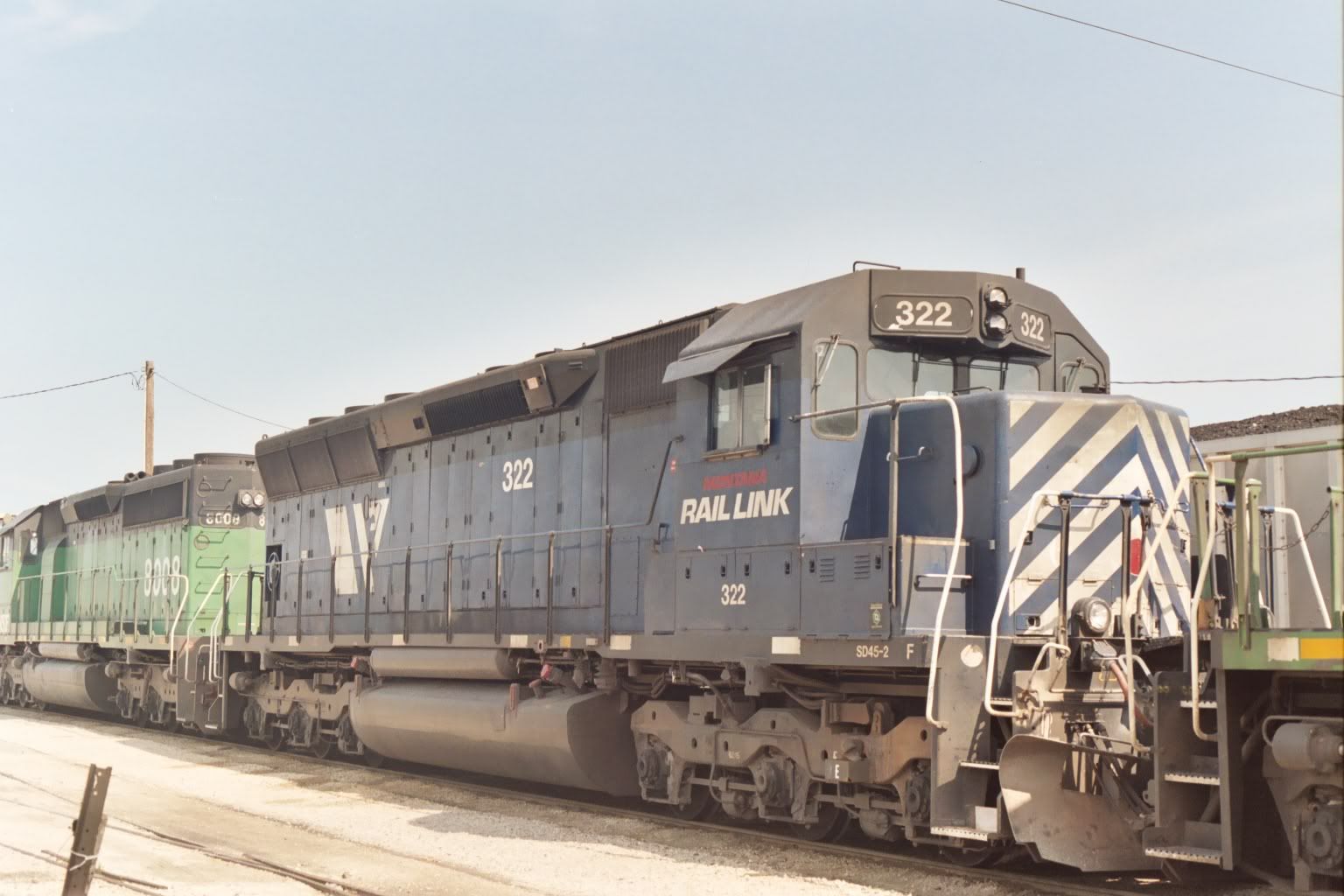
well i was railfanning out in Altoona some few days ago when a freight came through. always nice to see since almost nothing comes through anymore. anyway, the 2 locomotives were a CSXT AC4400CW and an HLCX 6-axle that i could not identify. when i uploaded the image to my rrpicturearchives account, it was classiffied as an SD40M-2. now i was aware that the SD40M-2 was an SD40-2 in an SD45 body. but some are just flat out SD40 body with dash 2 guts. so my question is. how can you tell an SD40M-2 from an SD40-2? the one i saw had SD40 trucks. is that it?
Unfortunately there is only one absolute indicator on whether a locomotive was built new as an SD40-2 or was converted from some earlier EMD model, even the HTC trucks do not confirm it as a SD40-2. Conrail ordered all of its SD40-2 locomotives with the older Flexicoil trucks rather than the standard HTC found on everybody else’s SD40-2s. The converse is found Kansas City Southern they have some SD40M-2 locomotives built from both SD40 and SD45 cores that have the HTC trucks. The only way to know for sure is either know the history of the locomotive or to measure the frame. The frame is considered the carrier of the identity of the locomotive since with EMD locomotives the serial number is stamped into the metal. Note that this doesn’t apply to Canadian built locomotives built before the 50 series debuted.
I saw an engine on the UP and got excited as it was built with flared radiators. Oh boy an SD45 right, NOT. It was an early SD40 with flared radiators. Now an SD40R-2.
what so shorter frames mean SD40-2 and longer frames are SD40M-2s?
No, not always. It depends on the source unit.
Other way round. SD40-2 has a longer frame. Frames have been getting longer for more equipment and larger fuel tanks. Even with frame length there are a couple of exceptions. The six former EL SDP45s rebuilt to SD40M-2s have a frame slightly longer than a SD40-2, also the former IC SD40A locomotives used the same frame as a SDP45 and so are longer.
SD40M-2 means it has SD40-2 guts, usually thru rebuilding. Could have started life as a SD40, or SD45. SD45s would’ve had the 20 cylinder prime mover replaced with a 16 cylinder prime mover. In either case, the prime mover would be overhauled and freshed up, and the electrial system worked on. Not sure if it would have been a full rewiring, patched up, or something in the middle.
Regular SD40-2s are 69 feet long, most have HTC trucks (except Conrail), and should have a sight glass by the front of the radiator section on the engineer’s side.
SD40s are a little shorter, and have Flexicoil trucks, without the shock absorber on the middle axle. Some still have the low-mount brake cylinders, but most have been changed out. They were vulnerable in derailments, hanging low they would be the first thing to be hit when wheel leaves rail.
Probably the best way to check is to take the picture, then bring it home and check the 'net to find out what it is.
Here’s another anomaly, one of the Alstom rebuilds was built on a tunnel motor frame.
I usually check the cab for evidence of cab overhang. That is a sure sign of a Dash 2 cab, also the knock out lights and water level sight glass are much more common on a Dash 2 than an earlier unit.
Anyone got a pic of an early SD40-2 with the winged radiators that rrandb saw?
I’ve seen winged radiators on MRL SD45-2’s. What gives?
what are knock out lights and cab overhangs? yes i’m still new at this advanced railfaning stuff.i only spent 16 years of my life just struggling to see a single train
let me get this straight now, an SD40M-2 was either once an SD40 or SD45 but now has SD40-2 guts and an SD40-2 was always an SD40-2 since it was built at EMD?
One thing that I’ve noticed about Dash 2 vs. original is the traction motor blower housing on the fireman’s side behind the cab. On the original, it looks like this -

while on Dash 2s from 1972 to late November 1982 it looks like this -

and on November 1982 to the end of Dash 2 it looks like the one on this GP60 -

Also note the differences on the side of the frame on the SD40-2 and the GP60 - the later “Phase II” Dash-2s also had a frame like the GP60 where there’s no “step-downs” over the trucks.
One way I usually used was to look for the water sight glass near the front of the radiator grill on the engineers side.
In my old decrepit copy of The Second Diesel Spotter’s Guide by Kalmbach there is a page dedicated to Dash 2 spotting features. It’s on page EMD-61. Dash 2 locomotives on the rear of the long hood have either high or low classification lights. One set will be filled with lights and the other will be blank. That is what I was referring to about the knock out lights. Sorry the terminology can be confusing. Also the cab roof on a Dash 2 will overhang the rear of the cab by an inch or two. On earlier models the cab roof is flush with the back of the cab. And a pure Dash 2 unit will have bolted battery box doors and the earlier 40 series had bolted doors. Of course all this is before rebuild and whatever parts are available for the rebuild of a unit.
One of the Alstom rebuilds was from an SDP40, it still has a squared off rear just like EMD built it 40 years ago. It visited our Ford Kentucky Truck Plant this Sunday morning.
Wow, you were disappointed by THAT? I’d have jumped up and down until the last car was out of the state!
rrandb how long ago was this sighting? There are only two flare SD40s remaining. One is with CN and the other with W&LE. [8D]
UP has several SD40M-2s with flared radiators, rebuilt from SD45s.
i think he means SD40s with flared radiators rather than SD45s. but why would the SD40 have flared radiators?
GP40X’s also have flared radiators.
They were three of the prototypes. They were built on a SD35 frame and so were even shorter. Because of the short frame the carbody had to be short (just enough room to walk around the long hood) the radiator cores had to be slanted out to get enough cooling area.
MPI had a short SD 40m-2 with flared radiators, kitbashed by MK