Shelf switching layout trackplan - looking for feedback & advice.

Hi guys,

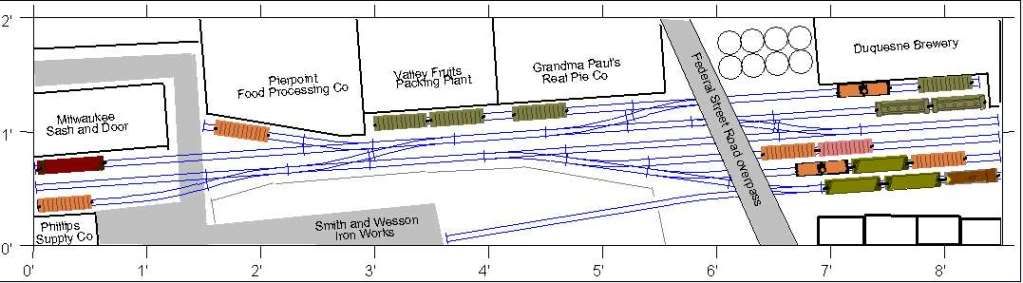
I’ve been fiddling with XTrkCad for many evenings now, and I’ve finally got to a trackplan that I think is working ok. I am working in HO scale, and I need to fit into a 6.5 by 2 foot space (with extra space for a fiddle yard off to the right).

I am trying to develop a plan that will work as a stand-alone switching layout, but can also be extended with a behind the scenes loop for continuous running in a model show environment.

Scenery-wise, I want a modern and urban detroit setting and something like a ‘Sweethome Chicago’ or ‘Brooklyn 3am’ feel.

I’ve reached this stage in the design:

This plan has four industries that require boxcars, plus a couple of small locomotive holding tracks sized to fit GP and SW locomotives.

The ‘mainline’ at the top of the plan is for continuous running in an exhibition setting only. For home operation, there will be a fiddle yard connecting the mainline on the right-hand side only. New trains will come in from the right on the mainline and enter the sidings from there.

I’d like to hear any feedback on how I could improve this plan further, and any parts that you guys think might cause problems in the longer term. Basically I need all the help I can get, as this sort of track planning doesn’t come easily to me! :slight_smile:

A few suggestions… As drawn, you have three run around tracks when you really only need one so I’d start by eliminating the other two. Perhaps just keep the one on the back edge. I’d also eliminate the short spur where you have the sw1200 as that is too short to be of much utility.

Lance

Books on Layout construction, design, and track plans

http://www.lancemindheim.com/bookstore.htm

I have a feeling that you are trying to put too much action into a relatively small sized layout, ending up with a little too much track, which even goes to the very edge of the front of your layout.

Layouts, like Prof Klyzr´s Brooklyn 3 am layout, live from their “simple and focused” design, allowing only a limited amount of moves. Jon Grant´s Sweethome Chicago layout is much, much bigger than the space you have.

If you are aiming at switching (shunting for the Brits [swg]) an industrial district off a two- track main, than Larry Forgard´s idea might provide some inspiration for you - you can view the track plan here.

Stein from Norway has also developed some interesting ideas in a thread I was running about two years ago - here are some of his design ideas:

It might also be worthwhile to find copies of some MRP (Model Railroad Planning) booklets published by Kalmbach.

(Taken from a reply by Stein):

MRP 2006 has Ian Rice on sectional shelf layouts and Mike Aufterderheide’s “Modeling the Monon’s Hoosier Hub”, Linda Sand’s excellent "Industrial Railroad on a shelf"and an excellent article

The area is an industrial spur mainly serving United Recycling Co, which receives boxcar of bundled scrap paper on pallets, boxcars of dyes on pallets in boxcars, boxcars of electronic scrap in small containers in boxcars, boxcars of plastic, tank cars of acids and diesel fuel for the melter, and the occational gondola of scrap metal or glass/cullet (broken bottles glass from breweries).

United Recycling ships rolls of brown paper, paper napkins, gondola loads of sorted and shredded metals, and plastic pellets in covered hoppers.

Empty cars to be loaded with brown paper or paper napkins must be spotted at dock A or spot D.Spot D may only be used if there is a car already being loaded at dock A. If car at dock A is removed, the car at spot D must be respotted to dock A.

Inbound cars of scrap paper or plastic recycling will have to be spotted at dock B or spot E. Again - Spot E may only be used if dock B has a car.

Electronic waste or plastic may be spotted at dock A or B.

Tank cars with acid or fuel oil are spotted at the tanks by the switch to the main.

Gondolas must be spotted under the crane, at spot C or F, for unloading into the plant or transloading to trucks.

The evening transfer run to the Humboldt Avenue Yard will set out 2-4 inbound cars for the industries and pick up any outbounds at the set out track around 11 pm.

The industry park switcher will come on duty at 6 am. You are permitted to use the main for switching, but the main must be cleared by 11:30am , when the morning Amtrak train will be passing through, detouring due to a wreck up on the eastbound main.

There might be a need for you guys to clear the track for a few other trains as well - we will keep you advised by radio if the need comes up.

Grin,
Stein

I’d look at moving the track out a little from the backdrop, and change the track closest to the backdrop to one or more industrial spurs / sidings. This will give you room to use some flats as industries, like Walthers “Background Buildings”. That would give you more room up front for things that don’t require any buildings, or relatively small ones…like a team track, small RR buildings, maybe an interchange track, etc. You don’t need too many tracks, if you have say three flats that each get 1-2 cars along the back, and a team track with 1-3 car capacity, that gives you plenty of switching. You could even fit in a one or two stall Pikestuff enginehouse if you wanted.

If possible, I’d try to extend one track along a narrow shelf for “staging” where a string of cars could be picked up by the switcher and brought onto the modelled part of the layout. That could represent an interchange perhaps, with cars picked up there at the start of the session and left there at the end.

hi jl,

if you are taking your layout to shows, you’ll find out you are maybe not even welcome. Or you have to belong to a group, with standard modules; like fremo. You’ll have to find out about the standards they require.

It has been said before, your layout misses a background.

At home a cassette might be a way to get cars from and on to your layout.

The second design, in contrary with the first, has warehouses as background, and low industries up front. (POV is point of view) In the first a cassette is added, should be added in the second one too.

You will have space for a double track main up front, but you have to know the standards before starting a design.

Paul

I had a similar thought to Stix. Eliminate one of the crossovers to the back (top) track and use it to serve a couple of backdrop flat industries and have the second track down as the mainline. Also, the runaround track right in the center of things sticks out as unnecessary. I also agree that the two stub engine parking spots might look better if placed where they could be a bit more useful. Maybe taking the middle runaround out would provide a space for your engine area.

Just some thoughts.

Good luck,

Lots of great feedback there, thanks guys. I definitely agree with the point about maybe trying to put too much into too small a space.

I like those suggested trackplans as well, so I’m going to head back to XTRKCAD again and see if I can slim things down a bit.

I definitely want to have plenty of scope for urban scenery in the plan, but I also want to make sure that there is still some potential for interesting switching, without being too ‘puzzle’ oriented. :slight_smile:

If you’re looking for some prototype inspiration for what a modern Detroit industrial switching line is like, I’d suggest taking a look the Detroit Connecting Railroad (DCON). DCON is owned by another MI short line, the Adrian & Blissfield (ADBF).

DCON operates ~2.5 miles of track just to the northeast of downtown Detroit. Here’s a Bing view of their “engine facilities” with two GE centercabs. An ADBF SW-900 also does work there.

Scroll up and down the tracks for more gritty urban goodness [:)]

The industry just to the north of the centercabs is EQ Detroit, which does liquid recycling. Further north is a largish scrap yard, which is probably their main customer. There is also a team track that occasionally gets produce reefers, but I think that business has dried up. Note also that there are many abandoned spurs for other businesses that have since passed on.

Interchange is with Canadian National to the north.

Obviously you won’t be able to do it all in 2’x6’, but a compressed representation that gives “look and feel” could be captured in that space (track for CN interchange, a scrap yard, a team track, chemical recycling plant, other resurrected businesses).

Thanks for the dcon link Dave, I’ll be taking a look at that for sure :slight_smile:

I’ve been tinkering some more in Xtrkcad based on some of the links that were posted earlier. I have got this adaptation of an existing internet plan now.

Detroit_Switching_V11

I think this might be a bit better, I’ve dropped the double-track mainline idea and gone with a much simpler layout.

it´s improving, but why are nearly all your head shunts curved and with such a small radius?

Stein-

I love your layout and operations guide! I’m going to play with it in 3rd PlanIt. Did you just slap it together quickly or you already had it?

Thanks!

Greetings:

I agree with Ulrich about the curved spurs. Said another way, the industries on the left side of the layout are all at different angles to each other, making it look toy like. Contrast that with how realistic the right side looks, with the streets and buildings lined up like the roads have purpose and efficiency. I would try to straighten the spurs to be more parallel with the main line and let the buildings line up straighter. Also, its harder to couple a locomotive to a car on a curved track.

  • Eliminate the crossing for the team track. The switch can be located one track south, next to the industry one switch. That would also straighten the team track and lenghten it. When you use crossings, it cuts down the useable length of the spur, so even though it looks cool, it uses more track than you need. A real railroad would try to use as little as possible.
  • You currently do not have enough room to switch industries two and three when there is a car parked at four. Relocate industry four to the GP38 track. The GP38 can be parked at the far upper right when not in use. Of course, when it is switching the layout, it won’t

Hopefully constructive advice:

  1. If those squares are supposed to be buildings, your industries are too small - one freight car load of stuff would fill those buildings to the gills, leaving no room for machinery and people to work there :slight_smile:

Pretty much the only way to do somewhat convincingly sized industries on a small layout is to do them as partial buildings instead of full 3D buildings. Which means that they go up against the backdrop or on the front wings of the layout - that way you can do a facade or partial building that looks like it is part of a larger building.

  1. cars spots vs industries. Compare this plan with the quick sketch I did. You have five separate industries (including the team track), which each take one car.

On the other plan I had but is two industries - but with a total of 10 car spots. Thinking in car spots rather than industries allows bigger (and more convincing) industries.

  1. Left end of runaround is too short. You were going to have an extension cassette on the right when operating, right? You still need to be able to take an engine and cars off the left end of the runaround if you want to switch industries 2, 3 and 4.

As it is, you might be able to take an engine and a car at the time out that way. That is not “providing more operations”.It is providing unrealistic frustrations.

  1. Industry four is in the way of switching industries 2 and 3. If you must do a double switchback, at least move industry four to the right end of the spur.

It is providing a fai

I put it together for this thread. But few ideas are completely original.

The core idea (industry along backdrop, set out spur on the aisle side of main, single car industry on tail end of set out spur, and operations decription) was inspired by Jack Hill’s switching layout New Castle Industrial Railroad (http://oscalewcor.blogspot.com/2010_10_01_archive.html).

Another couple of sources of inspiration for multi-spot industries was Lance Mindheim’s book “How to design a small switching layout”, Linda Sand’s article “Big industries in small spaces” in Model Railroad Planning 1999 (sold out from Kalmbach now, it seems, but other years of MRP is available at http://www.kalmbachstore.com/modeltrains-railroading-model-railroading-special-issues-model-railroad-planning.html), as well as descriptions of industry spots and train briefs at Linda and Dave Sand’s web page: http://www.sandsys.org/modelrr/

In particular, you might find the train brief and spot descriptions for the Sand’s Cedar River Terminal (http://www.sandsys.org/modelrr/modelbuilt/crt/) and Plymouth Industrial (http://www.sandsys.org/modelrr/modelbuilt/pi/) to be interesting and illustrative for the idea of multi-spot industries.

Smile,
Stein

You can operate in XTrkCad. This will enable you to see the operations challenges that others have pointed out. It will also give you a feel for how it will work out for you.

hi

The industrial buildings form a semi circle background.

The tracks labelled with “drill” should be kept free of industries.

Drawn with #4 switches; the radius of the teamtrack is 40" .

BTW all tracks are more parallel and the edges of the layout are concealed.

Paul

This is all excellent information, thanks guys, especially Stein and Paulus, I really appreciate your help with this! :slight_smile: It’s great to have such detailed feedback.

I’m definitely wanting to have a dense city feel, like Sweethome, so there will be buildings filling the back and sides of the layout, and I expect to be using something like the Walthers or DPM modular units to build up the industrial buildings, as well as some kind of ‘floating’ backdop buildings to give an illusion of depth.

I like what Paulus is suggesting with the two streets and the parallel tracks, and I wonder if this would be easier to operate than the no-runaround recycling yard? I’m more drawn to the urban feel suggested by this plan.

hi JL,

a remark…the more urban feeling is typical for the 50’s. Shorter cars and engines, 40 and 50 feet; hence the use of #4 switches. A 40" radius will let cars easily couple and uncouple.

The more modern industrial park scene is typical of the 70’s. Different and longer cars and #6 switches are needed.

Paul

Just a few more remarks:

Simplicity rules! Don´t overburden your layout with too much track in the attempt to make it more interesting to operate. Your moves will get over-complicated and you may not be achieving what your aiming at getting. Lance Mindheim, who is my personal guru of small (and larger) switching layouts, one stated “The more you know about real railroad operation, the less track you need” - true words!

Visit his web page to get plenty of inspiration from his “East Rail” or “Downtown Spur” layouts - you can find the page here.