What is it and why do you do it? Is it still done?
Here is a video of this being done on YouTube. I couldn’t quite understand this. Thanks in advance!
What is it and why do you do it? Is it still done?
Here is a video of this being done on YouTube. I couldn’t quite understand this. Thanks in advance!
In the video it basically looks like they are jacking up the body off of the chassis(for lack of a more acurate term) and then sliding wood blocks in to hold up the body. They were probably doing this so that they could access something better in order to fix it. From what they said at the beginning of the video it sounds like they are permanetly adding something in between the body and chassis to raise it up more. Don’t know for sure though. Someone on here with railroad shop experience could tell you a whole lot more.
Good points emmar, and I got the ‘attempting to fix something’ aspect of it. I guess I don’t know why something would need to be 1/4" higher. Clearance? What would likely necessitate that change/modification? What would be used (generally) to accomplish this? Is it a common thing to have to do? LOL I guess my curiosity was just piqued.
They are leveling the chassis across the trucks. One truck is taller than the other and when the front and rear trucks are on level track, one end of the chassis is lower than the other. Insert a shim on that end to raise it up. The wood blocks are for SAFETY while the worker has his arm between the top of the truck and the bottom of the chassis… oughta have a hard hat on, too!
Near the end, when the camera wanders off down the shop, someone holds up a very large ring and says something like, ‘These are the shims we put in.’
It is an E8 or an E9, and they are installing bolster shims.
About half way through the video, when the nut job sticks his head and camera in-between the truck and the locomotive body, (while the guy is still jacking the locomotive up from the other side), there is a part where the shop guy is explaining about the traction motor blowers…he points into the truck, and just behind his finger, you can see the bolster cup.
This cup and the other one on the rear truck carry the majority of the weight of the locomotive, and provide the pivot point that allows the truck to turn or pivot under the frame.
There is a king pin dead center of the cup, and the top cup on the frame fits into the lower cup on the truck…even with the lubrication they wear against each other, and eventually enough metal wears away that a shim is needed to lift the top cup up a small amount to reduce binding…it in not so much to adjust the ride height or level the locomotive as it is to replace the metal that has worn away in the cup on the bolster.
Adjusting the ride height or making the locomotive “level” is not a issue…in fact, most locomotives with a cast frame have a upward “bow” cast into the frame, with the middle of the locomotive being as much as an inch higher than the ends, so that when it is under load pulling something, the frame has some spring action, it flattens out to take up the tension…trust me, a ¼" height difference between the front and rear of a locomotive matters not a bit…that much metal can wear away in a year or two under heavy use, and you can lose that much steel off the wheels in a few months.
This is not some form of “home shop” engineering, but a standard repair with parts made by EMD following EMD recommended practice.
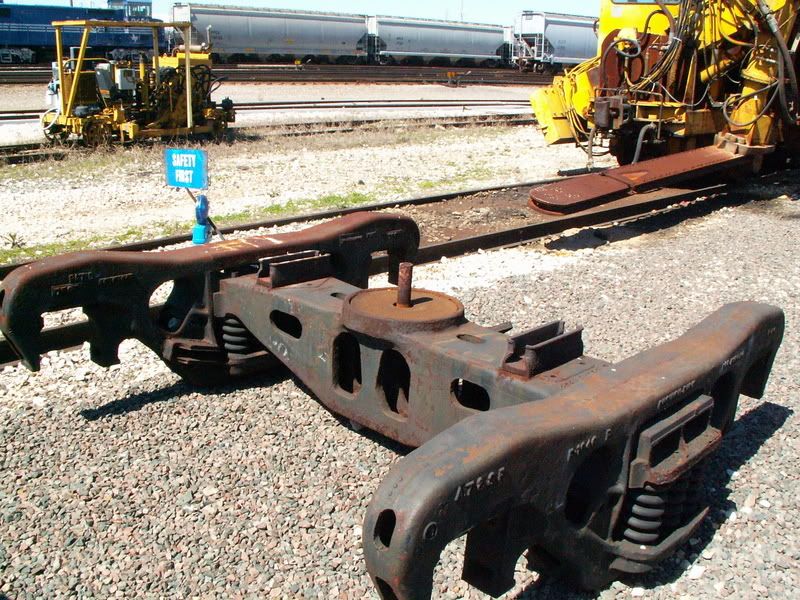
This is a freight truck, and you can see the bolster cup dead center of the span bolster…while not e