I have a small cirlcle layout with a few spurs. It will be some kind of shortline. My question is: what kind of shortline name should it be? The area is is Georgia somewhere but all the locomotives you can buy are always of the big class 1 lines. I’m no painting expert so I wouldn’t try and repaint my loco. At the moment I have a 4 axle GP39 CSX loco and a 45 tonner. Are there people who repaint locomotives?
As far as your CSX unit you can buy decals that you can patch out CSX.
What I suggest is finding a Athearn RTR CF7 in either Columbus & Greenfield,Chattooga & Chickamauga Mid-South or Ashley Drew & Northern.
Google search a current Georgia railroad map. You will be able to distinguish the shortlines from the Class 1 and 2’s and that should give you ideas.
Patching out loco markings is common amongst shortlines. Of course, patching a NS loco is much easier than a CSX loco.
There are people to paint locos. You might want to ask a local hobby shop for information on painters.
why is it hard to patch a CSX?
You could also operate it as a branch line of CSX or Norfolk Southern. Not too far from where I live, NS has a 5 mile branch to a quarry operation. Meets the mainline with a wye and a couple of sidings. Add a couple more industries and you have the equivalent of a shortline, but with NS diesels. They run the big ones down this line as the quarry operation generates lots of loads.
Paul
Shortlines tend to be spin-offs from Class One lines looking to offload the more expensive local work, while retaining the bulk of the linehaul revenue. So choose which Class One if the parent of your shortline, buy locos from that Class One and patch them. You’re good to go until management can afford a full repaint, just like the prototype.
SHORT LINES can be fun~!

This is actually a little used line at East Stroudsburg. The diesels are painted for “Delaware Western”, but NS trains come as far nortth as East Stroudsburg or maybe further, The steam locomotive comes from Steamtown in Scranton and is pulling an excursion train. (now pointed North)
A Short line is a good excuse to operate lots of different stuff on them. Amtrak will be absent, but excursions and tourist pax trains with odd assorts of equipment can be found there.
You would be able to build a small yard on one side of the table and use a view block so that you have a featured viginette in the front perhaps a small industry, a small station where tourists can get on and off.
In the Pix above The tour from Scranton arrived at East Stroudsburg where a picnic was held on the grassy ROW (it went from 4 tks to 1 tk), and the consist was then pulled south to someplace where it could be turned. The steamer was watered at E-berg by the Fire Department. A continget of DW RS-3s wat tacked ahead of the turned steamer for extra power up the hill. (They were probably on the tail end of the train when it came south.)
DW crews were woring on the innards of a signal bungalo, Probably to lift the crossing gates while there were futzing around with stuff.
ROAR
I grew up by the Morristown & Erie in NJ. As it’s name suggests, it had a connection with the Delaware, Lackawanna & Western in Morristown and was extended so that it’s other end connected with the Erie.
you might consider naming your railroad after the mainline it connects with and the town they connect at.
You’re fortunate that most branchlines don’t have unique locomotives. You should always be able to find a model of a locomotive the branchline purchased from a larger railroad.
All shortlines joined a Class 1 road somewhere and interchanged cars. Which makes a fine reason to have trains from the Class 1 road on your layout. And , repainting locomotives isn’t all that hard. I repainted this one from Union Pacific to Boston’s MBTA using just rattle cans and Microscale decals.
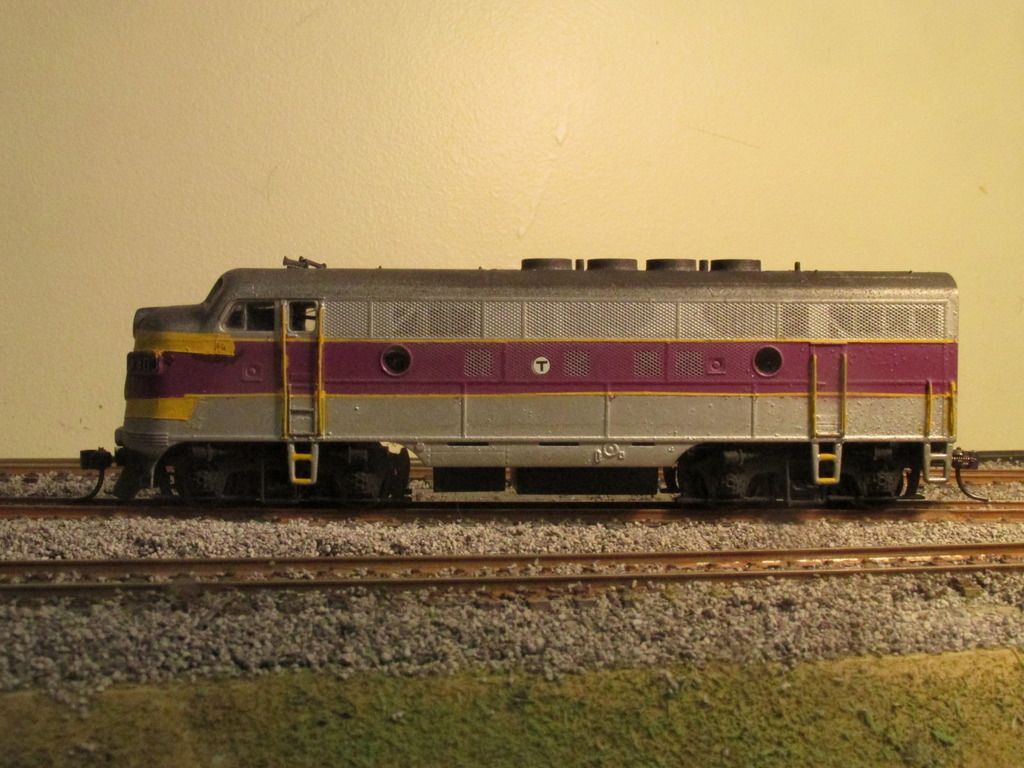
Well, painting a diesel is not easy in my books… I would do a bit of homework and read about shortlines in the area. If you don’t want to keep your CSX, one option is to swap the shell with another one.
Just for information. Short lines usually just operate the trackage a Port Authority buys it or leases it then hires a short line operator to run it. This is a means of saving jobs and the local economy.
Like all things railroad there are exceptions.
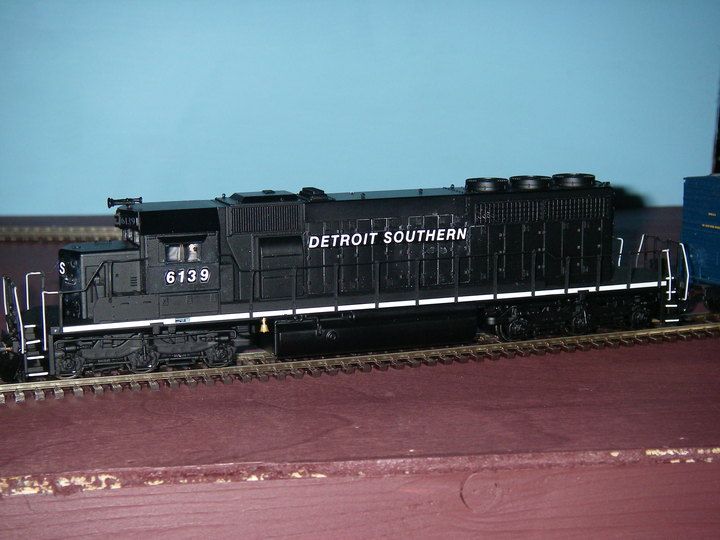
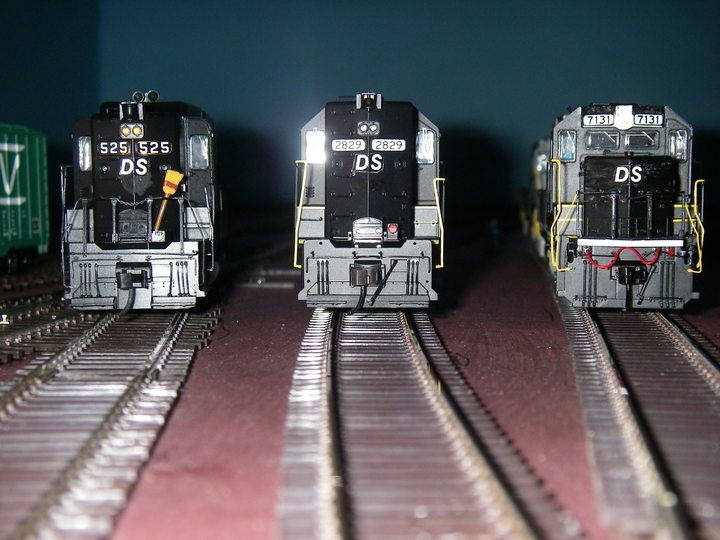
For my freelanced Detroit Southern my paint scheme is black with white graphics. My engines are primarily former NS, NW, NYC and IC black engines with the original lettering painted out by hand. I then decaled for my Detroit Southern. This way there is no need to do any disassembly or masking. Only need a bottle of black paint and a small brush.
By retaining the original engine’s number all of my engines also have correct numbers in the number boards.
Larry,
Yeah, that’s why I used “tend to be.” There are lots of variations. We’re actually discussing two different things here. My focus was on the relationship to Class Ones and you’re speaking more to who ends up with ownership and operating authority.
Even the definition of what a shortline is has changed drastically in recent decades. 50 years ago, a shortline was generally a small, independent RR, often focused on serving one location or industry that did not attract the attention of larger roads.
A few of those still service, but when we speak of shortlines now, most of the time it is some former part of a Class One that no longer is profitable enough for their accountants and managers to bother with further investment or service. Yet they serve industries that are vital sources of local jobs. Sometimes, there is a charter or other contractual obligation involved which requires continued service (although this is something that corporate lawyers, lobbiests and slus
I’m an old guy. To me, short lines mean this:
http://s51.photobucket.com/user/trainman203/media/image_zpshd3pqaiu.jpeg.html?sort=3&o=31
What never made sense is why a railroad with a industrial lead that terminates or originates 3500 cars a year or roughly 292 cars a month or around 73 cars a week will spin it off to a Port Authority…
There’s a lot in modeling a short line the best thing is needing one or two engines and no need for stacks,autoracks and other like cars. Even modeling a modern short line one will need lots of boxcars,covered hoppers, gons and tank cars.
The big blue CSX letters are often painted on rather thickly by the manufacturers. Simply painting over the letters will not really hide them. Not that showing through is a problem, but they stick out 3D wise because the paint is so thick.
I scrape off all factory lettering with a curved blade before patching, so NS is much easier for me than CSX. The lettering is smaller.
I model a short line with the exact same freight car list, but I added some hoppers. The diesels I include are 5. A GP9, NW2, SD45, C30-7, and GP38-2.
I intend to use the old failed SPSF paint scheme without the Warbonnet and replace the letters short line name in white. Replace the red number boards with white with black numbers.
I believe it will be easy. The era modern. If I’m modeling late 1980/90s the locomotives and cars will be mix matched patched, different colors.
I would patch a lot of Railbox and RailGon and have limited patched locomotives. By the 90s you would have less patch units.
On my SSRy the only outbound loads is rubber pellets in covered hoppers so,SSRy doesn’t own any freight cars.
Larry,
It’s all about reducing expenses while maximizing profit. Local switching is known for high costs, while bringing in limited revenue – until it hits the main, where the line haul portion of the trip tends to be profitable. If you can palm the beginning and end of the routing off to others – an operating contractor, government subsidy and/or outright public ownership – while retaining the more reliably profitable part of the business, then you’ll find a big fat bonus in your check from the management side.
Why that happens, or is allowed to happen, tends to get into politics, so I’m afraid that’s about all that can be said here.