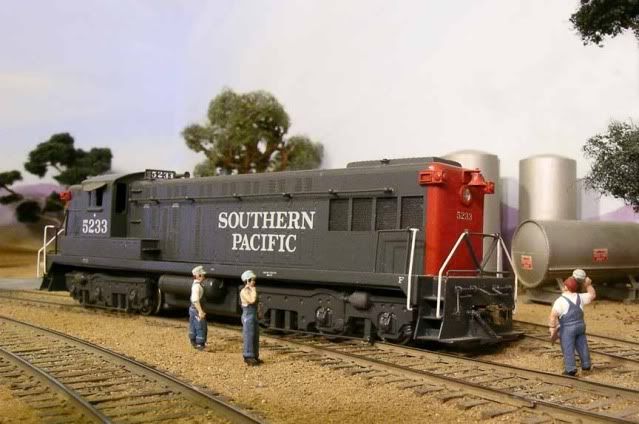
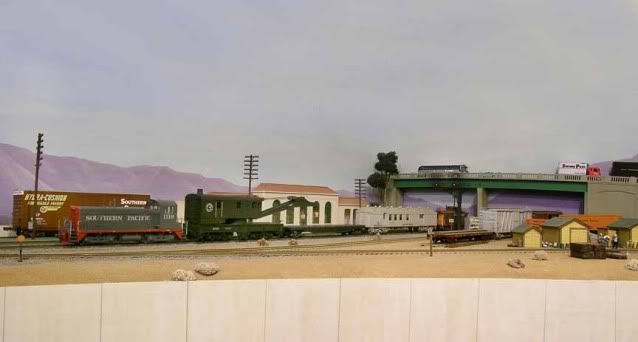
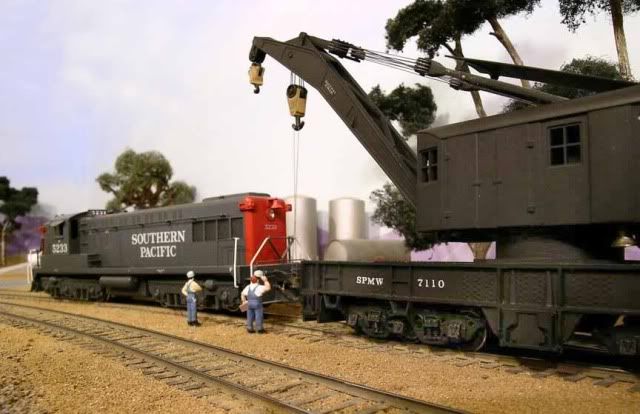
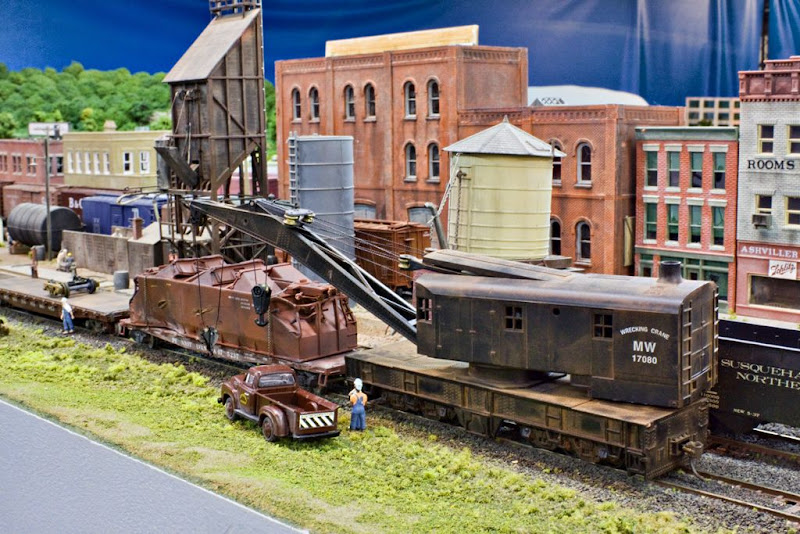
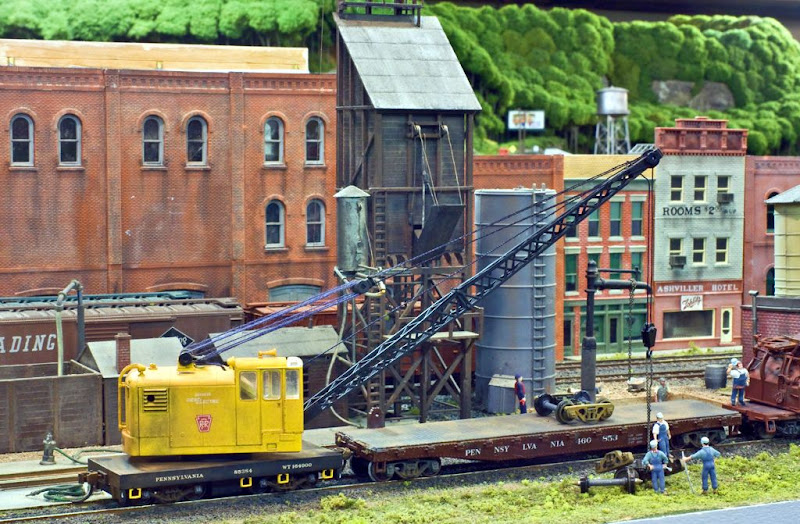
This is the Big Hook at work on my LA&SFV RR. I made up this picture story using my 250 ton steam hook going to lift a diesel’s six wheel truck back on the track. The crane is an old Athearn all metal model made in 1951, it is a very heavy model.
The Baldwin AS-616 derailed on the Gravel Pit track at Sun Valley. It was too far off the track for the crew to us a standard re-railer, so the a call went out for Southern Pacific’s, Taylor Yard, Big Hook to deal with the problem.
The Big Hook is on the way within a few minutes for a ten mile trip to scene of the derailment. It is kept on a live steam line 24-7, so when it is needed, it will already have steam up for running its giant hoisting machinery.
Within the hour the Big Hook makes its lift and the diesel will soon be back at work.
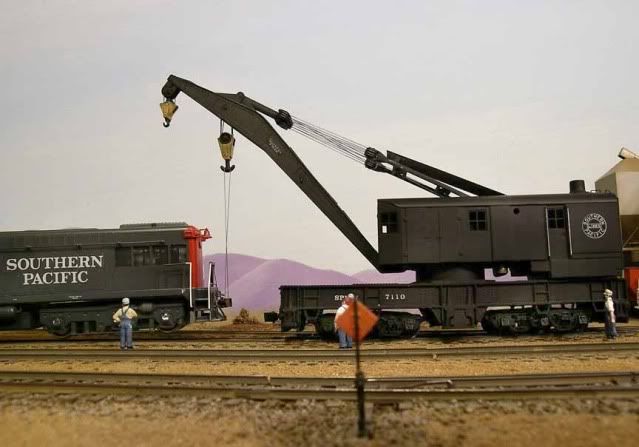
This side view of the lift shows that the brass diesel model is straining the springs on the Big Hook as it holds quite a bit of weight on the boom. The 12 cable sheaves actually all work holding the boom.
Lets see your work train and big hook pictures working on your railroad.
Wish I could but,C&HV doesn’t owned a big hook…If we have a derailment we simply call the closest R.J.Corman Derailmant Services which is in Columbus,Oh.
you have some great looking photos there. please don’t take this as a negative but isn’t it great how we can get all over the ground without tearing up any track at all? no broken or twisted rails, no bunched up ties, no furrows in the ground, no equipment buried in the mud… i wonder if anyone has ever tried to accurately model a real derailment. Gomez Adams, perhaps?
I happened to witness a derailment at a show one time that came about as close to the real thing as you can get, only the operator wasn’t trying to model it. This guy was running a large, what I would guess was a brass by the level of detail, O gauge, UP Big Boy when it decided to jump the track. I have to admit that I wasn’t prepared for that monster to come crashing through the scenery the way it did. The noise it made caught me off guard. I’m used to my HO equipment, which usually derails with a lot less drama!
The loco only had some minor paint damage but the scenery was a different story. I though it was going to plow right through the plaster hard shell and end up on the convention center floor. It took out a good section of real estate along with some trees and bushes and a lineside pole. About the time the whole shootin match came to rest, I made my way out of there for fear of one, possibly two, angry owners making it to the scene of the wreck. One for the loco and the other for the module. Didn’t want to be around for the “great debate” as to the cause of the derailment.
I’m not being picky or anything like that 'cause I am a great admirer of your work. I am just speaking as a former Quality Acceptance Supervisor, part of who’s job it was to make sure that all work was done safely and according to Code. As someone who has NO EXPERIENCE in real railroading, I see 2 potential safety problems with the situation.
1) Is that rickety old trestle going to be able to sustain the weight of the crane, its engine AND the weight of the wreck being lifted. Would it not be safer to have the crane on solid ground where the caboose is.
2) If the wreck happens to swing loose and smacks sideways into the trestle, there is the potential for the trestle supports to be damaged to the point of collapse, thereby taking out the trestle, the crane and its engine. At least if the crane were off the trestle, the load would swing away from the trestle. (Hopefully)
Sorry Crandell, but 13+ years after retiring, I still can’t stop seeing safety issues.
All that being said, I still think that it is a great scene. [tup][tup]
No problem, BF, and I did say it is an unlikely scene. At the least, on an angled lift like that, there would have to be outriggers deployed. There are no foundations for outriggers on a trestle. There would also be guy cables to keep the locomotive from swinging into the bents if the lift were to take place as shown. You’d have a heavy dozer with a cable attached to it down on the ground and to the side of the trestle, maybe 30 yards away.
Many years ago a Big Hook operator told me that the last thing the railroad would ever want to do is; “derail the Big Hook! Or worse, turn it over at the wreck site buy not having outriggers placed correctly.”
The speed on the main line for the prototype Crane is 25 MPH for the Southern Pacific, and similar speed on other railroads too.
I’m enjoying all these work train wrecker photos, thanks for posting them.
I got to see a real 1:1 scale derailment at the plant I work at. The rails used to load our tank cars were very close to a well used cooling tower and after years of the cooling tower wate