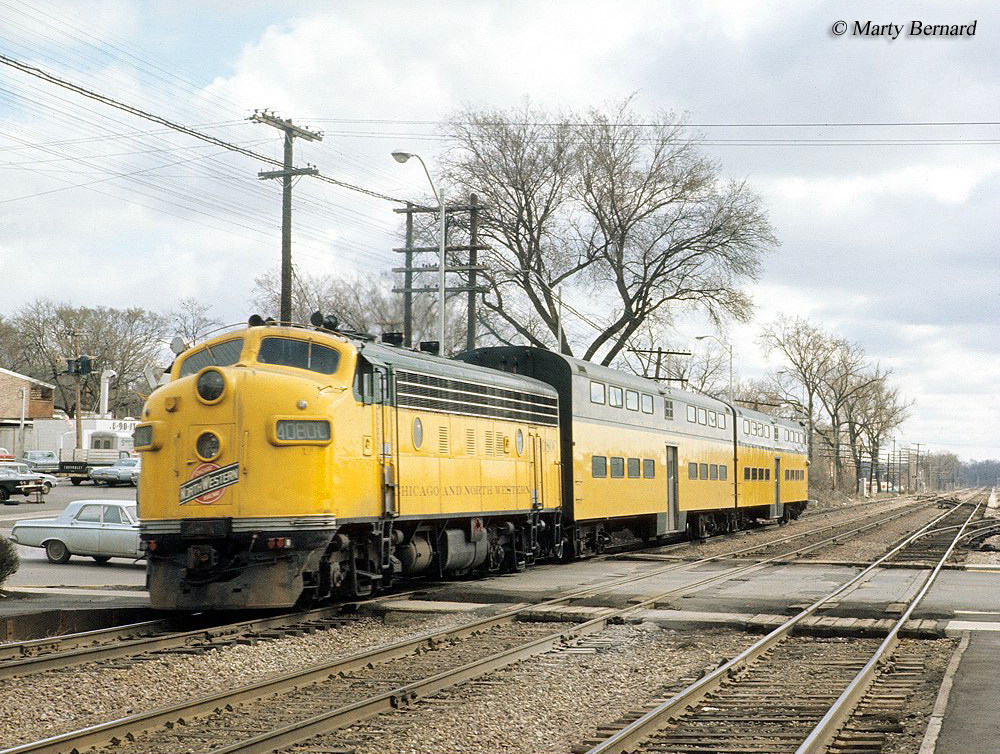
Here’s a couple
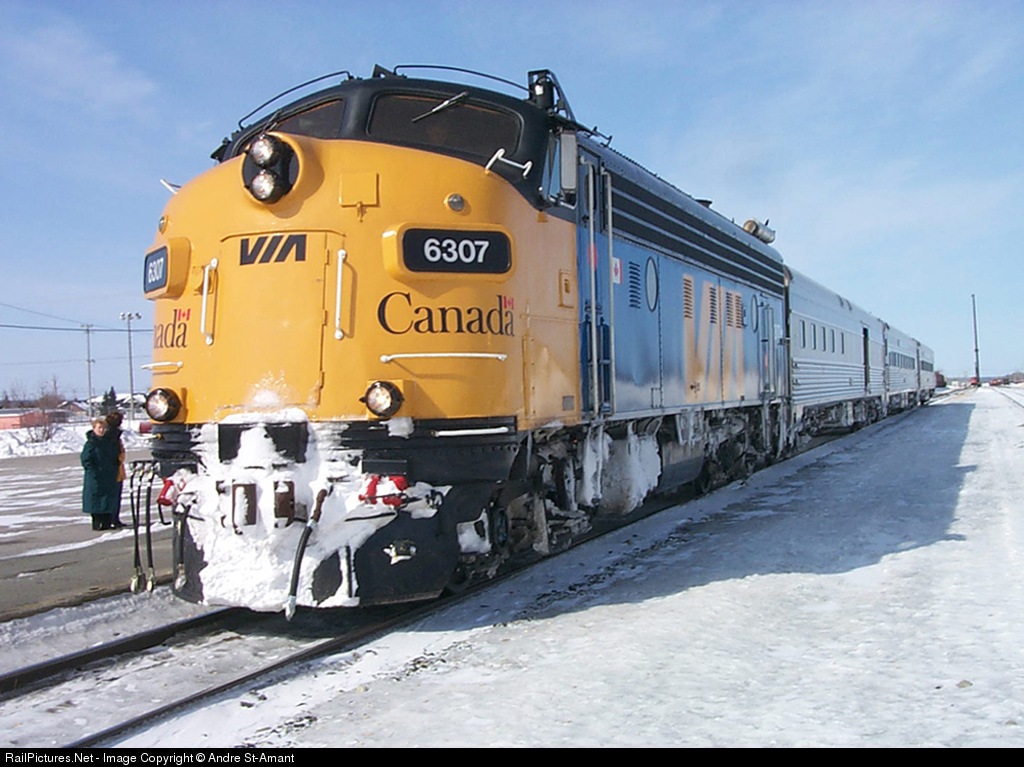
Not sure 6307 is an F

Here’s a couple
Not sure 6307 is an F
A Unit Alone.
Altho’ not an ’ F ', here is a CPR FA1 running alone on a freight just west of Montreal in June 1959 at the end of the herald tank car era. Steam would be gone in a year, streetcars in August.
Thank You.
I saw in a video where an old guy said that they didn’t run early diesel locomotives alone because they broke down too much. Instead they had to run them in groups so when one unit broke down the other units could keep the train moving and not tie up the line. I guess they weren’t as dependable as steam engines back then.
Hi,
Just a couple of additional comments…
To me, a single F unit in front of a freight just looks wrong. An AA or the addition of B unit(s) looks so much more appropriate - meaning better looking.
By the time the '60s came along, the older F and FT units were often troublesome and their reliability wasn’t great. So a second loco would be attached (if available of course) for added security.
Which railroads? I’ve seen lots of restrictions on steam engines but have never seen a speed restriction on a diesel when running in reverse (there may be restriction on an set of power when the engineer is controlling the move from the engine that is not the leading unit in the consist, but that’s not the same as running in reverse.)
A very nice view of a 244 Cab alone. St Luc Yard, Montreal.
http://www.canadianrailwayobservations.com/RESTRICTED/2015/November/images/cp/cpstluc3.gif
Thank You.
.
Great Black & White photograph.
.
Does anyone know what that load is on the flat cat immediately behind the locomotive?
.
-Kevin
.
Looks like what they called a “dish end” on the Reading, the end cap for a cylindrical tank of some sort. On the Reading these were usually shipped in gons fitted with special holding fixtures, but it could be that one is too tall for that and needed to be on a flat car to lower overall height.
–Randy
I’m going to revise my comments. There were restrictions on locomotives without a pilot or pilot sheet on the rear running in reverse. The pilot sheet is there to deflect debris and obstructions off the track and not having a pilot or pilot sheet would be a safety and derailment risk. Therefore running an F unit backwards on a straight away move might be speed restricted. Switching with an F unit would be no worse for an engineer, from a visibility standpoint, than switching with a steam engine. The reall problem was that it was very inconvenient for the groundmen to ride the engine or to work with the F unit.
Railroads do take the opinions of the crews into consideration, however opinions can vary. The traditional orientation for a brake stand/control stand in a locomotive is to the left side of the engineer, mounted at a shallow angle. The railroads recieved complaints that that was not ergonomically a good position, so they, in conjunction with the manufacturers, developed the console cab layout with all the controls infront of the engineer (a lot of the design based on European cab design). However that was a horrible arrangement for switching or operating in reverse. European railroads do way less switching than N American railroads. So several roads are going back to a more traditional cab control arrangement.
There are conflicts. It was proposed that the bottom step of the locomotive steps be lowered to make it easier to get on and off, the problem is that that would change the shape of the locomotive clearance plate and the
How did the engineer of an F unit see when doing reverse moves? Did he hang out the window since there were no rear winodws to see backwards as on a GP7 etc.?
It looks to me as if it might be the bell (part of the mechanism for charging) for a blast furnace.
Wayne
Yes. But then engineers on steam engines did the same thing and even engineers on hood units will do the same thing when shoving cars or switching.
No, why would he need to risk injury? There are safety rules in place as well.
Every engineer I worked with would simply turn his seat sideways and slightly lean back.Same for a steam engineer-some even made homemade back rests.
Railroads were frequently not concerned about what looked right or wrong, they did what was practical. I mean, modern ugly wide cabs look wrong to me but it’s imaterial really.
It wasn’t uncommon for F units to run with a single A unit.
Of course for the OP, it’s always whatever you want to run - it’s your RR. But if the OP “needs” a justication, railroads have done all kinds of things so in many many cases there is a “justification” chances are good.
Have seen a single F unit on a Southern RR work train back in the 60’s.
As often happens in model railroading, I think it comes down to doing what was normal / usual, as opposed to rare. Yes, you can find examples of a single F unit on a local wayfreight switching cars, but the vast majority of the time it would have been a diesel road switcher (or even a regular diesel switcher) instead.
Stix,Let’s not forget all things railroad comes into play seeing WA&G used F units in their last years of operation and railroads will do whatever they need to get a job done.
As a example a F7A was nothing more then a means so,if there was a motive power shortage assign F7A 2300 to the Wellingsburg turn or wait until you have a “proper” engine for that task and be sure to pay the assigned 5 man crew their pay since its not their fault.
But Larry what if there was no means to turn the cab unit for the return trip?
No worries a reverse move with caboose lead will work.The engineer will turn his seat sideways.
I’ve seen wide cabs on locals making a reverse back to the yard.The conductor and brakeman was on the platform of a caboose…I notice the engineer wasn’t even looking back since radios was being used.
If you are switching much, a BL2 isn’t a wise choice for a so-far-unstated reason: there is no walkway ’back’ from the cab along the bicycle chain guard AND no clearance through the engine room as on an F unit. Misery all around.
Probably the greatest user of F units carefully rectified them into workable road-switchers en masse as soon as higher-horsepower road locomotives came into use.
On a model railroad at least, it might be logical to use some version of a Draper taper that would not interfere with the bridge structure in the carbody sides. That was a surprisingly good way to achieve ‘necessary’ amount of rear visibility where it counted, and even a ‘poor’ railroad with hand-me-down cabs might be able to afford the surgery…
Thanks to everyone for keeping this thread alive with new and useful information.
.
As a practical measure, I might have to run my local wayfreights with single F-3s at the point. I need the trains to climb up a 5% grade with a 22 inch radius curve at the top. Only my Stewart/Kato F units are capable of pulling more than 5 cars and a caboose through this torturous section of track.
.
The switching will not be performed on the layout. The wayfreights just run in and out of staging. All the switch moves take place out of sight, so no real crime is being committed.
.
To me single F units on freights always looked OK. I think that is because so many train sets in the 1970s were freight sets with a single F unit in the package. These train sets were my prototypes when I was learning about trains.
.
Please keep the comments coming.
.
-Kevin
.