I’ve been absent from the hobby for about 8 years. Looking to build something in a couple
corners of my garage. What is the latest & greatest Model RR planning software in 2025?
I don’t have time for some complex learning curve.
Thanks BBF
I’ve been absent from the hobby for about 8 years. Looking to build something in a couple
corners of my garage. What is the latest & greatest Model RR planning software in 2025?
I don’t have time for some complex learning curve.
Thanks BBF
A pad of quadrille paper, a pencil and a ruler.
That’s all I ever use.
If you’re looking for something a little more sophisticated, then I’d recommend https://trackplanner.app/. It’s neither the latest nor the greatest, but it is free and effective.
How does planning software handle flex track? Is it easier than drawing with pencil on paper?
I don’t believe that it works with flextrack, which is fine for my uses but for others… not so much. Where it comes out ahead of paper is in the exact dimensions.
Nearly all CADD programs of any kind have a moderate to high learning curve unless you are already familiar with that sort of software.
The easier they are to use, the less accurate or less features they will have.
I would never count on exact dimensions, any drawing, CADD or manually drawn, only proves it will work in the available space. It does not provide reliable exact dimensions.
I am a manual draftsman/residential designer with 50 years of professional experience. I have studied CADD, but found it not necessary or effective for my particular needs.
I have also drawn a number of track plans for myself and other modelers over the years.
This is my currently under construction layout plan. It was drawn by hand at 3/4" = 1’-0" and then converted to CADD by a very experienced CADD operator.
A CADD program is not likely to insure your plan will work any more than a carefully hand drawn pan. And not likely be any faster unless you are already experienced with the software in question.
Sheldon
That is true of the more complicated track planning systems. The two that I’ve used (that is, the two that I could find for free) both did not have any kind of high learning curve. One of them was too buggy to use (https://traxeditor.com/), the other is Trackplanner which I already linked to. In my experience, a “carefully hand drawn plan” requires templates and the like, which I do not own. Perhaps part of what makes the program faster for me is because I use sectional track (ah, yes, the epitome of the toy train  ) and thus it is a lot faster to piece the sections together. In those cases, the CAD program almost certainly will make it be faster and take less effort.
Anyrail.
Ditto. Add a really good eraser, too. I have tried to use xtracad several times, and I cannot make it work. I guess what I really mean is I do not want to invest the time and effort to learn it. Especially since I have a BIG pad of quadrille paper just begging to be used.
I like AnyRail. It has extensive track libraries, including flex track.
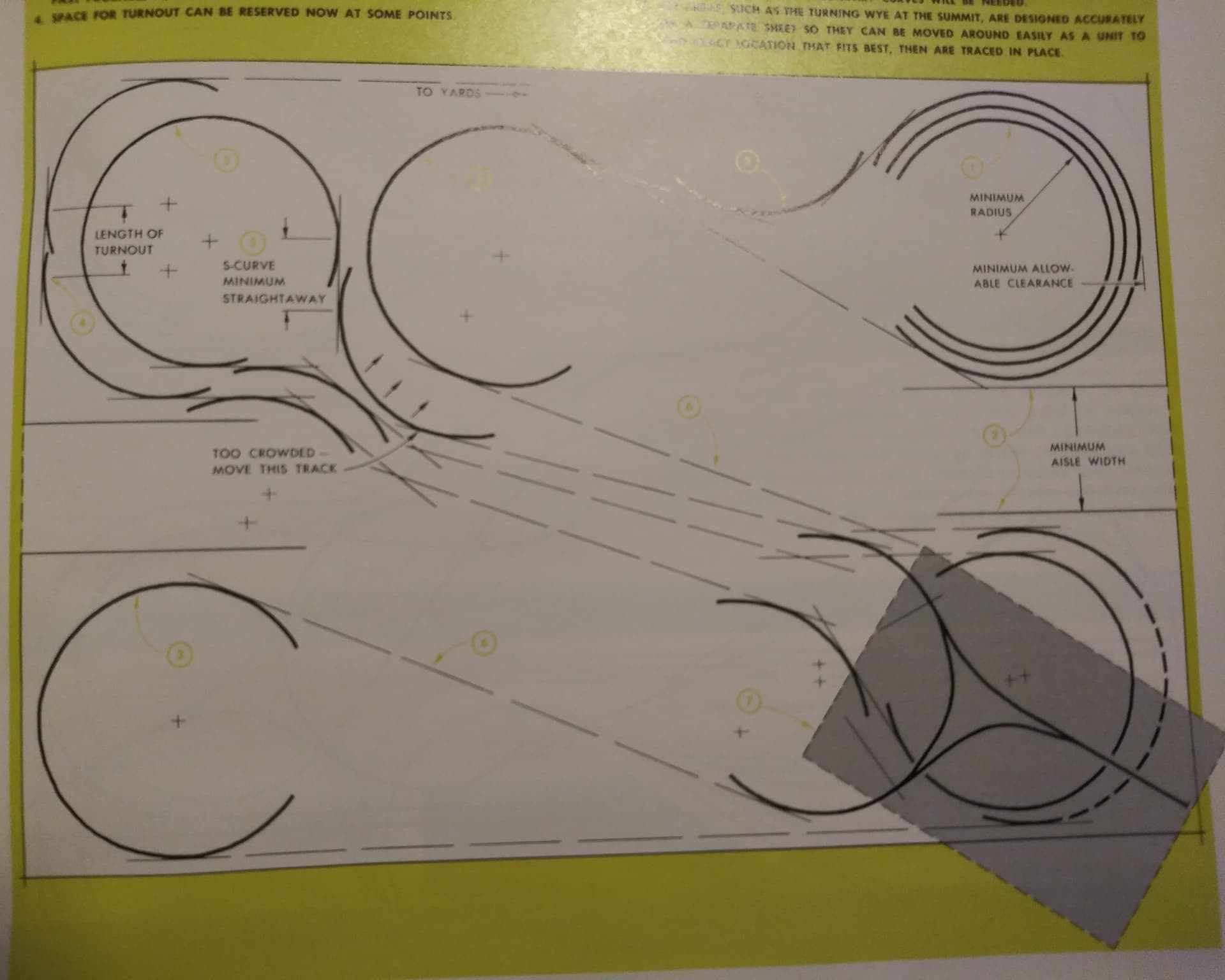
John Armstrong’s approach was to draw circles representing the min radii in those areas and then fill in the spaces in between.
You also need to accurately represent the lead lengths of turnouts, and appropriate distances of siding between frogs.
I use RaillModeler Pro. On a Mac. I receive regular updates. Very easy to manipulate and connect components. Has libraries from many different manufacturers in many scales…even Lionel 027 which I recently used to plan a little “layout” for my grandson. And does flex track. Builds you a list of pieces.
if you dont have “time” to learn a software, then why using it?
Just go with the flow. I build my shelf layout without any trackplaning software, why? iam using Flextrack, if i need something i cut it to length and go from there.
here’s a diagram from John Armstron’s Track Planning for Realistic Operation showing the use of min radii circles and tangent lines determining their endpoints. Flex track to connect them without needing details
I have that book by Armstrong.
Also another book written by a mechanical engineer which is great for
armchair modeling & coffee but complicated to get your layout actually up and running
except over a long period of time planning and construction including the benchwork.
But as I said in my other post, I’m trying to zero in on an appropriate space to build the thing.
Unfinished garage interior seems to be a No-Go according to most modelers on this forum
who have responded.
I wouldn’t be discouraged if your only option is an unfinished garage. You have already mentioned a work-around; storing your engines inside when not in use. That’s good. So is not soldering your rail joints. Depending on how you build/finish your layout, you may be able to put a light plastic tarp, like train show vendors cover their tables on Friday/Saturday nights when no one is there. That would protect against dust and moisture from above.
A second option would be to go modular. There are several modular clubs in So Cal, from NMRA standard modules to Free-Mo. Again, store your engines inside, build a couple of modules, add a staging track, and you have an interesting switching layout.
Your goal is to have fun within the means and limitations you face. Do not be discouraged, we have all faced similar challenges at some point.
One more point. You mentioned that you have John Armstrong’s book. I am so glad I got to see him present a clinic; it was great! Remember how he emphasizes “Givens and Druthers?” Well, you would druther have a finished layout space in your garage. But if that cannot be a given, figure out what other givens (solutions/ideas) will work for you.
I was thinking more of those heavy clear plastic curtains used for welding or other
critical areas in factories. I think they are at least 1/8 an inch thick. It would substitute
for a wall at about 3 or 4 feet from the front edge of the layout.
That saves having to do the whole garage where the opposite REAL wall is about
around 20 feet, or so from the front edge of the layout.
I suppose also covering the layout with thin sheet plastic would keep the dirt and dust off it.
I was never really clear about what Armstrong meant about “Givens and Druthers”.
Thanks
BBF
Givens and Druthers are fairly simple concepts to have in mind when track planning. Givens are things which have to be there, which cannot be compromised or eliminated: say, for example, a yard of x size. Druthers are things which would be nice to have, such as a yard of y size (y being greater than x).