A streamlined steam locomotive model from the Soviet era was put up for auction in Japan. The seller said it was very expensive on a Russian handmade HO scale and would not be shipped overseas. Does anyone know this locomotive? The starting price is 175,000 yen (about US$ 1,700). How about you millionaire?
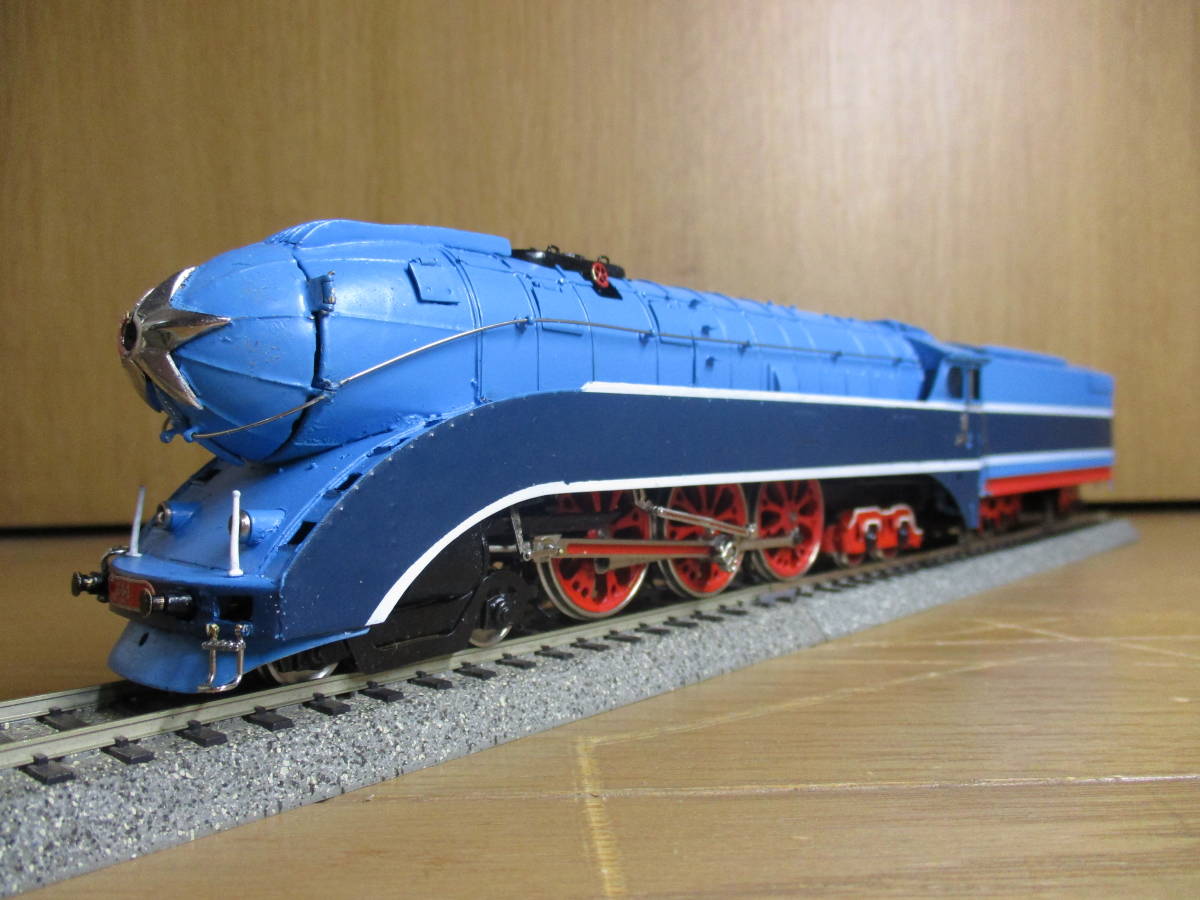
The prototype was as I recall intended for the October Railway, ruler-straight between Moscow and Leningrad (at the time) and unless I am mistaken is road number 6998. This is the one from Voroshilovgrad in 1938 (2-3-2V), the ‘production’ engines from Kolomna a year earlier (2-3-2K) were streamlined differently.
Due I think to the war this engine never was actually used ‘as intended’; I believe it survived to 1969 before being scrapped. (That it was not preserved, in a land that honors its P36s, perhaps indicates it was not quite the DR 05 competition intended…)
You’d have to have specific interest in Soviet steam to pay that price, but it certainly looks to me as if careful craftsmanship went into the production. I would ask if it’s scaled in 1:87.1 or slightly smaller so “HO gauge” track equals the Russian 5’ prototype (pity it’s not O gauge where 1:48 would be just right!)
Be interesting to see if this modeler also did the Kantola-inspired streamlined 2-8-4…
1 Like
I did not know about it, but I love it! It just screams “Soviet Union” from pilot to rear coupler.
The image has been saved to my idea file… thank you.
-Kevin
As I was digging around looking for a picture of a 2-3-2K for you, I came across something far better.
https://m.youtube.com/watch?v=8DgIm8jyDc8
(The “2-3-2B” uses the Cyrillic V; it’s not a different class)
i don’t think we ever celebrated streamlined steam in any of our subways…
Not only does it scream “Soviet Union” but to my eyes at least it screams my mom’s Sunbeam Mixmaster. Compare the speed control to the smokebox front:
Dave Nelson
I think it’s a response to Otto Kuhler.
It’s tempting to mention Ruthie Egnor, who would probably have ‘developed’ enough by then, but she wasn’t famous yet in '38.
Maybe not technically “in the subway” but - Philly Market East station:

–Randy
Ah, yes…Dagmar, built like a Dagwood sandwich…loaded.
Wayne
Just the first bullet train.
The first locomotive looks like a Russian version of the Hiawatha
I think that streamlining at that time had three purposes. The first was purely reduction in running resistance, which occurred in Germany and the UK. The second was a commercial appeal that flourished in the US. It’s a way to counter competing railroads, rising aircrafts and highways. (Is there any dissent?)
The third is enhancing national prestige (nationalism?). That was the case in Japan. There is a record clearly stated by the designer. The Soviet is probably this third.
One does wonder if these early streamlining efforts had any effect.
Aerodynamics of vehicles are still not fully understood because of ground effects.
At steam locomotive speeds there would be virtually no benefit to any aerodynamic designs. Even cars really don’t experience much effect below 100 mph.
Just putting a pointy nose onto the smokebox likely had no discernible effect.
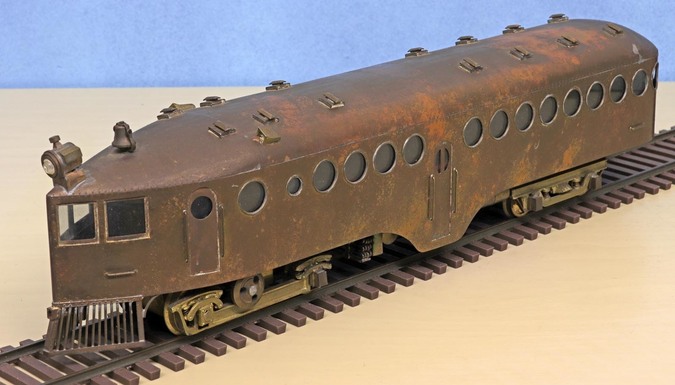
I think it’s exactly what Lastspikemike says. However, there were rolling stocks in the United States that was seriously developed to reduce air resistance. These are McKeen cars. The manufacturer tried to help the poor prime mover as much as possible and adopted this form. The photo is Ken Kidder’s O scale.
Hydrodynamically, if you move forward as it is, turbulence will occur at the rear end and it will become a resistance. On the contrary, the reverse has less air resistance. Well, this car shouldn’t be fast enough to create turbulence. The principle can be understood by envisioning the shape of the DC-3’s fuselage.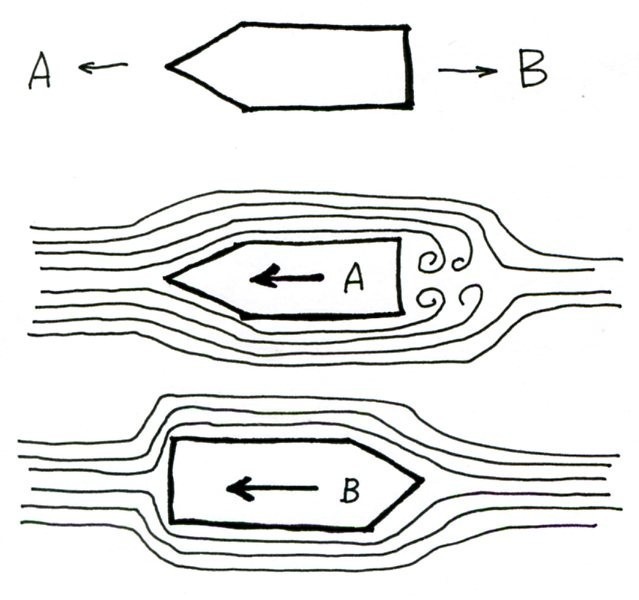
The NYC Jet car also has a shape that ignores this fluid dynamics. For a long time I believed that jet engines were at the rear end. The photo is from Kato and is N scale.

https://patents.google.com/patent/US49227A/en
Designed, appropriately enough, with reference to the hydrodynamics of crew shells.
A little ironically the aerodynamics of a locomotive improve significantly as you add cars to the train. For a simple illustration of this effect watch any NASCAR race, for a few minutes only as lengthy viewing will affect your brain.
While the total drag of the train goes up as you increase train length the drag of each car, and especially the locomotive, decreases.
There is no point to improving the aerodynamics of the front of the locomotive. These were styling exercises much like the fenders and fins on cars of the 1950’s.
The load gauge prevents any meaningful improvement in the drag coefficient.
Two or three RDC coupled in a train would be much faster, gearing permitting, or fuel efficient if maintaining the same speed as a single RDC. In this case total drag goes up but so does total power.
Aerodynamic drag includes form drag which is affected by frontal area and three dimensional shape and skin drag which is not, ask Professor Kamm about that.
PS the plow or cowcatcher helps reduce drag a fair bit because of ground effect although the height of the railhead interferes with this. For those doubting the airflow blocking effect of a slotted cowcatcher be aware that airflow through a vertical barred grille is substantially reduced at high speeds. Careful design can block airflow almost completely. A matrix style such as a modern radiator core exhibits similar reduced flow effects with vehicle speed. Of course cowcatchers were not designed with aerodynamics in mind so each fabrication would perform differently.
Yje fiorst wind tunnel was invented in 1871. The Wright Brothers used a wind tunnel to help design their airplane. Aerodynamics was much more understood, much earlier than people think. The biggest problem was getting a power plant that could produce enough power while beign light enough to lift itself,t he plane, and the pilot. Some of those relatively huge early hit or miss engines look liek they ought to be 100’s of horsepower - they’re maybe 10 for the bigger ones. ANd weigh tons. Great for grinding corn or loading the silo or pumping oil, not so great to power an airplane.
–Randy
Understanding aerodynamics empirically is much older than that. Any sailing vessel could sail into the wind at some angle the mechanism for which was not understood but known of for millennia. A sailing vessel is the only interface vehicle devised. The aerodynamics of the rig act in concert with the hydrodynamics of the hull and especially rudder and any specifically shaped keel. The slot effect utilized by dive bombers in WWII was understood empirically by sailors for millennia.
For a truly fascinating illustration of the sciences of hydrodynamics and aerodynamics (at subsonic speeds these disciplines overlap completely) watch a few Americas Cup 2021 races. You can safely watch the entire series and suffer no ill effects to the brain. Understanding how these boats work will require considerable contemplation. The broadcasters display nifty stats like true wind and apparent wind direction and strength and “hull” speed and VMG (Velocity Made Good which is the effective speed attained as if the boat sailed a straight course from one gate to the next which would be very slow if actually attempted).
Hydrodynamics has been well understood empirically for millennia.A very interesting example is found in the canoe designs of the Aleuts which use a reverse rake bow, built no doubt for ease of construction reasons, which we now know reduces form drag from the bow wave.
Leonardo de Vinci obviously understood aerodynamics.
The Great Leap Forward occurred at Kitty Hawk. After that aerodynamics was studied scientifically with huge advances made very rapidly. Sailing was also fully understood at the same time using the same science. CFD was devised. And then the late Great Chuck Yeager explored the difference between hydrodynamics and aerodynamics as then understood. Very fast submarines are not yet feasible.
Actually he understood their practical import relatively poorly in terms of practical utility, although he was one of the first to recognize how progressive aerodynamic resistance worked. Note his helicopter, designed by analogy of how a screw bites into wood – and how the equivalent in air works much differently in a number of respects. And heavier-than-air flight was held up by the ornithopter idea for centuries… even though nature provides perfectly good, and well-observed models: any bird can flap, but it takes smart birds to fly.
Actually, the Great Leap Forward by the Wrights was the realization – finally! – that the issue of practical flight was controllability, not propulsion or lift. The astounding thing to me, now almost as much as ever, was that Langley could use so much erudition, and do so much work, and spend so much money, and not produce something that would actually fly.
In a sense we’re only just catching up with the Wrights regarding variable-geometry ‘wing warping’ as a low-drag-loss method of control. But note the optimization of all the different expedients in the ‘meantime’ when materials science dictated more rigid construction of physical control and lifting surfaces…
A better Great Leap Forward, in my opinion, is Sikorsky with rotary-wing aircraft: he actually figured out what was necessary to drive the thing, and then implemented that.
Not the case. But a quite different use of aerodynamics (more precisely, gasdynamics) in conjunction with hydrodynamics is necessary to make that trick work… the amusing thing being that some of the early experiments were inspired by what the lemon oil does on crew shells.
The problem with submarin
Remember British usage refers to an aircraft propellor as an airscrew and that is precisely how it drives an aircraft forwards. Lift on each blade is one thing. The blades also have to be opposed.
The Wright brothers actually got it wrong by trying to copy bird flight.
Bird flight is much different to fixed wing flight, combining propulsion with lift.
Feasible and possible are not synonyms.