So Spain has an issue of theft of copper cables from this high speed rail line? How is that possible from an active high speed rail line? Just curious.
I can’t make heads or tails out of the article as to what was observed of the collision - very poorly described.
Probably written and/or translated by AI.
Too early in the news cycle, article was just posted at 10 am Eastern. From what I could glean sounds like track or wheel issue.
They talk in the article about a “faulty rail joint” and previous reports of bad rail conditions in that area.
Train that derailed was less than 4 years old and had been inspected January 15th. Story says it was only going 110 km/h at the time of derailment, which suggests to me that the collision of the train set going 200 km/h the other way, less than 20 seconds later, may have caused much of the injury and damage.
I cannot tell from the picture how the track on this line improvement was ‘structured’ – this does not seem to be full-HSR-style track, which would have very particularly-implemented continuous expansion ‘joints’ between welded rail stretches. I would like to see pictures and technical discussion of the ‘joint’ in ‘bad track’ that was supposed to have been progressively opening or widening in gauge (the story’s language does not clearly establish which to me).
Source: Reuters https://share.google/s2juPw7XCepKeU9zf
Sounds like the had a busted fishplate between 2 sections of rails and over time it caused the gauge to widen there. They found other damage to the trackbed in that area.
Probably need an article in a European railway journal.
The line is a high speed line with a speed limit of 250 km/h (155 mph). It is the line from Madrid via Ciudad Real, Puertollano, Villanueva de Cordoba to Cordoba. The accident was near Adamuz between Villanueva de Cordoba and Cordoba: HSR lines in Spain

According to Spain’s transport minister, Óscar Puente this part of the line was renovated in May 2025.
Puente said the cause of the collision remained unknown. He described it as “truly strange”, given that the accident had taken place on a straight stretch of track that was renovated in May.
Source: https://www.theguardian.com/world/2026/jan/19/spain-train-crash-adamuz-what-we-know-so-far
A defective rail joint and a fishplate were mentioned as possible causes.
I have my doubts at the moment. The information comes from unofficial anonymous sources, rail joints are largely avoided and replaced by electronic location methods. LZB (Line Control, continuous automatic train control) was originally used on the affected line, but has been replaced over time by ETCS Level 2 (ERTMS). Signals therefore only play a minor role as a backup.
Expansion joints on the line would be unusual, but could perhaps be explained by the high temperatures and temperature differences in Andalusia. But they don’t have a gap:Vossloh rail extension device
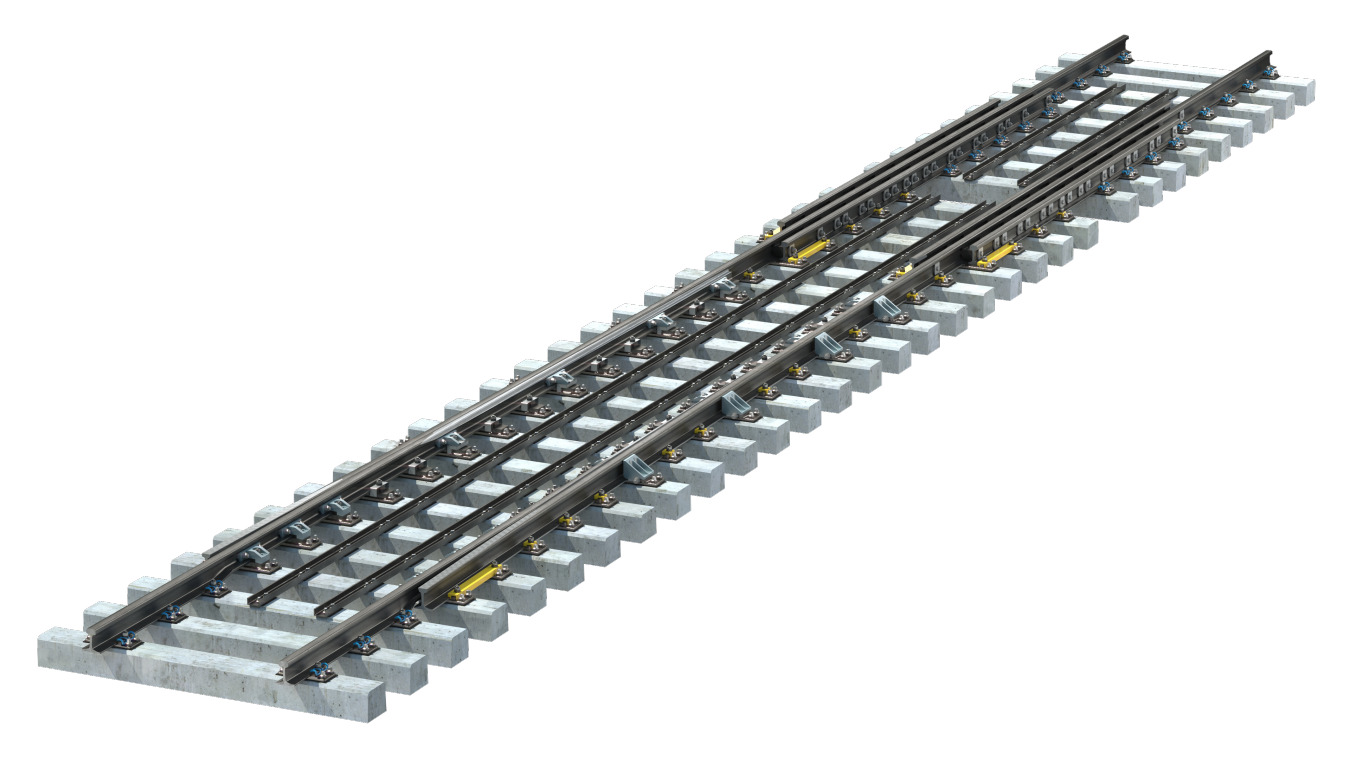
As for possible causes, we should wait for official information.
Gruß, Volker
Story has now changed to one train going 200 km/h and the other 210 km/h. Reports seem to be saying this was a straight section of line but the early pictures of the train that supposedly first derailed appeared to be on a slight curve.
The speed limit was given as 250 km/h; Volker inadvertently left out the ‘5’. I find it highly unlikely there would have been a ‘fishplated’ joint in the structure, unless there had been a broken rail temporarily fishplated pending proper conditions to weld it. The original story I read seemed to indicate there was some problem with the track geometry in that area. I don’t know the weather conditions around the time of the accident, or the neutral temperature used, but that will be part of the accident analysis.
Spain has extensive experience with true HSR; I believe they have the most track-miles after the Chinese. So I am prepared to doubt that this is incompetence.
I agree that the ‘expansion joints’ provided on a line of this speed would not have a ‘gap’ (nor should they provide a transient widening of gauge if not fully laterally secured), and I agree with what Volker said in German at the end: we should wait for the Spanish technical analysis and report.
1 Like
Thanks for the corrections. A number of keys on the notebook’s keyboard stick. ‘5’ ist one of them. Because of Windows 11 I need a new one anyway.
The mistake with the last sentence happened when I got in a hurry but thats no excuse.
Regards, Volker
If you’re saying that you want a new computer so you can get Windows 11, don’t bother. Windows 11 absolutely sucks.
Windows 10 is sufficient for me, but it is no longer supported and my old notebook is not compatible with Windows 11.
1 Like
I would stick with it until it absolutely no longer works. Windows 11 is really quite horrible; I wouldn’t have gone to it except my computer had begun to sound like an EMD GP9 and I needed a new one.
1 Like
I had no trouble with it though I saw no improvement over 10. But I don’t play games. On a new Chromebook, its OS ((name?) works nicely.
I’ve found that Windows 11 definitely bogs down my computer a lot more. My new computer is basically the same specifications as the old one, but Windows 11 has difficulty dealing with Paintshop Pro, AutoCAD, and sometimes even Audacity! 10 was far more effective in those regards. That, and the user interface has been changed, and for the worse–though that could just be me being used to 10. Plus, it’s bloated what with all the “AI” junk–which they did install into 10, but it’s awful wherever it is.
To be honest, though, just because it’s no longer supported doesn’t mean that it won’t work. I have a computer–a very nice one, top-of-the-line back in 2009–that runs Windows 7 and does so quite well. It doesn’t give a fig that 7 is unsupported; it runs it anyway.
New details: the ‘rear’ of the southbound train was the first to derail, with the back end diverging enough not only to foul the northbound track but to promptly derail and deflect the northbound train.
This may be related to the ‘missing wheel’ that was reported. It suggests to me that whatever the problem was, it was progressive and not a ‘point defect’ on one car of the train, unless that defect damaged the track or created a ‘derailer’ at a point on the track.
It is difficult to imagine a control system that would recognize a progressive lateral derailment of this kind and react quickly enough to stop a ‘facing’ train already no more than a few seconds away. Many of the possibilities might introduce more risk to passengers from the required deceleration rate for a ‘false positive’ actuation.
I have Windows XP and Vista machines - they have not been supported for years but they still work. The problems are that some of the ‘newer’ applications do not work with the historic software. Since the XP machine dates from 2003 and the Vista machine from 2008 - I feature it will be another decade before user software moves beyond W10.
I’m sure of that. To be honest, I don’t get why they moved away from XP.
One word money. Microsoft needed revenue and selling a new version of windows is a guaranteed money source. 200 bucks a computer is one hell of a reason to force people to upgrade.