Now that I’ve been running my layout for a couple of years, I’ve figured out the best type of staging for my operations is a return loop “balloon” at each end of the railroad.
The above illustration shows only the staging level… there’s a lot that goes on between the balloons!
These work best because the WM did a lot of run through traffic with the N&W on the west end, and the Reading on the east end. This allows me to run eastbound trains out of my yard at Ridgeley with Reading power, into the east staging yard, and they’re all ready to come back during the next operating session without having to fool with the train in between. I just turn the waybills, and everything is set. Likewise the westbound trains.
That’s ideal for a point-to-point scheme. For a continuous circuitous route, double-ended is great, especially in “small spaces” like a bedroom or garage.
I didn’t plan to use big staging in my new track plans, in fact I prefer to use a big yard at the starting point and a second one at the end of the line,.
The trains run through traffic like yours going to the east or coming back to the west. These yards act as balloons and the general arrangement is like yours.
My start and end of the line are really return loop whith integrated yards which acts as stagings.
I’m planning on staging some what similar to yours. What are the radii of those curves around the balloon? Do you have problems coupling and uncoupling on the curve? These are some concerns I’ve been having in designing mine.
Why would he try to couple or uncouple on a staging track (which is intended to hold a whole train, already assembled and ready to go)?
Even though several parallell hidden staging tracks superficially may look like a classification yard (several parallell tracks, turnouts forming a ladder of some kind), they are not really classification yards.
Staging tracks can be as curved as you like (except that they should not be so tight radius that trains will derail, since it often is hard to rerail cars on staging tracks …).
If you need to add or remove cars from trains in staging, you can always drive them out onto the layout and swap cars there, before putting the train back into staging again.
for Mark and Mike who are making an answer difficult. It all depends what you are doing in your staging area, during an OPS and before it; in the ante session. And of course if you do like to have an ante session at all.
Staging tracks are just holding trains. If you like you can change their direction and consists before starting an operation session. Mike is right, doing so needs coupling and uncoupling; which means you have to have access and broad curves (radii = 5 times the length of your longest car). But this job can also be done in an ante session at another convenient place on the layout. So you do not have to worry much about access and radii; so the space allocated for staging can remain modest.
See it as organising a party; you will have to have the coffee and cakes ready before the party starts; and having done the shopping as well.
If you don’t like an ante session your trains must be re-used without switching. A balloon, just some double ended sidings or no staging at all (David Barrow on one of his previous pikes, Lance Mindheim on his East Rail), all can be done. The balloon tracks of the OP’s layout have pretty long straights too; here the switching is done if needed and wanted.
When your train leaves staging it can enter a division point yard; the whole train can be reblocked or rebuild now. And of course if you don’t want to perform this job either; take the train as it is and decide which car has to go to which destination.
I prefer the holding tracks on a less visible place. More general I always loved a point to loop kind of layout with a lap connection. The lap connection made it possible to run as long as I wanted, while having just one loop “forced” me into doing terminal switching also.
Balloon staging at each end of your railroad can be ideal as long as you just take trains into staging, just to ‘re-use’ them later. I suspect that your staging is going to be ‘hidden’ for the most part. My layout has a double ended staging that each ‘end’ of the railroad connects to. Also, the staging is about 6" higher and behind a small town scene. A large bluff about 8" high hides the staging, but it is visable standing on a step stool. This gets rid of the access issues, and the operator can ‘see’ what he/she is doing when a train is entering/leaving staging.
I have even added ‘off-line’ staging(drawers) so that freight cars can be cycled on/off the layout. After operating the railroad, I run a clean-up session to re-stage the trains(and find miss-routed cars). This usually takes about 30-45 minutes. The railroad can handle about 100 cars before being clogged up, and I have over 300 cars that are era appropriate. This way, a car that goes off-line to the other end of the country does not show up again on the next operating session.
As with any staging construction; build the staging, and test it before you cover it up! My staging uses Tortoise motors for positive turnout alignment. I have bi-color LED’s on small panels to verify that the entrance/exit routes are correct. If your staging is hidden, an optical detection system or small home security system may be of assistance.
If you have a group of tracks where switching chores are performed for storage, classification, making and breaking up of trains, etc., what you have is a yard.
If you have tracks used to represent the rest of the railway system (considered off-scene), and may hold multiple complete trains, it is staging.
If the staging is subject to human intervention (0-5-0 handling), it is fiddle staging.
So, if you’re talking switching, you aren’t describing staging.
Lee, those two balloon-track staging areas take up an awful lot of space. The usual solution is to have one on top of the other. One disadvantage of balloon-to-balloon staging shows up when open-top cars when the predominant direction of the loads/empties is one way, such as hoppers carrying coal from mines to port. One either removes/adds the loads after each trip or one ignores the problem; or there is a continuous connection between the two balloons.
Edit – Nevermind my comment above if you have another deck above the staging so the space above them can be used for more layout.
I’ve operated on layouts with both single-ended staging and double-ended staging. Both methods work, but with single-ended staging a train can only be used once during an operating session. The trains are returned to their starting points between sessions. With double-ended staging, trains can be used multiple times and by default they return to their starting positions. Single-ended staging, however, “liberates” layout design because the route doesn’t need to return to the same staging point.
As long as staging does what it’s intended to do, it’s good - and more is better.
On my layout, staging takes several forms. From simplest to most complex:
Spur connected to both (directional) main tracks - holds EMU cars awaiting their timetable runs to the visible world.
Long double-ended sidings parallel to the thoroughfare track, hold several trains each, fed from a reversing loop but not part of it.
Double-ended yard, with one dedicated track for each passenger consist. Some turn on that one and only revese loop, most (DMU) don’t.
Back-in, back-out staging, works something like John Armstrong’s reverted loop, stub-end tracks where the locomotive is always on the end away from the bumper. One of those stubs is a cassette dock, the cassettes providing lots of additional off-layout staging.
Dedicated branch line with passing siding and train elevator, to get the loads back to the mine and the empties in position to reappear at the correct tunnel portal.
With the exception of those unit coal trains, which change engines, nothing gets physically switched or ‘fiddled’ in fixed staging. ‘Fiddling’ is only done to rolling stock in cassettes. Freight cars in staging lose their waybills and are given new ones as appropriate. Live loads go to cassettes to be unloaded (or vice versa.)
Since my layout was designed around a specific prototype, including its published schedule, staging design and quantity was the first priority, not an add-on or afterthought. In truth, all of my construction to date, and everything I’m likely to complete in 2010, is and will be located in my Netherworld, trackwork which isn’t meant to see the light of day.
Again playing with words is fun; but do it right. If the staging is subject to human intervention (0-5-0 handling), it is fiddle staging. You can not use the part between brackets as the main issue. If staging is subject to human intervention also by changing a consist without using hands, it remains IMHO part of staging,
So you can switch trains in staging, mostly done before an operating session, as I described rather carefully. All activities dealing with setting up or holding trains before they can play their role in a “formal” OPS are considered staging by me.
BTW the word yard is a tricky one too. I think about classification or blocking while others are calling every thing with a couple of tracks a yard. But again even staging yards that are used for holding only are called yards, even by you.
The word hold is where we disagree. Human intervention is more then just holding.
You gave three definitions and one conclusion. Problem is the definitions by the LDSIG don’t speak at all about what is happening, or what is not happening, during staging, with exception of fiddling.
So your conclusion is your conclusion and not at all promulgated by the LDSIG.
When switching is done in a yard (definition 1) it does not mean that there is no switching outside a yard. The most common errors by “students”.
BTW lots of words have different meanings; like city, yard and apparently also staging.
I disagree with your opinion that the LDSIG definitions don’t address what is happening in staging. Each of the definitions has a verb describing what is happening. Yard definition has the verb “switching.” Staging definition has the verb “holding.” Fiddle staging has the operative “is subject to human intervention.”
My conclusion is my conclusion. I had only said the definitions were LDSIG’s. Nevertheless, my conclusion is logical based on the LDSIG definitions. In shorthand: yard equals switching. staging equals holding, fiddle staging equals holding plus human intervention. So, I rightfully concluded that staging does not equal switching.
I never said that switching didn’t occur outside of the yard. I was comparing the difference between yards and staging. … And I ain’t no (sophomoric) student,
Don’t be condescending. I’m not the idiot you seem to think I am.
One conclusion is inevitable: staging is more then just holding.
You said, not me, switching was done in yards so it has nothing to do with staging.
Language is more then definitions, the way we are using words is often a bit different.
On Tony Koester’s layout trains, that have entered staging, have to be turned and reblocked before a new OPS can start. This involves fiddling (by hand) or switching (hands off) on a convenient place on a layout. That’s why some people chose for a different kind of staging.
Just stating, as you did, that switching has nothing to do with staging and is done in a yard, is not adding anything to the line above.
The problem, if it is a problem, is that the phrase “staging yard” has come to mean different things. Anytime one term describes two or more different things, these kinds of discussions are gong to ensue. Maybe we should be putting “staging” in quotes?
I think of the primary distinction as being between active versus passive. Pure passive “staging” is the classic holding of a train, intact, so that it can make its appearance on schedule. That notion suggests the train is hidden until it is, well, not hidden. That is the oldest kind of staging and was perhaps first written about in an analytical way by Linn Westcott in his “If I Had a Million” trackplan. He did not use the word staging – I think he called them holding tracks - but the idea is there. For that kind of passive staging a curve or helix works fine since you have no reason to couple and uncouple. Obviously you need to have a large enough radius to avoid string lining the train on restarts and a gentle enough grade that you can restart the train. Since stuff happens in this world some kind of access is wise.
Passive staging does not necessarily involve running the same train over and over again. A train can be made up in a yard and sent to staging for example, but the staging area itself would be passive But on some layouts trains such as commuter trains are run from one staging area to the next and the consist never changes, more or less just like in real life.
Active staging is in essence what goes on in a rail yard but because it is not a “modeled” yard you might or might not feel the need to have a locomotive do the work and you might or might not keep the wheels of the freight cars on the rails at all times. The realistic movement of trains is not the point. If you use a sector plate or casset
I’m using reversing loops at each end with 3 tracks in each. The tracks are long enough to hold 2 trains each. I recently installed detection for the tracks as they are on a lower hidden level. My layout represents 3 small towns on the mainline so staging allows for lots of traffic.
Thanks for all the feedback. Perhaps a bit of clarification is in order.
In the perfect world, I would have a separate room where more active staging could be performed, as Paul describes. It would be great to spend time between sessions re-blocking trains to speed up handling in the division point yard, but given that my givens don’t include vast acreages, I’m using the space below decks to use as storage and staging. The balloon tracks at the west end each hold 35 or so 50’ cars, which is actually longer than any of the surface sidings can handle. This will be useful if the yard above gets clogged, I can pull excess cars out into an extra train just to get them out of the way for a bit.
There will be zero switching in the balloon tracks. In and out only. In fact, the exit throat is constructed with “floating” points, so the trains can pretty much only move in one direction. I’m including a crossover and stub tracks to manage any problems like a random uncoupling, so I’m pretty confident the system will be idiot proof (enabling me to run my own layout [:)] )
To me, defining staging as “active” or “passive” is adequate. Mine is passive.
Lee, you can re-block trains in staging without ever touching, or even looking at, the actual rolling stock. It’s all done with car cards and waybills.
Except for that ‘scrambled extra’ dispatched to staging to get the excess cars out of the way, every train that gets parked in staging should have its waybills checked, turned and/or pulled as necessary. The way I do it is to check each waybill.
If the car was dispatched empty to pick up a load off-layout, the waybill is turned. That car is now a load, to be handled in accordance with the waybill instructions.
If the car was dispatched loaded in captive service, the waybill is turned and the car returns to the shipper for another load (or vice versa.)
Some cars cannot be loaded or unloaded on the visible layout (auto racks, container cars, large high-speed reefers…) Their waybills are turned, since one side is marked for UP staging and the other is marked for DOWN staging.
There are a few 4-sided waybills, mostly cars with live loads. Those get turned to the next side. The fourth side reads Route to DOWN staging, cassette dock.
If the card was loaded when it arrived in staging, the waybill is pulled and a different one is inserted. The car may now be an empty for loading at a visible spot, or a load going to a visible spot. It will be handled according to the waybill instructions.
So far this system has been working rather well, using a lot of waybills I made up during a tour in Thailand forty years ago (and some of more recent origin.) Did I mention that my operating scheme is pretty much set in stone?
Chuck (Modeling Central Japan in September, 1964 - with passive staging and active waybills)
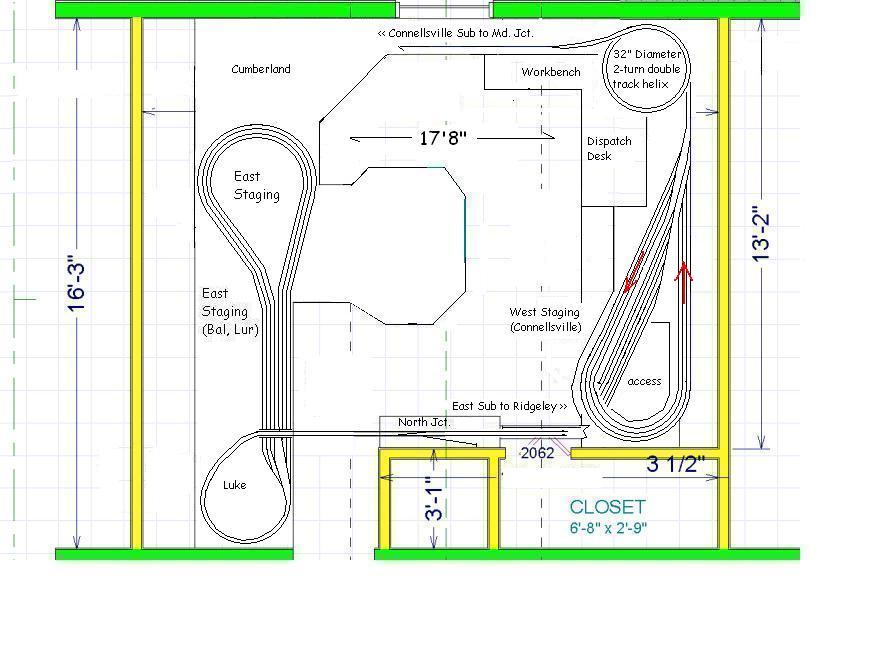 The above illustration shows only the staging level… there’s a lot that goes on between the balloons!