I know this probably has been covered before, but I can’t seem to find it. I have read in the past that Stewart shells fit Athearn drives. I have a Stewart F3 shell and a BB Athearn F7 drive for a project and I was trying to assemble the combination and can’t seem to get them to come together. What do I need to do to recitify the problem? Any help would be welcomed.
…buy a Stewart drive. They are one of the finest drives out there…and had cheaply. David B
The Stewart shell attaches to the chassis by the porthole glass assy. The clear plastic has 2 strips each side that provide “latching” to the Stewart frame. Even if the shell physically will fit you may need modification of the catch or filing of the frame. Some added styrene may be needed as a “shell” rest/ stop. The fit is rather tight, the Stewart has 4 milled vertical slots to accomadate clearance for the latches/ strips.
BTW, I agree w w/ Dave that the Stewart drive (both the early Kato and the Stewart/ Bowser are unbeatable in possibly the best drives available. Nothing in my roster of over at least 50 units compares to the drive quality and running properties. You may consider putting that shell on one. There are numerous ones available and quite reasonable $30- $50
The Stewart shell is a drop-on fit for the Athearn Genesis drive, but not the older Blue Box drive. The reason for this is the Genesis/Highliner shell was made to fit the Stewart drive back in the early/mid 90’s, but then Athearn bought the Highliner tooling and started making their own drive to fit, creating the Genesis model.
You can probably make the Stewart shell fit the Blue Box drive, but it will take some modification.
I agree with Dave and Bob. Forget the Athearn drive. Purchase yourself a Stewart F-unit chassis (with Canon or Buehler drive) off eBay. They run smooth as silk.
Tom
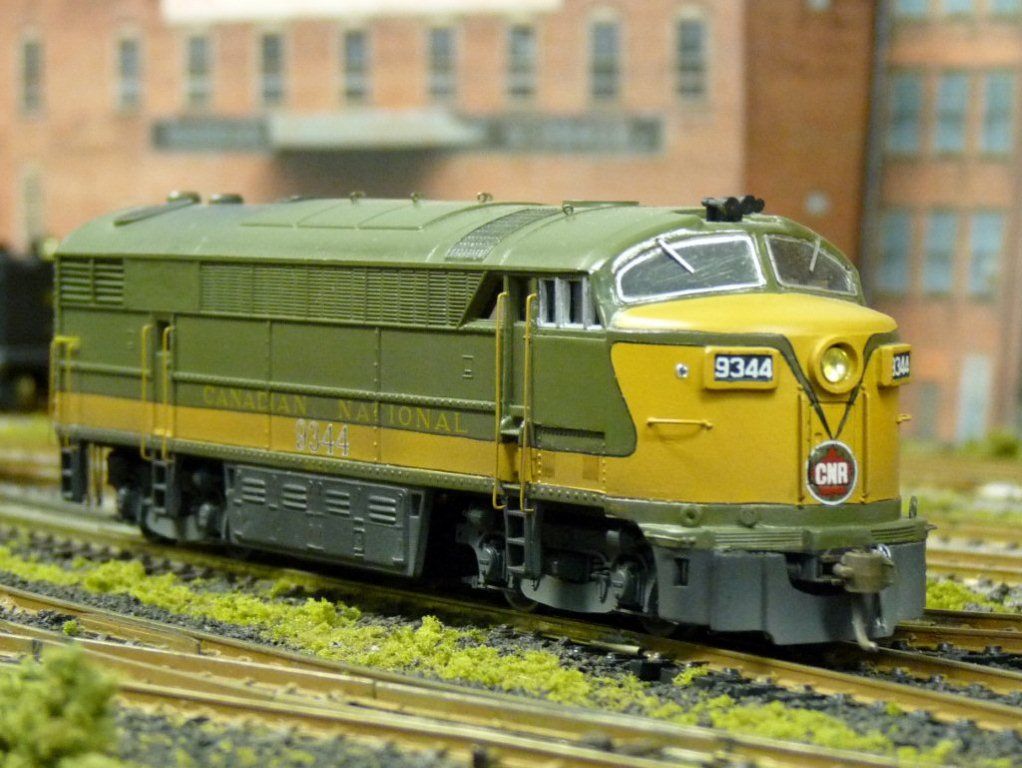
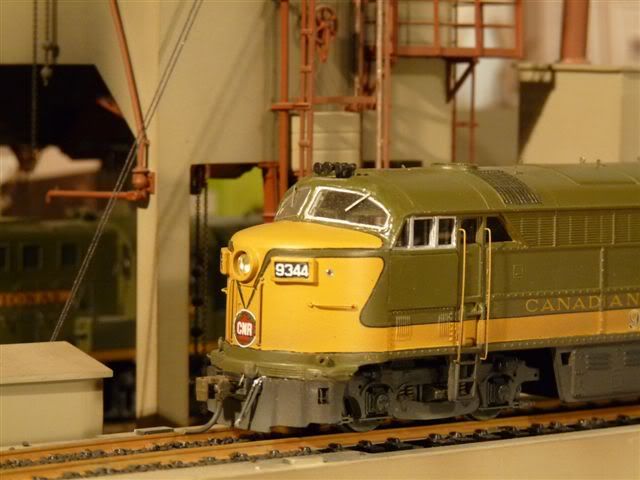
Here’s a Rivarossi C-Liner shell on the running gear of a Stewart Baldwin AS-16. It was pretty-much a drop-on fit. The sideframes are from Detail Associates:
Wayne
Another vote for Stewart. Silky smooth.
I concur…Those are smooth drives.
The main reason I was looking at the Athearn drives is that I am intending this to be running display. Should something break, I would probably be the one that would need to fix it. (There aren’t any people in the group besides me that are model railroaders.) Athearn drives are very easy for me to fix. (I have worked with enough F7 drives over the years, I can almost fix them blindfolded. My Tythearn GP20s also use Athearn drives (GP35s) that use the same trucks at the F7.) I don’t know anything about Stewart drives.
Just looking at what I have, the only modification I see right off is the “pegs” on the sides by the trucks need to be removed. Other than that it looks like everything else would snap on. If I have missed something, let me know.
Athearn BB drives have their issues that need to be corrected if you want a running display. Namely the sintered wheels, live frame, noisy gearing and ancient motor. The stewart drive is the finest available and has zero of these issues. Penny wise… David B
David,I know from first hand experience the older BB drive is far better then any drive I would care to use simply because of the wear and tear constant running causes.
I will run my BB engines without concern 6-8 hours nonstop daily for all 7 days of the county fair and I will run my Atlas and P2K no more then a hour or two before replacing them with BB engines.
In this case a penny wise is the one in your pocket for such extended operation.
I have many different kinds of BB drives for my own layout. (3 F7s, 5 GP35s, 4 SW7s and a SW1000) I love them all.
I have a P2K GP18 engine that I had to replace the drive on when it quit working after I upgraded the drive wheel gears so I can agree with that statement whole heartedly.
I have never had issues with the wheels. The live frame is not a problem for me as I won’t run DCC for this project. (I don’t even run DCC on my own layout!) By the time people get into the room and if the track is laid correctly, I don’t think the small amount of noise should be a problem. The motors may seem “ancient” to some people but I have only had to replace 1 Athearn gold flatside motor due to a failure.
I’ve got to vote for the Stewart drives too. Genesis F units have pick up issues, and BB frames have all the advertised issues. [:(]
To make a BB frame as smooth and silent and amp miserly as a Stewart would require new wheels, flywheels and a more efficient motor, outstripping the cost of the Stewart. In modular displays, I’ve run days with Stewart/Kato/Atlas units without even a wheel cleaning. They are not hard to work on either,just different…put them to the test, broaden your horizons! Later you’le thank us![;)]
Sorry but I vote for the Atearn drive.Especially since he already owns one and they can be tuned to run silky smooth if your willing to put an effort into it.The money invested in the Stewart drive will more than cover any improvments needed for the BB chassis.As for that “HOT” frame a piece of electical tape under the motor cures that.Four pieces of electrical wire and a few minutes with a soldering iron gets you a very good electrical contact system without breaking the bank.
IIRC, if you enlarge the slot in the fuel tank skirts you can get it to fit.
But presonally I’d get the stewart chassis. I know some people who have run them at ops sessions since they first came out and they still run great. I’ve gotten a few Stewart/Kato ones for $20 each…
I was doing it, just because I had the parts - an Athearn BB “Heavyweight” F unit chassis and a spare Stewart F7 B unit shell. It was a LOT of work with a Dremel to frind away space for the various projections inside the Stewart shell to fit over the Athearn casting (and that’s without the extra weight on top of the motor that made it the “heavyweight” version).
Hmm, wonder if I still have that Stewart B unit shell… I now have a spare Stewart chassis since I replaced one of my FT’s with a sound chassis.
–Randy
Ok, he’s been asking “how do I make the Stewart shell fit the Athearn chassis”, and nearly everyone’s saying “you make it fit the Athearn chassis by using a Stewart chassis instead”. Yes, the Stewart runs better, but an Athearn drive will run for decades if you take care of it. Can’t anyone help him with actually doing what he’s asked for advice on doing, instead of telling him to spend money he didn’t plan on spending? The only reason I haven’t is because I don’t have enough experience with the Stewart body to tell him.
kbkchooch, the Genesis drives have been hit and miss, but when you get a hit, it’s a REALLY good runner![:D] My Genesis F3A runs as smooth as any Kato, Proto, or Stewart diesel I own![:D] And I still can’t get over how good it looks with that plated Warbonnet finish.[:)]
Darth,
One of the things to do to “rectify the problem” (as the OP asked) would be to purchase a Stewart chassis. Given that they can be purchased at pretty reasonable prices, it is a viable option to modifying the Athearn drive.
And, it’s possible the OP would still need to spend money to modify the Athearn chassis. So, ultimately knowing what each option entails will allow the OP to determine which one is the most economically feasible for him.
Tom
In looking at the Athearn F7 shells that I have, that’s what I was thinking eariler as well that the hole would need to be expanded
Using a Dremel tool to alter frames to fit is nothing new for me. (Every one of my Tythearn GP20s has had their frames altered to fit the shells.)
At least in my rough looking at the A shell, I don’t see the projections that you were mentioning. (They could be on the B shell only as I haven’t looked at those yet. I figured I would attack the A unit first and go from there.)
In mocking up the assemblies, the main issue (excluding the super weight) seems to be getting the shell to fit on the nose end. The coupler mount appears to be hitting on part of the nose. When I do get the coupler mount into the nose (with some coaxing), the whole mount fills the coupler hole such that I know I can’t put a coupler on the nose using that mount. (Not a big deal if I have to remove the frame mount as the front coupler will not be a functional one on the display.) Whenever I get to the point of expanding the holes on the shell to fit the Athearn mounts, everything looks like it will fit except for the mentioned front coupler and the engin
[quote user=“FRRYKid”]
Packer
IIRC, if you enlarge the slot in the fuel tank skirts you can get it to fit.
In looking at the Athearn F7 shells that I have, that’s what I was thinking eariler as well that the hole would need to be expanded
rrinker
I was doing it, just because I had the parts - an Athearn BB “Heavyweight” F unit chassis and a spare Stewart F7 B unit shell. It was a LOT of work with a Dremel to frind away space for the various projections inside the Stewart shell to fit over the Athearn casting (and that’s without the extra weight on top of the motor that made it the “heavyweight” version).
–Randy
Using a Dremel tool to alter frames to fit is nothing new for me. (Every one of my Tythearn GP20s has had their frames altered to fit the shells.)
At least in my rough looking at the A shell, I don’t see the projections that you were mentioning. (They could be on the B shell only as I haven’t looked at those yet. I figured I would attack the A unit first and go from there.)
In mocking up the assemblies, the main issue (excluding the super weight) seems to be getting the shell to fit on the nose end. The coupler mount appears to be hitting on part of the nose. When I do get the coupler mount into the nose (with some coaxi