a friend built his layout high enough that you could work under it while sitting on a desk chair with wheels. you can use the chair to get under the duckunder
1 Like
That already looks like a much better utilization of space! I think there is a use for the smaller yards. If you haven’t already done so, download SCARM. It’s a free layout planner, though the free version has an actor limit of I think 128. Should be sufficient for getting a rough idea of the track plan.
I’m a fan of around the room plans more than walk ins with big turn back blobs. Your plan has more switching opportunities and both point to point and continuous running.
1 Like
Thanks! Seems I’m on the right track.
I already had Scarm installed, don’t really know why I never use it. Perhaps because I hit the maximum limit of pieces to use.
I replaced a lot of straight ones with flex, and this is what I came up with.
All the curved pieces on the main are 24" and where flex is used it’s larger radius. On the sidings I used 22". No6 turnouts are used on the main, and a mix of #4 and #6 in yards.
This plan is really hugging the walls, I could make it a bit deeper basically all the way around, and still have a square of about 75" in the middle to operate from!
The one thing that bothers me a bit with this one, is that the upper yard is a bit too short, but with deeper shelves, that yard could be put on an angle from the middle of the left wall facing towards the entry.
Or, put the yard along the left wall, and have the industries located a the top. I just want the shelves to be narrow at the bottom wall, as I mentioned before.
I also did not include the wye in this one. It’s a bonus, after all, one that I didn’t knew I wanted.
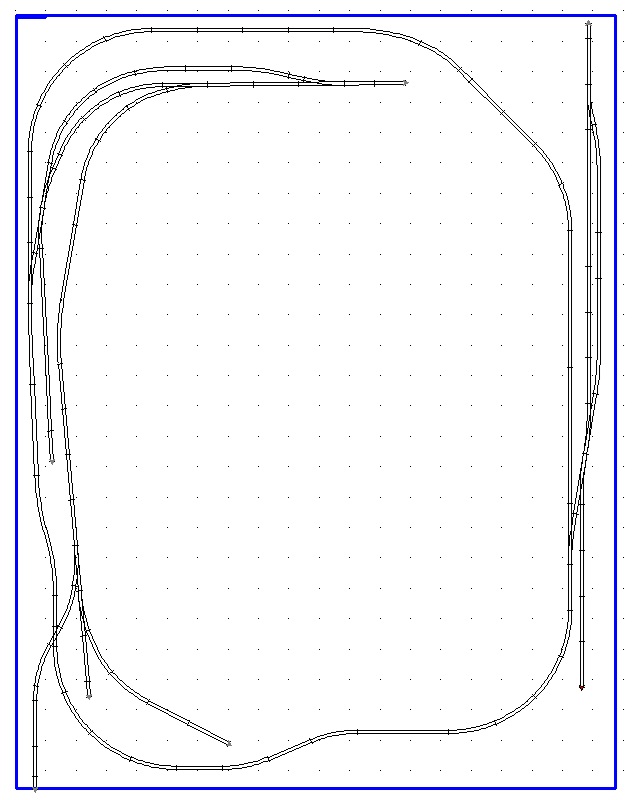
Will have to continue tomorrow, it’s getting a bit late for this where I’m at.
Happy holidays, and thanks for all your input!
wouldn’t it be better to put the “run-arounds” on that mainline and use them as station sidings allowing trains to pass one another? My layout has several towns with stations and industries to be switched

looks like you want something of a branch, why not avoid the crossing and run it behind the mainline and possibly rising a little.
1 Like
For one reason, I’ve “always” liked the idea of one track crossing another like that.
In my very first issue of Model Railroader, they build the 4x8 Turtle Creek Central (yes, I still remember the name), where spurs on the inside of the loop makes it out to the edges of the layout. One was later connected to a coal mine.
Young me was amazed at this American magazine, everything in it was new and exciting, and this track plan, or features of it, sticks to this day.
That is why that crossing is put there, no other reason than to satisfy this urge from childhood.
The reason for runarounds at each end is to, in the future, be able to use a switcher in each small yard, and with one or more extra spurs at each end break down trains and rearrange the cars. Let’s say, a loco is running as a point-to-point, dropping off the string of cars and picking up another one for the return. The switcher could then sort the cars, some will go on the next return trip, and the rest will travel to the outside world, when the same locomotive (let’s say a SD-45) makes the trip around the entire loop.
Perhaps I could fit a few industries along the wall just below the door as well.
Just to be prepared for the future, so extensions and rebuilds can be kept at a minimum, while getting more operating options.
I hope it makes some sort of sense, English isn’t my native language, and some things are a bit hard to explain. But I hope and believe you get my point.
1 Like
don’t see a yard and i only see switchback spurs near those run-arounds. no real need for run-arounds in those cases
the same activities are required in the diagram i posted. With multiple industries on each spur, switching may require sorting cars to match the industries on the spur. Often a car at an industry is not to be picked up and needs to be respoted. The siding/run-around allows the loco to switch facing point spurs.
An other town on my layout has a switchback spur with 5 industries. Sidings on the mainline also allow trains to pass one another when going in opposite directions.

it takes me no less than 20+ mins to switch either town. It takes some operators over an hour. Both of my towns are ~10" deep. That switchback spurs uses cardboard building flats

when there are both trailing and facing point spurs on a mainline, the loco would switch the trailing point spurs on the way out and after moving the loco to the opposite end of the train at the end of the run, would switch the facing-point spurs on the way back
you could have two overlapping ovals with a crossing so that a train needs to go around twice to return to it’s staring point
1 Like