I am new to this forum, and new to “proper” model railroading as well.
Got the keys for my new house a few weeks ago, and had big ideas. A load bearing wall shrunk those ideas, and I am now limited to a smaller train room than I had hoped.
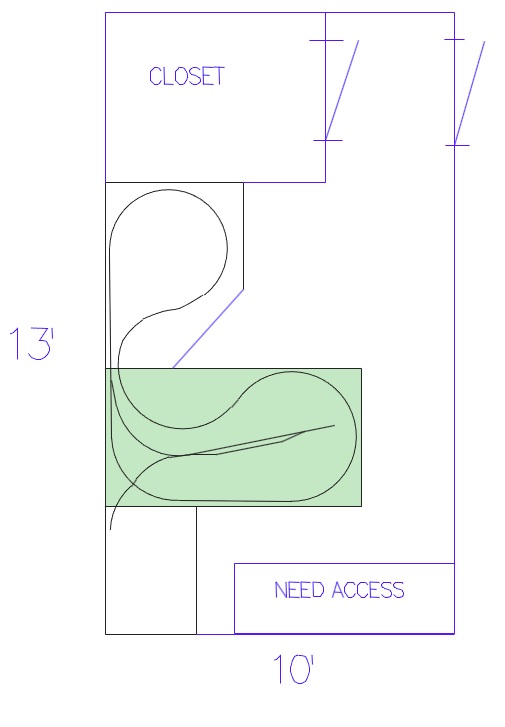
The room is about 13’ long and 10’ wide, with incoming water and pipes for the kitchen above to consider.
Anyway, I would really appreciate suggestions and ideas from more experienced hobbyists, before I start cutting the lumber and setting on a design.
In the future, I am getting Peco turnouts and flex track, but for now I got this big box of Power-Loc that found it’s way over the Atlantic to northern Sweden. The scenery will have to wait until the final track is laid, but I still want to play with my trains.
I’ve got a UP SD-45 and a switcher, and quite a lot of freight cars, and the plan is to run the main with the SD, and have a smaller industry area / switching puzzle to keep the small Alco unit busy.
They all seem to negotiate the 18" curves on the Power-Loc, but in the future I am going to be able to widen them a bit, to 22". If I get more engines, they will be diesels of similar size, and perhaps a small steamer, like a Mikado or something, just for fun.
The scenery will be pretty flat desert, with a mountain hiding the upper loop.
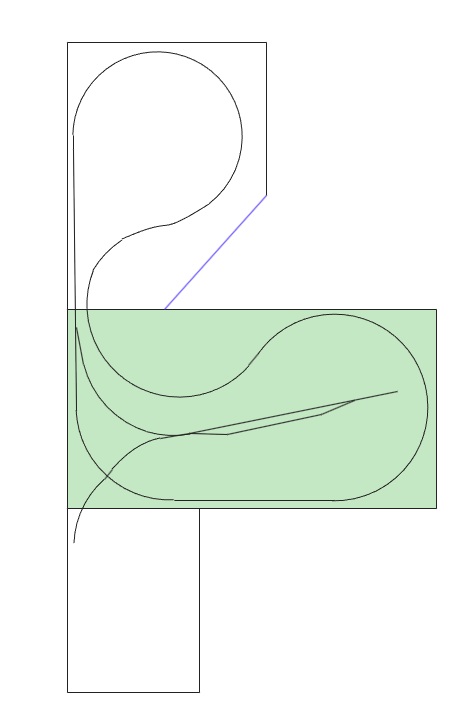
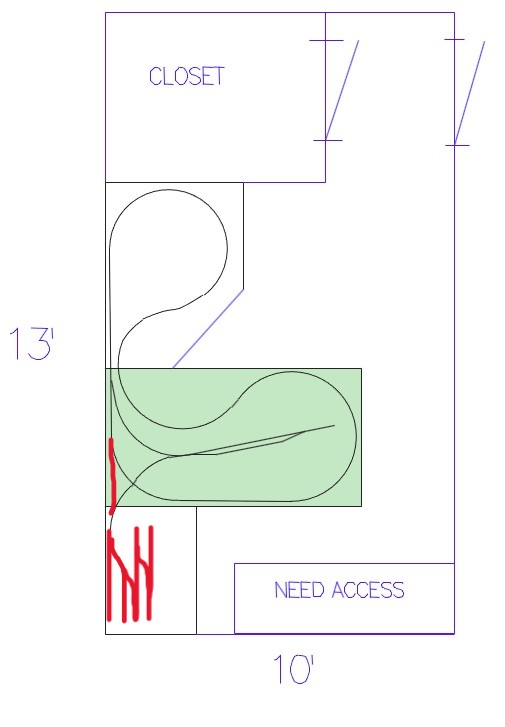
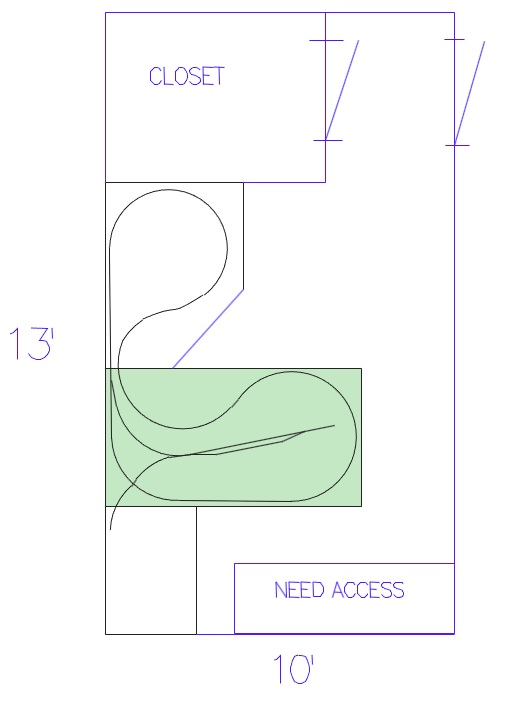
This is what I’ve come up with so far. The board in the middle is a 4x8, but with about 6" cut off the end, to make it easier to squeeze by. At the bottom is the future industrial area.
I am not sure about the runaround track in the middle, among other things.
“Space permitting” is the key word here, don’t really know how to make it fit.
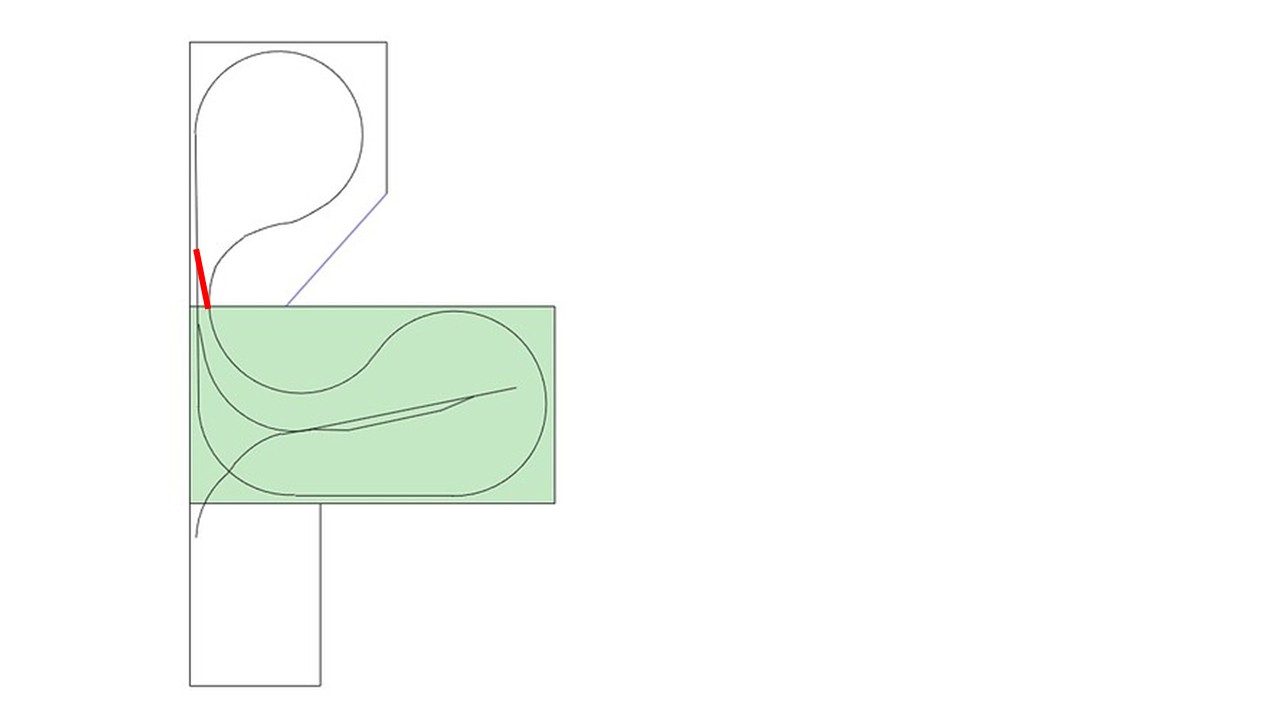
Perhaps try to move the turnout on the left further up, between the to tracks of the main. Then the runaround can be put at an angle from there to the lower right end of the green board..?
Clearly, space, or lack thereof, may be the issue. However, the ability to turn around trains into the opposite direction will add to the enjoyment of running trains.
Is your power DC or DCC?
Reversing the direction of trains also involves consideration of conflicting polarities, so that needs to be taken into account.
You mention 18" radius curves with the possibility of 22" curves. That would definitely improve performance. From personal experience, I will add that 24" radius curves would really be desirable in HO scale.
Just out of curiosity, have you considered N scale?
First off, I’m running on DCC.
I’m not sure I really like the extra trouble with a reverse loop, to be honest.
And I already have too much equipment to start over with N scale. Here in Sweden, American models tend to be either hard to find, very expensive, or old, used models not up to today’s standards.
Once in a while, you can find decent ones though, like my P2000 switcher and BLI SD-45.
A point to point is nothing for me, at least not a “true” one, without the possibility to just run a train and watch it, no matter how non-prototypical that is.
In the bottom right corner, is where the water pipe from the street is coming in to the basement, and to the left is where the kitchen sink is located, on the upper floor. So for maintenance I’d like to stay clear of that area.
The 13’ is from the closet to the bottom left.
I’ll use the track I have at hand for now, just to play with the trains for a bit, the future flextrack will be 22" radius, to fit the boards. I would prefer much larger ones, but the space available is what it is.
To the right of this room is another, and the original plan was to make an opening in the wall, maybe 5-6’ wide, and continue with the layout in the other room. But it’s too much of a hassle with this load bearing concrete wall, and on both sides, along the ceiling, are pipes for heating, to/from the kitchen sink and so forth, so it’s not easy to get a steel beam in there, to take the load from the upper floor.
If you aren’t afraid to add some grades, you could probably get a lot more track real estate to run trains with some bridges and stuff. Of course the greatest problem with your space and track plan is going to be the lack of space, something I had to keep in mind when I designed my 4x8 to fit in an apartment. Any grades you do add to allow for overhead travel will likely need to be steep, probably a 4% grade. It does look like you have room for a pretty good staging yard, though!
I think something else you could do is add a good siding on the bottom side of the 8’ section of straight track. Something I regret with my current 4x8 was not realizing how much I enjoyed switching, but I had at least enough foresight to add in a few switches! I look forward to seeing more progress and what you end up going for!
I would agree about getting some elevation it not only adds more track options but great modelling opportunity. I had a 4x8 once that i added to and that addition added a reversing loop. But I had an issue that was that once i had changed directions once it was not possible to change back to the original direction. I found this frustrating. But totally agree that being able to run in either direction is much better.
The walls to the closet are some kind of lightweight brickwork, so it’s not load bearing, and could be easy to remove. But I would prefer to keep it, to store train stuff and relevant magazines.
I’ll have to think twice about this, I have two 4x8s on framework, the plan was to use them as is, to form an L-shaped layout, but quickly realized that having a 4’ deep layout would make it extremely difficult to reach everything.
Before I cut them, it would be nice to have the track plan decided.
I’ve looked at several 4x8 track plans, with possible connections to the outside world, a yard or whatever.
But I would prefer a longer main line, so I can run long trains, which an L-shape would give me, and an area for switching operations, perhaps to keep two operators busy with each locomotive.
Thanks for the diagram showing where things are located in your train room. That’s helpful.
Given your choice of an SD-45, I would encourage your to consider a layout with curves at least R24" or >. While the SD-45 may negotiate R18", the swing out on a 6-axle locomotive will be excessive and not look good.
From your diagram there are two important access areas that need to remain open: The entry way into the train room and the point where the water pipes from the street enter the house. That’s good planning. You could manage an around-the-room layout (with larger curves) using lift outs at those locations. Even with R18" or R22" curves, you’ll need straight sections of track between your opposing curves to avoid “S-curves”, which can lead to derailments. The straight sections should be as large as your largest locomotive wheelbase, which - for your SD-45 - is 53’ or 7.3" (HO). I don’t see any straight sections of track in your interior curve separating them from the opposing exterior curves.
Carl, let me play around with the given room specs and see if I can come up with an alternative plan…
It never occurred to me to let the track run all the way around. And with a couple of wider sections for yards and industries and such!
Regarding the lack of straight track to get rid of the S-bends, I just used a very simple online cad program to do this drawing. When I’ve been fooling around on the floor with the trains, I’ve always put a 9" straight in between the opposing curves. Never had a problem with the sharp curves, and I imagine that four more inches will make it good enough. But if I run it on shelves around the room, of course it could be made to 24 or 28".
I will not get a Big Boy or passenger service on my layout, so even wider curves would be more for aesthetics than necessity. I think I’ll be happy to get a descent layout within the space available, even if the curves are 22", really.
Can confirm, though for me it’s a compromise I had to make with the space I have in my aparmtnet. Not looking forward to doing the ballasting on the back of my layout, that’s for sure!
It doesn’t cost that much to have an opening and header built into a load bearing wall. While you probably wouldn’t want to remove it, the trains could punch through the remaining wall to reach more space, and the wall would be a natural scene separator. Actually an advantage sometimes.
I don’t know why you can’t put the track plan under the water and kitchen pipes. As far as maintenance, I haven’t touched either the main pipe or have a need to reach the kitchen pipes in 10 years of owning a 30 year old house. Maybe design that area to have simple scenery in case something happens, but not having any track run under those pipes seems extreme.
I could have a narrow section of the layout under the sink area, but if I need to reach them pipes and drain for some reason, I can’t have a 4’ deep section right there.
The previous owner of the house left some fitness machines in the other room, and perhaps it’s a good idea to keep them there (and actually use them), and let the train room stay within the limits in my drawing.
You can make a decent yard in a 18 to 24 inch deep shelf. The angle of a ladder should clear it. And. You can build the narrow table strong enough to stand on. Put a scrap piece of plywood on the tracks to distribute your weight. Again, I think the time you would need to climb up there is rare, but I don’t use your kitchen sink.
Just a thought. Maybe you could have one town along a shelf in the exercise room then have the trains punch though to the main room to do some looptys in the main room to then head to another town under the pipes. Point a to point b. The main section could be built first as a continuous running loop section.
Not trying to deviate from your plan. I’m just trying to think about how to use total available space without causing any problems.
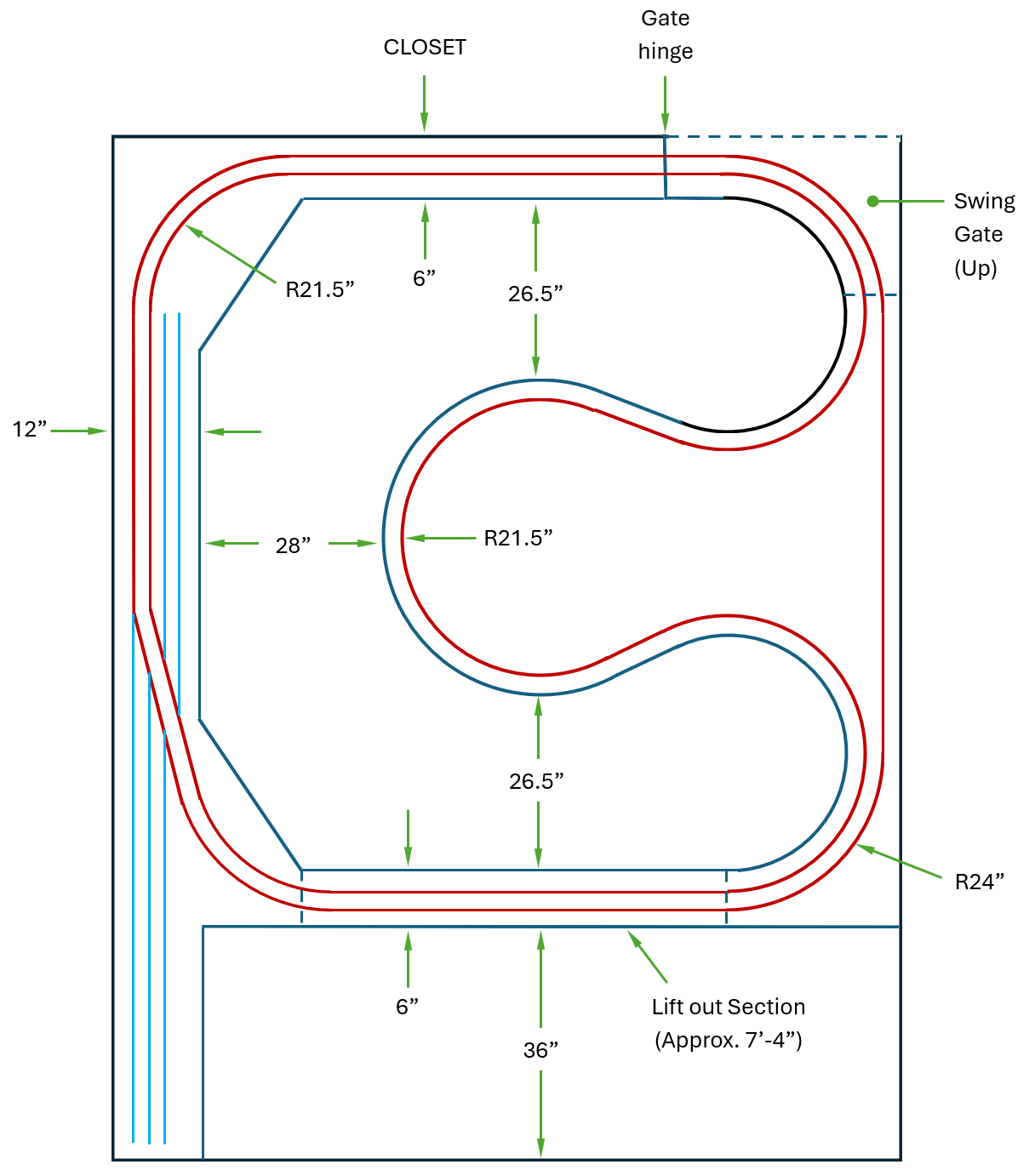
I spent a 2-3 hours on an alternate plan for your layout space. I retained the curved track but provided a double mainline (red) and a yard (blue) for each mainline track. Straight sections between opposing curves is a min. 9"
Access into the train room is via a swing gate that swings upward. Aisle widths are shown, as well as the radii of the mainline track curves. The center-to-center (CTC) distance between mainline tracks is 2.5". CTC distance between yard tracks is 2". Reaches into the layout for working on it or accessing the occasional derailed car(s) is 24" or <.
There is a long lift-out at the bottom where you wanted access to the city water pipes coming into your house. I made the access aisle 36" wide.
While it’s not a perfect plan, Carl, it does optimize your space and increase the radii of your curves to R21.5" & R24". Those will make your SD-45 look and operate better as it rounds the layout. You should also be able to modify the plan somewhat to your own liking and preferences.
Now when I have more or less decided on a layout around the walls, I’ve looked at several existing track plans.
The “need access” area doesn’t have to be completely out of bounds, if the shelf is about a foot deep, it’s still easy to put a step ladder and reach the pipes and electrical wiring above.
Perhaps having a small yard at each side of the entry, so I can run it as a point-to-point if I want to, or close the gap and have a complete oval, with single track main line.
Then from one of these yards, likely the upper by the closet, a branch can be worked by the switcher, to different industries along the outside wall on the left.
That could also be used as an interchange track, if I find a nice model from another railroad operating in the same area, like SP or BNSF.
So basically a very simple loop of track, with some curves here and there to make it a bit more interesting, a runaround track and an extra siding or two at each “end”, and from one of those a branch line.
I should be able to get 24" on the main and about 22" on the branch, as a minimum.
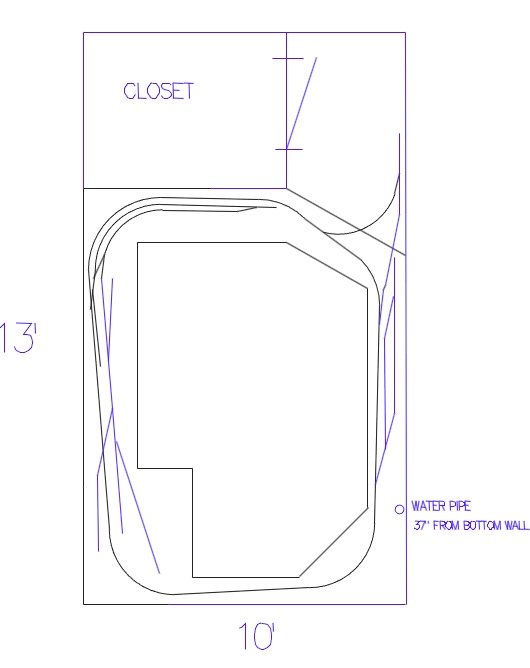
I guess everybody is occupied with the holidays around the corner, but I just made a quick track plan, not everything is to scale, to show my recent thoughts.
Do you think the (very small) yards will be useful? And I added a wye in the upper right, so I can pretend the two yards are at each end of a point-to-point if I choose to.
The original drawing of the room was, to be honest, not really correct; the entry to the room is actually further up along the wall, I just simplified it as I didn’t see that “corridor” as useful space. But for a wye (20" radius or something), it will do just fine. The wall to the left is about 4’ from the bottom right corner of the closet to the door.
The main line is all 24" curves, I aim to keep the sidings at 20-22", as I have some longer freight cars as well, like 60’ box cars.
I’m still in my 30’s, so I will try to build the layout at such height that a simple duckunder will do for the entry, and if it becomes cumbersome, I’ll have to look for a solution with hinges.