Now, the MicroLus tilt-arbor obviously has one advantage- the tilt arbor. On the other hand, I’m not sure just how important that will be for me. My immediate uses will be PC-board ties and plywood for a dice tower (sorry, different hobby, same skills used). Who knows if, sometime down the line, I’ll want to make mitred corners on buildings.
So… honestly, the Harbor Freight tool is inexpensive-enough that, if it comes down to it, I could buy it now and use it for six months or a year or five, whenever I decide I want to do mitred corners. At that time, I could invest the $$$ in
The Horrible Fright table saw lacks a rip fence, which could be a real pain-in-the-butt. To get a good cut, the fence must set up and lock parallel to the blade. Without a rip fence, ripping becomes very hard. You have to place a home made (presumable wooden) fence on the table, secure it with C-clamps, and then fiddle around to get it truly parallel to the blade. Plus the user reviews on the Horrible Fright website are not encouraging.
The Micromark looks to be a better saw, for $134. It has a rip fence.
I’d try your regular table saw. There is no reason to mount a small blade, a 10 inch blade cuts just fine. You can get remarkably thin kerf blades these days which will reduce the amount of stock turned into sawdust. You can make or buy a zero clearance saw blade insert to keep small pieces from falling down into the works.
I’ve used a borrowed Dremel saw (now that’s a really good friend) and it generally worked well in wood up to about 1/4 inch thick. Beyond that it didn’t have the power necessary to continue the cut and would stall.
When it stalled it had an annoying habit of throwing the drive belt off and that would have to be put back on the pulleys.
Well, I’m not sure I’ll get good results from my cheapie Ryobi table saw (there are differences in tolerance between building simple furniture/shelves/modular railroad frames, and building scratch-built buildings…). The rip fence isn’t very accurate, for example. It worked well-enough last spring for ripping a bunch of stakes for a anti-deer fence around the tomato garden, but they were rougher than I would want for modeling.
I’ll look into it, though. For a good quality finish, I figure I should be looking for an 80-tooth blade (on 10" diameter), preferably one that can cut both wood, plastic, and metal. One candidate at Lowe’s looks like:
At $72, I’m already half-way to the lower-priced Micro-Mark saw!
I could perhaps cut down to 60-tooth blades, which brings the price into the mid-$40s, but the finish quality starts to become an issue much below that.
I mentioned kerf width because of the immediate reason for considering this purchase- cutting PC board ties. When you have a 1/8" kerf, and are cutting 1/8" ties, you’re looking at 50% wastage!
I haven’t used one, but I would get one with a really good fence if you’re planning to rip small parts accurately. The HF has no fence and the cheaper MicroLux fence doesn’t look very sturdy since it only attaches one side.
As noted above, if you already have a table saw / radial arm saw / band saw, i would try to using that first.
I have the MicroMark Tilt Arbor saw, & it is fully accessorized, from about 6 years ago (when I could stock up on tooling), & although I don’t use it every day, when I do, I really like it.
If you do get any saw, consider getting the sled for it. I use that all the time with a pair of small ratchet clamps for stops, & holding material & it works great.
I use it mostly for wood, but it has seen a lot of styrene parts.
Once you get one, you will be glad you have one!
I have not had any maintenance or trouble issues, but do vaccuum it out now & again.
EDIT: I meant to note, whatever saw you choose, I can only share my experiences with this saw.
While I don’t have a micro table saw, one rule I’ve learned over the years is always buy the best tool you can afford, even if it means putting it off a while and saving up for it. With a good tool you only cry once. With a cheap tool, you cry every time yo use it.
Really use care when ripping the ties. You’ll need a zero clearance insert, a very good rip fence and a jig or something to hold the board to keep your fingers away from the blade. Even though it’s small scale, it can still bite you.
Stupid question perhaps, but how many pre-cut ties can you buy for the price of a reasonable quality mini table saw?
I’d say that you should have a whole lot of other uses lined up for it before you spend the money, and you should make sure that the saw you choose can actually make the cuts you want (i.e. bevel cuts, zero clearance table inserts, etc. etc.)
However, if you get a lot of pleasure out of cutting your own stock then the point is moot. If you like to cut wood then go for it! The cost for the material becomes a lesser issue, but if you cheap out on the saw you may not get as much pleasure out of it as you had hoped. In fact if the saw you thought was a bargain requires constant tweaking to maintain a consistant cut you will not be happy! Therefore, as has already been said by others in this thread, don’t go for cheap![2c]
And remember, with a little glue you can turn all that sawdust into scenery material[(-D].
How many ties? That’s not a stupid question at all!
Of course, this isn’t ONLY to cut ties, it’s just that a semi-urgent need for ties (train show next weekend, and I’ve got a handlaid turnout partially torn apart because of performance problems, needing a new throw rod) popped the thought forward far-enough in my mind to actually ASK. However, as I mentioned, there are other projects it would be useful for.
I generally don’t buy cheap, but I do try to buy inexpensive, if the distinction is clear. Since it looks like acceptable-quality saws are not in the price I want to pay today, I’m simply going to spike that turnout closed for the show, and save up for a month or two.
I think that you are smart to hold off on the saw until you can afford a quality one. I can understand your distinction between cheap and inexpensive. There are good quality items out there that are not overly expensive. A good quality saw will give you hours of pleasure and a poor quality one nothing but disappointment.
I have the Dremel saw with a Sears Craftsman label. It has servrd me well for 40 years. I do, however, respect its limits. When cutting copper clad fiberglass for PCB ties, you will dull a blade very quickly amd a dull blade is dangerous like a dull knife.
Fast Tracks uses a punch and die method to cut their ties BTW.
I have the Harbor Freight one, and it is a good little saw.
Certainly does what I have required it to do. It is certainly built well, even though it might be short on some options.
I have it down close to the layout room, but have the option if something more detailed is needed, I have a 12" 220 volt Craftsman in the garage.
You could certainly make a couple of jigs that would help immensely on more difficult cuts if you are so inclined.
But for the money, for a little hobby saw, I think it fills the bill. I also have their small verticle belt sander and love it., actually use it more than the saw. I have them located in a 5’ x 12’ staging area along with a small work bench for quick fixes. My main model building area is in the computer room upstairs.
Keep the fingers out of the way. I always say that as my Craftsman took two fingers on me back in 1978.[+o(]
Not to take anything away from Johnboy’s experience, and I must say up front that I do NOT own a miniature table saw.
That said, my experience in buying tools of all kinds is that the cheaper the tool, the lower quality you get in terms of both parts and manufacturing tolerances. In other words, cheap saws may have a mdf top, a slightly wobbly arbor, and a miter gauge or rip fence that doesn’t quite lock true. At higher qualities, you eliminate many of these issues (tighter tolerances, steel instead of plastic or mdf, etc.). In general. The trick is to find the price point at which you can tolerate the little issues with the cheaper models.
Go with carbide blades. My plain ten year old 40 tooth ten inch Vermont American carbide blade still cuts smooth as glass. Cost about $25 at Home Despot. Bet you can still get a thin kerf model for under $40.
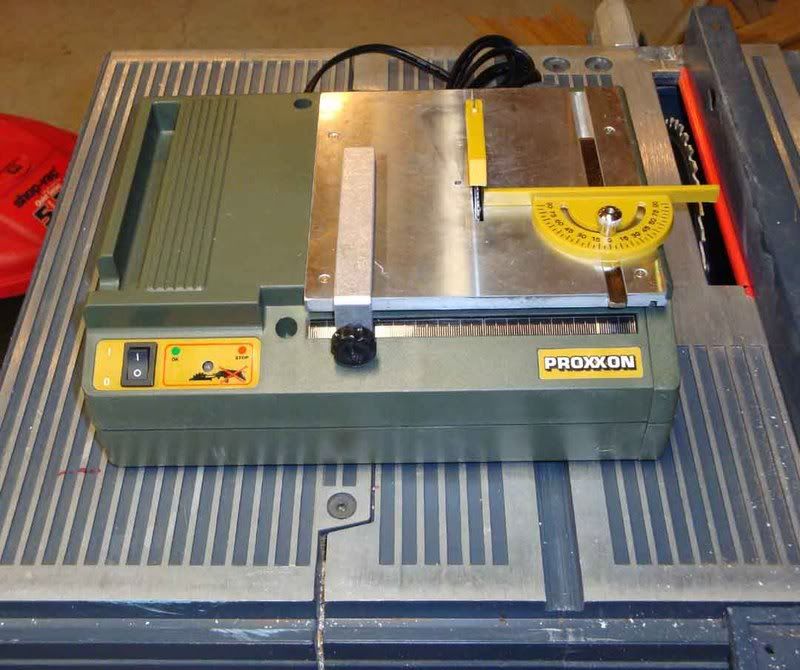
I have had a Proxxon mini saw for a number of years, and am very happy with it. It cost about $110. It comes with a rip fence and an adjustable push fence. The blade is fixed in both depth and tilt; you have to spend $150 or more to get those features. It had a bi-color LED that changes from green to yellow to red as you are cuttting and slow the blade down - a good feature that protects the motor and drive belt.
Here it is sitting in its usual place on my table saw
I haven’t decided on a specific model, but it will likely be one of the more-expensive ones. One of the deciding factors will be whether I decide that the ability to tilt the arbor is vital, or Just Nice To Have.
Meanwhile, Necessity, being the Mother of Invention, visited. I just sat down with my 35-year-old Craftsman scroll saw, fashioned a fence out of 1x4 scrap and a couple of clamps, and cut what I think will be a suitable throw rod for the problematic turnout. Total cost: a couple of bucks for the PC board material, and ten minutes of time. Thanks, Mom! [:D]
I agree that Carbide blades are a good investment but there is one alternative that I would suggest for the modelers using 10" saws. That is a hollow ground planer blade. It is a blade that does not have any set to the teeth. Instead, for getting clearance so it doesn’t bind, the blade is ground so that it is thinner in the center than it is at the teeth. This results in a very smooth cut because instead of the tips cutting sawmarks into the wood, the planer blade shaves the sides of the cut smooth. Mine are SEARS Craftsman - I’m not sure if other companies make them.
They are not carbide! They are sensitive to what you are cutting. If you use them in MDF you can toss them into the garbage in about 10 minutes - too much crap in the mixture of wood and whatever. Also, most saw sharpeners don’t know what to make of them so they will often try to set the teeth which destroys the function of the blade.
I have used mine to make walls for scratch built buildings. With a little care it is possible to cut very thin slabs. I use mine in a radial arm saw so it is easy to hold the stock still and draw the blade through it smoothly. I have no experience with table saws but I’m sure those with table saw experience could duplicate my results. Here is an ice house built using the slabs cut with the hollow ground blade. There are a few blade marks visible but I think that just adds character to the structure. You may disagree.



 <
<