Raising small areas between yard track on plywood/flat yards is easy but what methods have you used to lower them? (drainage ditches, etc.) Does a router work on 1/2" plywood or does it just tear up the multi-glued layers? Have you cut out narrow ditches cookie cutter style and placed “U” shaped screen/plaster in them? What’s been the practice in pre-foam bench top days? My current yard area is not raised up on 2" risers, but it’s easy to move joists. I’ve been looking through older magazines, but if you have some tricks and or detailing parts laid between tracks to avoid the flat as a pancake look and could post pics I think it would benefit a lot of us as this is always a “buggaboo” for scenicing. So easy yet often so hard to get things to look convincing. I am laying sheet cork over the plywood initially, so wondered about cutting/routing through that and what issues that might raise… I’ve occasionally seen yards with tracks laid on cork roadbed instead of flat. Is this at all prototypical? I think the CMR built steam loco servicing yard layout was done this way, although that may have been an unusual owner preference. I do not want to use foam. (Health issues) or this would be easier  Thanks.
I would think that you could use a router, or drill a hole and then use a sabre saw. It’s going to make a dusty mess either way, though, so this is something to do before you lay your track. If you end up with a slot all the way through the plywood, take a piece of plaster cloth and cover it up. The plaster cloth can then be shaped into a U-shaped or V-shaped channel while it’s still wet, and it will dry with a good base for scenic stuff. I put a thin ditch between two tracks in my yard, and then added “dirty water” with tinted Envirotex. I put some tall grass and other scenic cover around the edges, and it came out very well.
I originally laid my yard with full-height roadbed. It didn’t look right at all. To keep everything level with the yard leads and main line, I filled in the space between the roadbed with Durhams Water Putty to get a flat yard. This isn’t a great way to plan a yard, though, and I would have done it differently if I hadn’t already laid all the track and roadbed before realizing the mistake. The putty, by the way, dried very hard and would be almost impossible to carve features in.
One thing that might work for you is 1/4 inch poster board. It is a foam material, but a different kind, and the surfaces are covered with paper. It comes out about the same height as roadbed. It’s easy to cut, so you can put in ditches and gullies very easily.
I’ve also added a few small rock castings to my yard. These look like small pieces of ledge sticking up through the soil, and they also help get rid of the too-flat look.
I have used a router and a grinder. It makes a huge mess and is hard on everything around the work. I would never try it on 1/2" I have used the cookie cutter method and it works pretty well. I have some on this layout. I have used screen and plaster, but plaster cloth is easier. Butcher paper works well also, though I have not tried it. That is one of the reasons I now use foam for everything.
Thank you for your responses. I’m leaning towards ways to do this after the track is laid, preferably… but if I can visualize what I’ll want ahead of time it’ll be easier. I’m thinking I’d like to place buildings and other structures and some adjacent scenery to see where natural run-off would occur, etc. I hadn’t thought about sawing rather than routing. That would allow after track laying should a last minute inspiration strike and a fine toothed hand saw would keep the vibration down. I’ve been looking for pics of narrow (tiny?) drainage ditches, small puddles, gullies, etc. but most I’ve been able to find have been as large as if two standard roadbed cork strips had been laid side by side… I haven’t ever seen this covered in more than very fleeting detail in any scenicing books… I’m going to use some structolite, plaster, sand, dirt, rocks, etc. to alliviate some of the flatness and have seen plenty of good examples of these “raised” techniques. The plaster cloth is a great tip. Thanks for the poster board tip too. I’ll check it out for other locations on the layout. The sheet cork is going to be used in the main yard. Still hoping for pics but don’t we all? I do plan on using locomotive inspection pits for some of the depressions. Are there other similar equipment oriented “lowered” areas between tracks further out in the yard? It’ll be a balancing act to not overdo this lack of flatness thing, too. I plan on lots of tall structures (coal towers, signal bridges, etc.) to take the eye away from the flatness. This yard is one whole side of a room (16’ long approx.X 30") and I wanted to see what can be done before I glue the sheet cork down. Thanks again. Looking forward to more ideas.
I might add a couple suggestions and observations. I was working in Columbus a couple months ago and found myself eating lunch at one of the large yards. Some of the things I noticed were that the yard is not flat at all, from side to side, end to end, and even from track to track. There were grades that had to be approaching 3%, but only for a very short distance, like 100-200ft. From side to side, some tracks appeared to be level with surrounding tracks, then had a service road (depressed) and then several more sets of tracks at a lower elevation (maybe 2-3ft). This really doesn’t jive with most yards I see in pictures, where each track is precisely 2" apart, straight and flat. This might be alleviated by using the sheet cork with different thickness in different widths and lengths, sometimes even having 2 layers to shape a grade. As for drainage ditches without the mess, try using a sharp wood chisel. If you think you are going to go deep, glue a “patch” piece of plywood on the underside before carving it up.
I should think that there wouldn’t be a lot of drainage ditches in railyards - they’d be a real safety hazard for the workers on the ground. Most of the yards that I’ve seen are underdrained, with open ditches, perhaps, on the perimeters.
You can use scenic effects to simulate subtly different elevations, as shown in the photos below. Different ballast colours and types, along with weed and grass growth, can suggest slightly different elevations where none actual exist. All of the tracks shown are laid directly on the plywood, with no roadbed whatsoever.
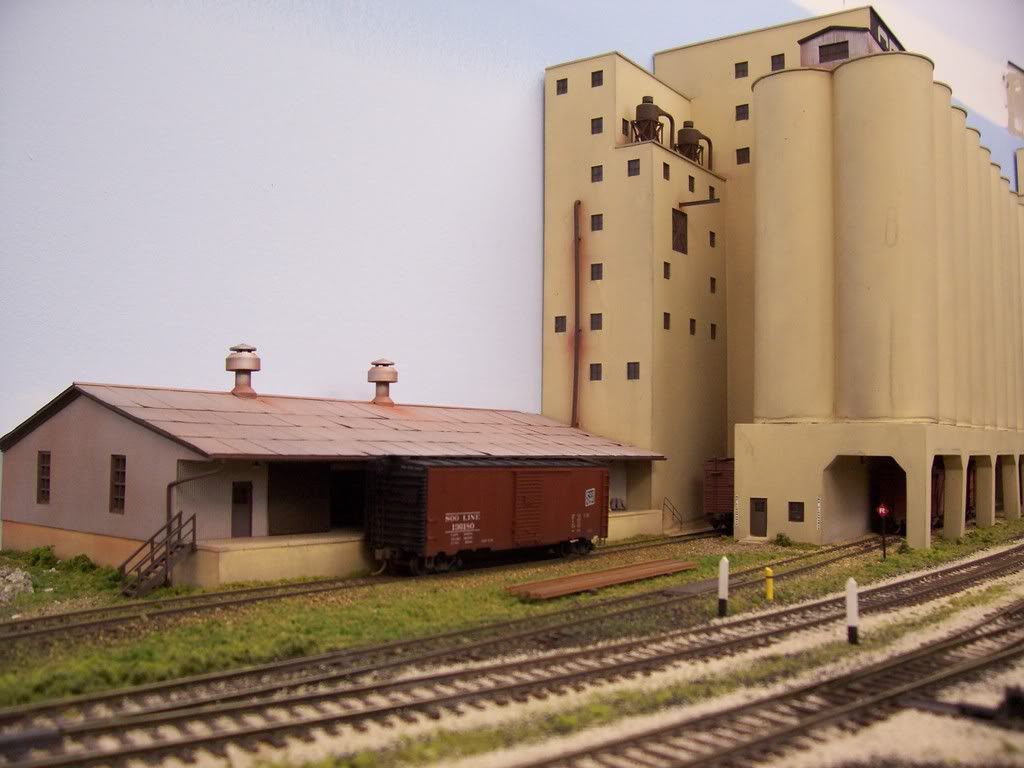

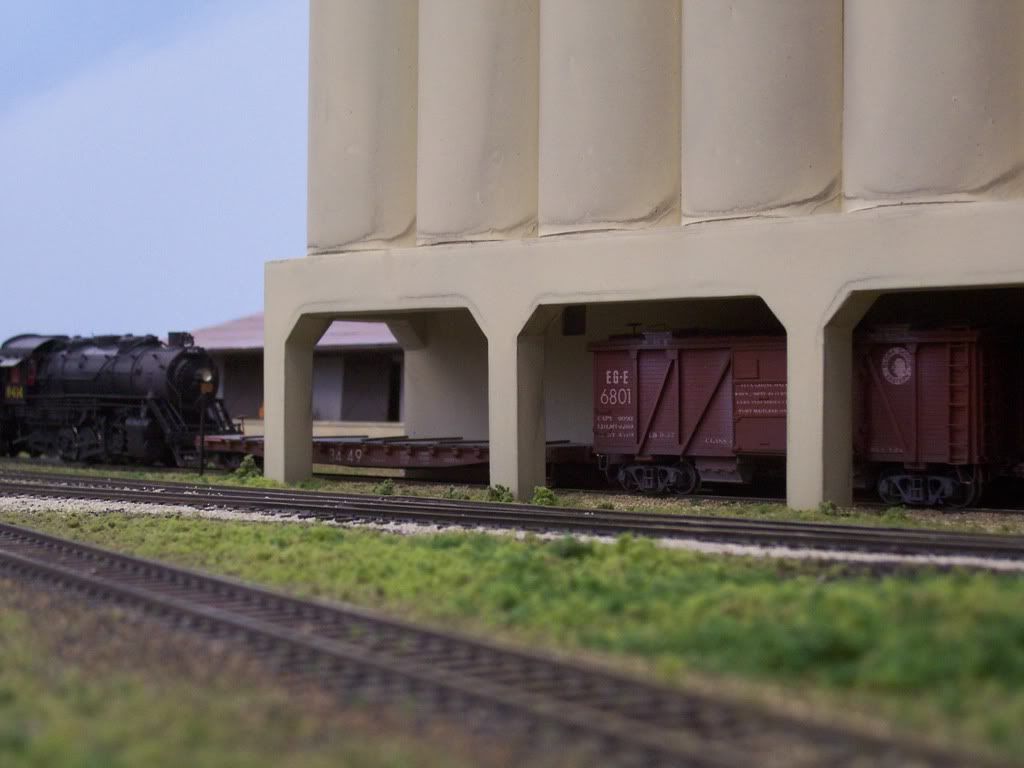
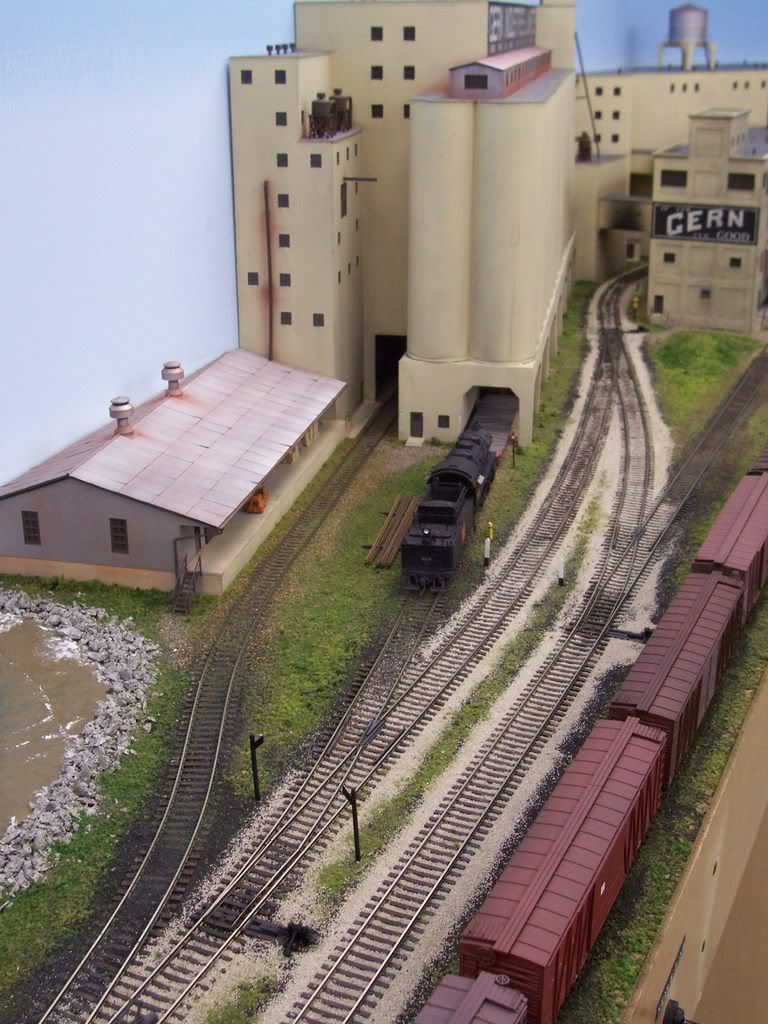
Wayne
The photos I’ve seen of flat-switched yards, especially in the steam era when there was lots of foot traffic in the yards, suggest there were not deep depressions between yard tracks. If you do want some modest changes in level ( few scale inches), seems like laying the yard tracks on cork sheet, then cutting away cork between the tracks, would be a better choice than going at the plywood between tracks with a router after the track is laid. That sounds like a recipe for disaster.
doctorwayne. Thanks for the pics. It’s amazing that such an optical illusion results from the color variations! Your photos made me realize that perhaps some other shots I’ve seen that I thought had minor depressions were indeed just ground cover and ballast as you’ve done. I’ll try that on a test area and see if it has the desired effect. Your layout always “knocks me out”. Your craftsmanship and artistry are the quality I’m trying to aspire to. Cuyama, I suppose simply cutting through the sheet cork for puddles, etc. would be deep enough, scale wise. I’m not looking for crew tripping ditches just very minor depressions here and there… I’ll experiment. I’ll go back through magazines and see if I can spot the color variation “tricks” of the eye better now. There will be a lot of spilled coal and cinder ballast in this yard, not sure how much greenery I’ll have yet, if anyone has examples of coal/appalachian yards that use these variations that would also be helpful. Thanks everyone. I’ve got some techniques to work with, now.
Thank you, Capt., for the kind words. [:)]
Wayne
I recenlty bid on a railhead project that took a single track and diverged into a four track yard. I’m new to the forum and haven’t posted a pic yet, but I am very easily able to scan a profile plan sheet showing the ditches and slopes between a “flat” yard track. It has storage staging along one side and an access road down the other side. Anyone can PM me or respond to this and I’ll send it to you. Jason