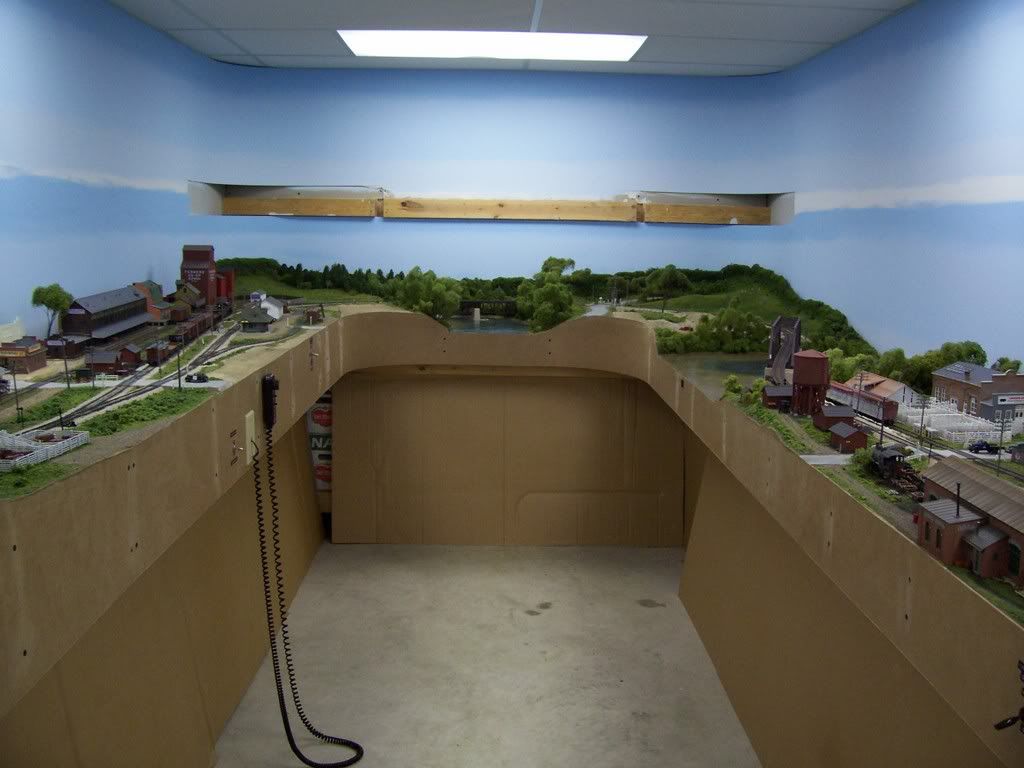
I’m starting to design a layout where it will be a around the wall layout that is roughly 9x12. I trying to determine if I should use #4 or #6 switches or some type of combination of both of them. Most of my freight cars are 40’ or 50’ box cars and passenger cars are 85’.
Your passenger cars should work over the #4 switches but not all will do so. The more expensive the car the less likely they will do so. AHM/Riverossi with truck mounted couplers will have no problems even if they do look strange. Body mounted couplers may baulk.
Mostly (on the layout of the LION) realestate is the confining issue : Do I have room for #6, or should I use a #4. Actually in practice, I stll have some snap switches left in service from two layouts ago. Gotta use what you have.
In any event, LION runs 50’ long subway cars, and they will run over anything, so STAY OFF OF THE TRACKS!
I have a #4 switch track for practice use. Running Amtrak Superliners will do fine, but I don’t like the appearance that it gives. It shows off overhang. I would love to see coach diagrams stay together instead of see a huge overhang between the diagrams that might kill a passenger while walking thru it.
One might coax some brands of passenger cars through a #4, but not all. And many cannot be shoved through a #4, especially in a ladder arrangement as in a yard.
Note also that not all turnouts labeled “#4” are the same. The Atlas “#4” is actually a little broader, it’s about a #4 1/2. Still not broad enough for many passenger cars, but gentler than some other “#4”s.
Some manufacturers offer a #5 in HO (for example Walthers and PECO Code 83). These still may not handle all passenger cars, especially when shoving through a ladder, but would work and look better than a #4.
Being a real beleiver in #4’s, when you get to those long passenger cars, you really start needing #6, maybe even #8. Cars 40’ or even 50’ have no trouble with #4’s but as far as looks goes, the 50’ers are starting to push the envolope as far as looks.
Welcome to posting on the forums. See you have been watching for awhile and are now ready to join the conversations. I’m sure you already know there is a wealth of information from the folks who participate here. In the near future, hopefully, you will be sharing your experiences with others.
My “in planning” layout is of similar size to yours. I am planning to use both #4 & #6 turnouts on the layout. Passing sidings and sidings that service passenger stations will have #6’s. Most of the time my longest cars will be Athearn heavyweights, which will negociate #4’s, but as mentioned above, look better on #6’s or larger.
I go as small as #5s in parts of my yard and or sidings. My Rapido coaches go through fine on the slow. #6s would be better if possible with even larger ones on the main.
One thing you might want to look in to is curved turnouts. They can offer more flexibility in track planning. I have many on my layout as they enabled me to start the entrances to yards and sidings on the curve before the straight section of where I wanted the yard tracks to be.
I have a mix of 4’s, 5’s and 6’s plus some curved 7.5’s. My advice is to use 6’s or longer for turnouts the passenger cars will run in at open road speeds, say scale 40 MPH or more. For coach yards and other areas where the passenger cars will be run slowly the 5’s work fine. The curved 7.5’s work for both of those applications and can save lots of space in certain situations. Limitthe 4’s to industrial switching or stagng for the 40’ and 50’ freight cars.
You didn’t say what scale. But in HO at least it’s easy to get #5s.
As John Armstrong said many years ago, #5 are a perfect compromise. My last layout used all #5s and even multiple 72 foot centerbeams had no trouble with them; I would think 85 foot cars would do fine at reasonable speeds.
A good friend used #4 on his 1950s layout with almost 100% 40 foot cars and he said he wished he’d gone to #5s.
When I use numbered turnouts on my Japan National Railways tracks I use #5s.
When I want a puzzle palace, whether of curved three-ways or multiple double slips, or even a single turnout connecting non-concentric superelevated curves, I lay them out with temporarily-configured flex track and then hand lay them. As a result I get the exact track geometry I want, smooth operation and flowing trackwork with no compromises to make Brand X commercial specialwork fit. (Diety of choice) knows the actual frog numbers.
My longest JNR cars, passenger and freight, are about equivalent to Athearn BB shortie passenger cars in length and characteristics. If I ran longer cars, I would need #6 or larger turnouts where they would operate. OTOH, #4 turnouts are more than adequate for my coal hauling mountain goat trail, where all the rolling stock has the geometry of Michigan or Minnesota taconite cars. Of course, all my passenger and longer freight cars are banned from the route, as are all but one of my JNR locomotives.
Hand laying turnouts isn’t for everyone. For those who can do it, it beats commercial products in every respect except absolute adherence to prototype appearance. To understand that last, take a hard, close-up look at a prototype turnout. You’ll see a lot of specialized metalwork (that isn’t reproduced on most commercial products either.)
I concur with those who mention the advantages of curved turnouts and obviously, the higher-numbered turnouts. However, the brand of commercial turnouts makes a difference. For example, I can run 6-axle diesels through my #4 turnouts because they are Walthers/Shinohara Code 83 and have a points’ radius of 26".
My layout is much smaller…5’ x 10’ or so but I knew I wanted to to run some long passenger cars (even if a bit odd on 25" curves so I decided first(!) that I would use #6 typical mainline turnouts, #8 as warranted, and #5 (not #4) into yards. So I do subscribe to deciding first. what one is likely to run, and plan what turnouts to use typically.
Do recognize that turnouts can be trimmed (the straight parts) so that they can be arranged tighter than when butted together, so that provides flexibility.
I tried and like using a (free) software program to design my layout. I liked XTrackCAD. These are a neat way to try out options.
I’d opt for #6s at a minimum, regardless of what you plan to run on them. I’ve never understood why anyone chooses to base their layout on the sharpest turnouts or tightest radius, rather than the largest which will fit.
If your available space is so limited that you’re forced to the minimums, then don’t compromise it further by trying to run large cars and locomotives.
Atlas Custom #4 switches can be used for standard 40’-60’ cars and short passenger cars like Athearns’.
However.
A Peco #6 switch would be the better choice though because its about the same size as the custom #4. The Peco #6 switch is 9-3/16" long.
This was pointed out to me by Rich on this forum and after some research I had my eyes open concerning switches because for years I used the Atlas Custom #4 switch on my ISLs.Blinded by brand loyalty perhaps?
When space is limited, of course we’re often forced to use sharper turnouts and tighter curves, but a 9’x12’ around-the-room layout isn’t so restricted.
In the photo below, the room is just under 9’ wide. There’s only one turnout within that width, a #8 curved one, but the radius of the curves at the room corners is 34", with easements and superelevation.
You’re right about the Peco #6 - a friend gave me one which he no longer needed and I was surprised that it was so short. However, much of the length of the Atlas #6 is in excess of what’s needed for the actual turnout, and I often hack-off some of that excess if I need to put the track into a curve. You can also cut the tie strip portion of that extra length into individual ties, then introduce the beginning of a curve as part of the turnout.
I had several Shinohara #4’s in various places and it seemed I was always tinkering with them. When I rebuilt/added on last year I replaced all of them with Shinohara #6 which work like a charm regardless of the length of equipment. Now I am rebuilding another section and have switched to #5’s. I would refer you to the John Armstrong book ‘Track Planning for Realistic Operation.’ He provides some very useful information on turnout size as well as a chart which shows the various Closure Rail Radii as well as the Radius of Substitution for different gauges and turnout numbers. I think you will find it very helpful.
I made that comment some time ago when I first bought a Peco Insulfrog #6 during the Atlas turnout shortage. Until then, I used Atlas Custom Line turnouts on my layout. Now, I do not plan to return to Atlas.
The Peco #6 is about 3 inches shorter than the Atlas #6, so in a passenger yard, for example, I save one foot of space for every four turnouts on a ladder.
And, the Peco #6 is about the same length as an Atlas #4.
And, if you are interested and willing to use your fingers to throw the points, the Peco is spring loaded so it doesn’t need a Tortoise or a manual ground throw.
Well, you have had some pretty good insights so far, and all I can add is my experience with the different sizes…
For freight yards and sidings for a layout of 40-50 ft freight cars, #4s will work out just fine. For the 85 ft passenger cars, a #6 is minimum. My current layout uses #8s and they are a major improvement as far a looks are concerned.
Four axle diesels and short wheelbase steamers will do #4s, but prefer larger turnouts.
My advice is to use the biggest turnouts you can fit.