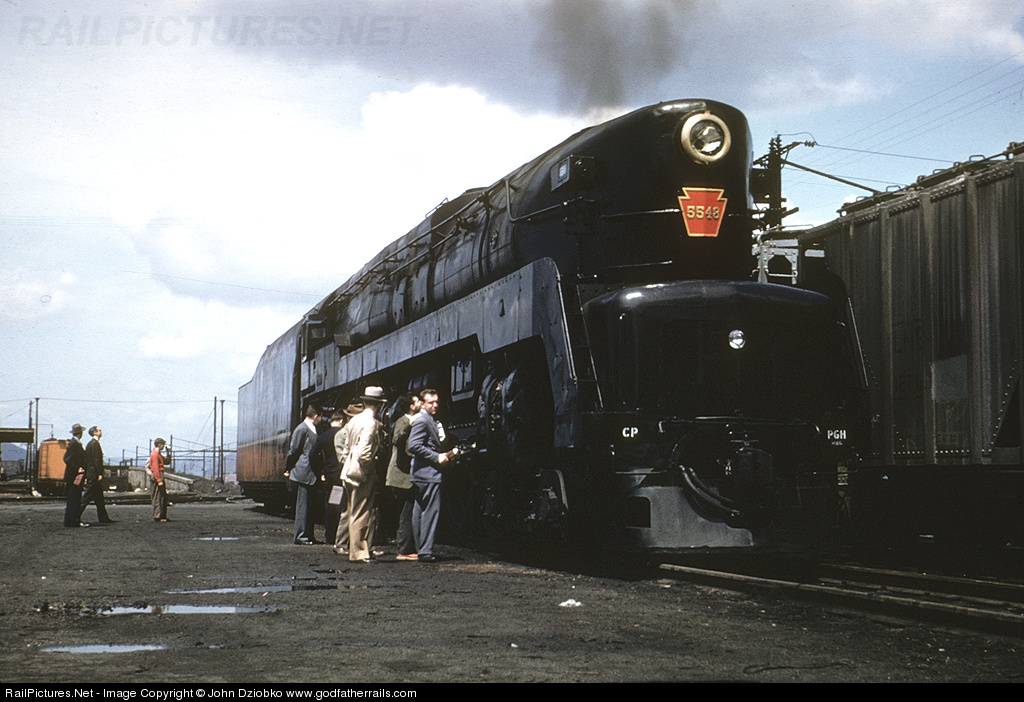
You can clearly see the catenary system in the background, and I have a beautiful painting of the T1 chugging under the catenary wires. I like the look.
When leaving the station in Harrisburg, what kind of terrain was encountered. Last time I was in Harrisburg was when I was five, I don’t remember what it looked like real well. How does its topography compare to the counties surrounding philly like Bucks, Berks, Delaware, Montgomery, Chester, Lancaster ect
No mountains will be on my layout, at this point, it will be more of a diorama, with a T1 under catenary, I think thats the look I’m going for. The rest of the layout I don’t know what the terrain past harrisburg is like, slight hills, tunnels, If I model harrisburg, will I need excessive massive grades? My layout is too smal for that.
There had to have been a place where the GG1 dropped the train and the T1 picked it up. Thus the T1 had to run under catenary, even if it was only for a couple of hundred yards.
One scene that sticks in my mind from 1957 Tokyo was a fat, bulldog-ugly Consolidation smoking up the catenary two tracks over from the EMU I was riding. Is it a surprise that my main modeling theme is changing from motors to coalburners, and vice-versa?
Today I was also wondering if it was possible that at least one T1 ran west towards Harrisburg from Eddystone, PA? Afterall, several T1’s were built there at Baldwin Locomotive Works.
Here is a T1 (the early version which makes me drool [swg] and its only a short drive away from Philadelphia!
I hope MTH releases the early version of the T1 in HO, their O gauge version is the only one that exists in model railroading.
As noted, there would have to be an area where the trains switched from electric to steam power where you would find steam under the wires. Generally it would be pretty rare for a steam engine to actually be pulling a train in an electrified section. Railroads tended to electrify for a reason, such as a city (like New York) having a ban on steam locomotive smoke, or because the line had long tunnels, or some other reason. Otherwise, they wouldn’t have gone to the cost of electrifying the line.
In the west you did have situations like the Great Northern where an electric engine pulled a train - steam locomotive and all - thru the electrified territory though.
The New Haven had electrified four-track main line from New York to New Haven, but on that line, you could see heavy steam pulling freight trains from Devon to New Haven, on account of a junction at Devon where a major, non-electrified branch joined the main. I don’t know if you could find a similar justification for heavy steam on the PRR electrified main, but you might!
Harrisburg is the western terminus of the catenary. Rarely did any passenger steam run east under the catenary. Half the T1 engines were made by Baldwin in Eddystone and half by the PRR at Altoona. So the Baldwin engines would have been tested on the corridor. I have found no evidence of any being used on the PRSL or for that matter anywhere east of Harrisburg. Harrisburg is where the mountains begin. They are bigger than the Bucks County hills maybe up to 2000’ tall but remember the way the Allegehy mountains run. They arc from south to northeast around to Allentown forming an arc around the southeastern part of the state. The PRR pretty much follows the course of the Juniata river to Altoona going through a very short tunnel and winding its way through the mountains. This is the famous Middle Division that is steadily uphill all the way to Altoona where the real grade begins over Horseshoe. T1 engines were pretty powerful and dependent on length some did need a helper over Horseshoe Curve. There is a picture in one of Ball’s books of double headed T1 engines going up the curve on a mail train. Need justification of running under the catenary? How about a problem at the power plant or maintenance. A wreck would shut it down as would storms causing tree limbs to damage it or get tangled in it requiring shut down of power and removal. Everybody sees the pictures of GG1s streaking along but it took a lot of people and a lot work and maintenance to allow that on a daily basis. Have a big enough railroad and you could have a division point where half is under catenary and half isn’t. Every train would need to exchange power there giving more operational involvement for you. All that being said steam did run under the catenary. Apparently the exhaust going past the wire would create a harmonic vibration causing it to sing by some accounts. You can justify it by having a branch join the mainline for a
I live 15 minutes from the "Burg. Topography will vary depending on the direction out of Harrisburg. Heading west bound you will cross the Susquehanna river, then start hitting the mountains as someone above accurately described. Same thing heading north. But if you’re heading South towards Maryland or East towards Lancaster/Philly the terrain flattens out into rolling hills and farmland. If you need pics of the surrounding area or anywhere in particular, PM me and I’ll see what I can do to help.
In 1917 the PRR installed catenary on the helper grade west of Philadelphia (and east of Harrisburg), so you definitely saw steam under catenary there, with a box-cab motor either pulling or pushing the trains. Ex-Great Northern box cabs were used there in the 1950’s.
A quick look though Pennsy Power II shows steam under catenary at Dillerville PA, Trenton NJ, Harrisburg, Lawrence NJ, Broad St Stn, Paoli, 30th St Stn, and Princeton Jct. Both pasenger and freight. No T1’s though!
I’m on a similar situation; I like the T1 well enough to include it on my otherwise WWII RR (in postwar, stripped-down trim) which has lots of NH and PRR electrics, running under invisible catenary as of this writing.
So the T1’s in PA ran through mostly mountains and other considerably grades? Did they roam the flat lands as soon entering ohio? Beautiful land I am sure, just extremely hard to model with limited space and resources.
If only the T1 did roam those rolling hills and farmland east of Harrisburg…
They ran all the way to Chicago. Crestline Ohio was THE location for all the big power. There was even a special extended stall for the S1 6-4-4-6 that ran at the Worlds Fair and designed to pull 18 cars at 100mph. The Q1 and Q2 engines were based there also in large part. You can never say never with the PRR. The Standard Railroad of the World had more anomolies then can be imagined. As soon as you say they never ran an engine somewhere somebody will show you a picture. The one exception would be the motors because they needed the catenary but many were made in Altoona and pulled to the wires so pictures of them without catenary exist.
If you can, get a hold of the GG-1 edition (Summer 2009) of Classic Trains. On page 28 there’s a shot of a GG-1 next to a K4, both with Pennsy keystones on their noses. The whole scene is under wire, and it was taken in November, 1954 in South Amboy, NJ.
The K4 looks like a little engine next to the GG-1.
I know this is “wrong side of the pond” and a bit off topic but the weekend before last I saw a steamer being pulled backwards on the tail of an excursion train behind a diesel under the wires at Crewe. The diesel was making more smoke than you would have expected the steamer to make flat out with bad coal.
One thing that struck me at once when I looked at the OP was that dirty/smokey coal would create some problems with the feed wire. Smoke is (I think) unburnt chemicals from the fire… as distinct from steam ejected from the cylinders. It would therefore put a layer of muck onto all the overhead fittings in its path (both going up from the chimney and coming back down). This could mess with insulation… which would demand more maintenance.
When conditions are right - usually mist or frost - the passage of a pantograph can be accompanied by a passing crackle of small arcing. I would guess that smoke deposits on the wire would tend to cause the same thing. I’ve never seen the overhead arc out in a big way but know that it can reach out big time if something gives it a pathway to earth. (We had an incident with youths entertaining themselves throwing scrap wire at the overhead a while back… until the juice reached back and hit them).
Our working limits are no closer than 9 feet when the juice is live.
I seem to recall that a year or so ago there was some discussion about the overhead and dogboxes???
As for steam sooting up the catenary, it certainly does, but I have not read about that causing any problems. Maybe it did. Once upon a time, the Milwaukee staged a shoving competition between their new “Bipolar” electric and a large steam engine. The event was staged on a bridge for spectacular viewing. The electric loco pushed the steam loco backwards; I suppose they could have just looked up the TE specs and stacked the deck, but a publicity stunt is just that, a stunt.
High voltage electricity can burn through quite a lot of filth. On the New Haven, we used to watch the pans from trackside to see the big blue sparks. If I recall correctly (!), F. Scott Fitzgerald described a NH box cab lighting up the landscape at night, in The Great Gatsby. It was a spectacular sight. I have heard that there is a model railroad simulator of those big blue sparks that is in development for the working overhead wire modelers.