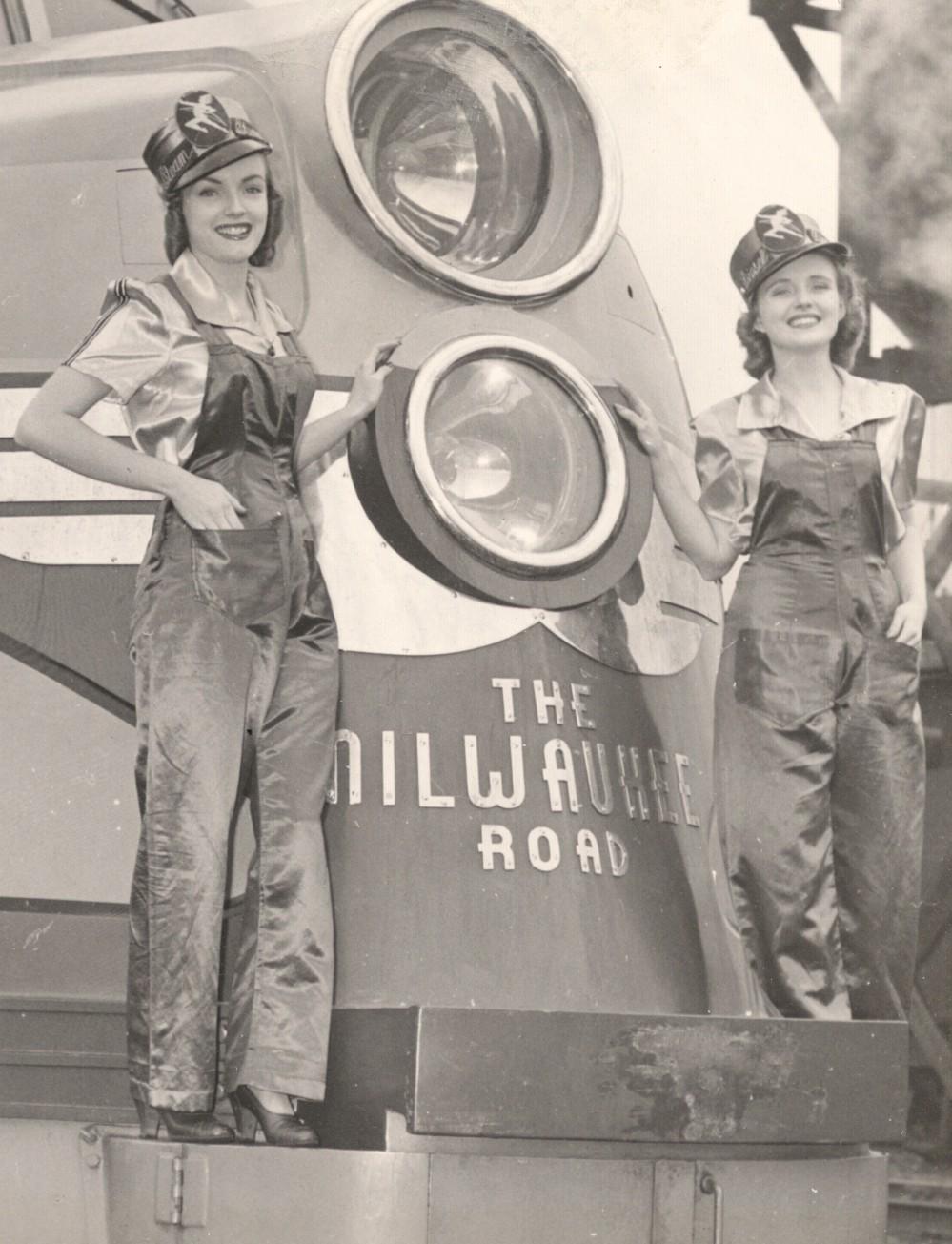
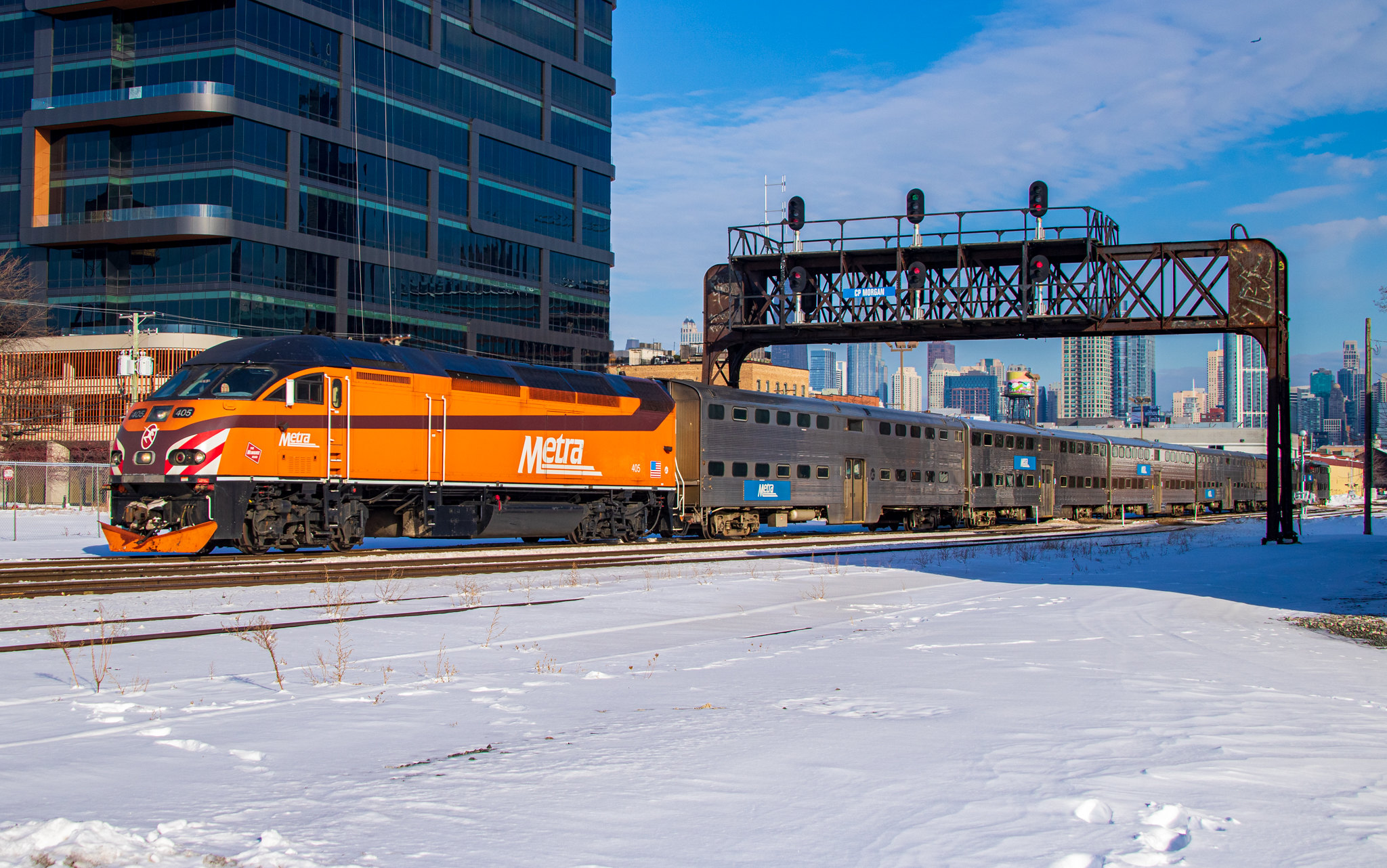
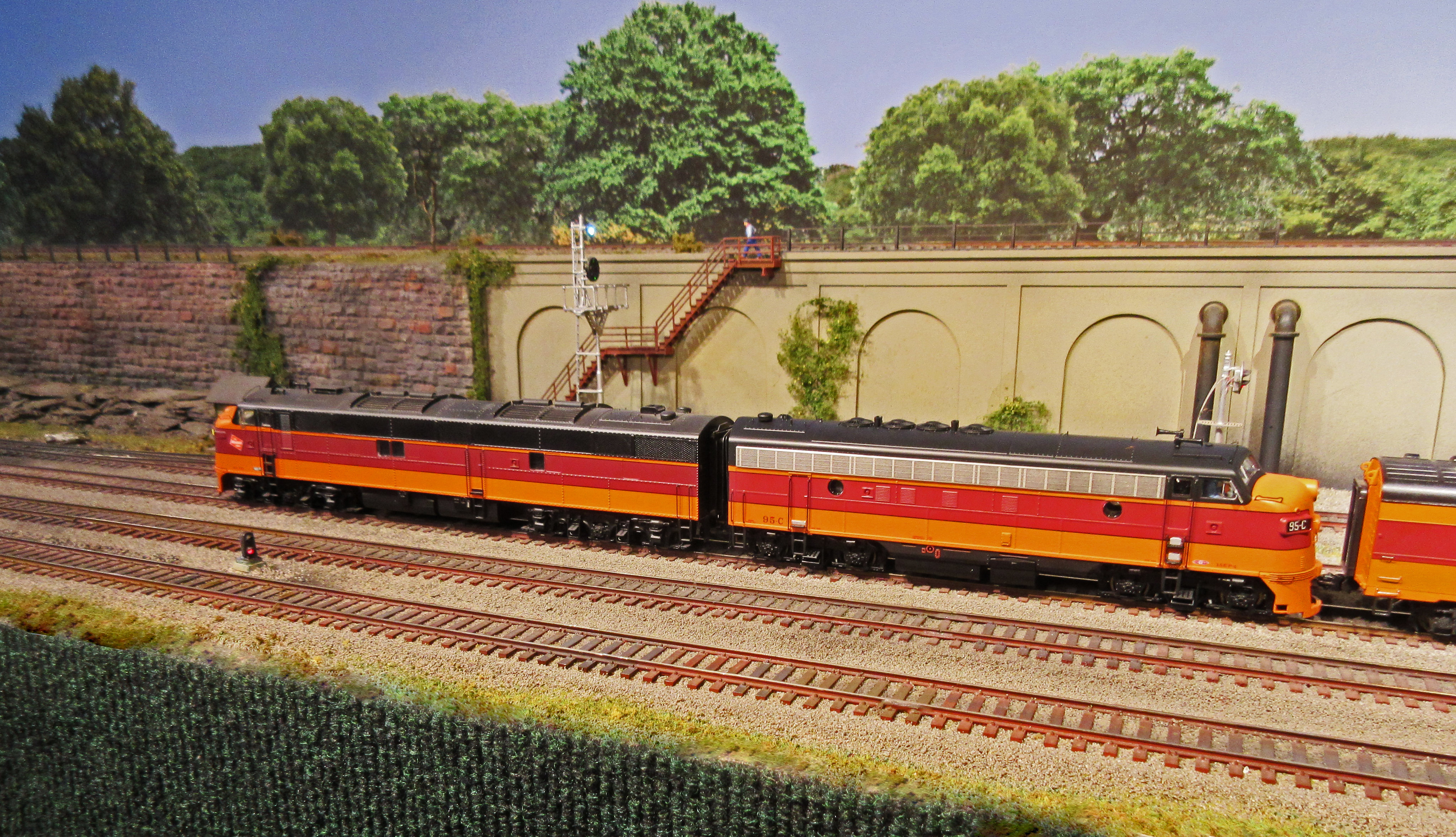
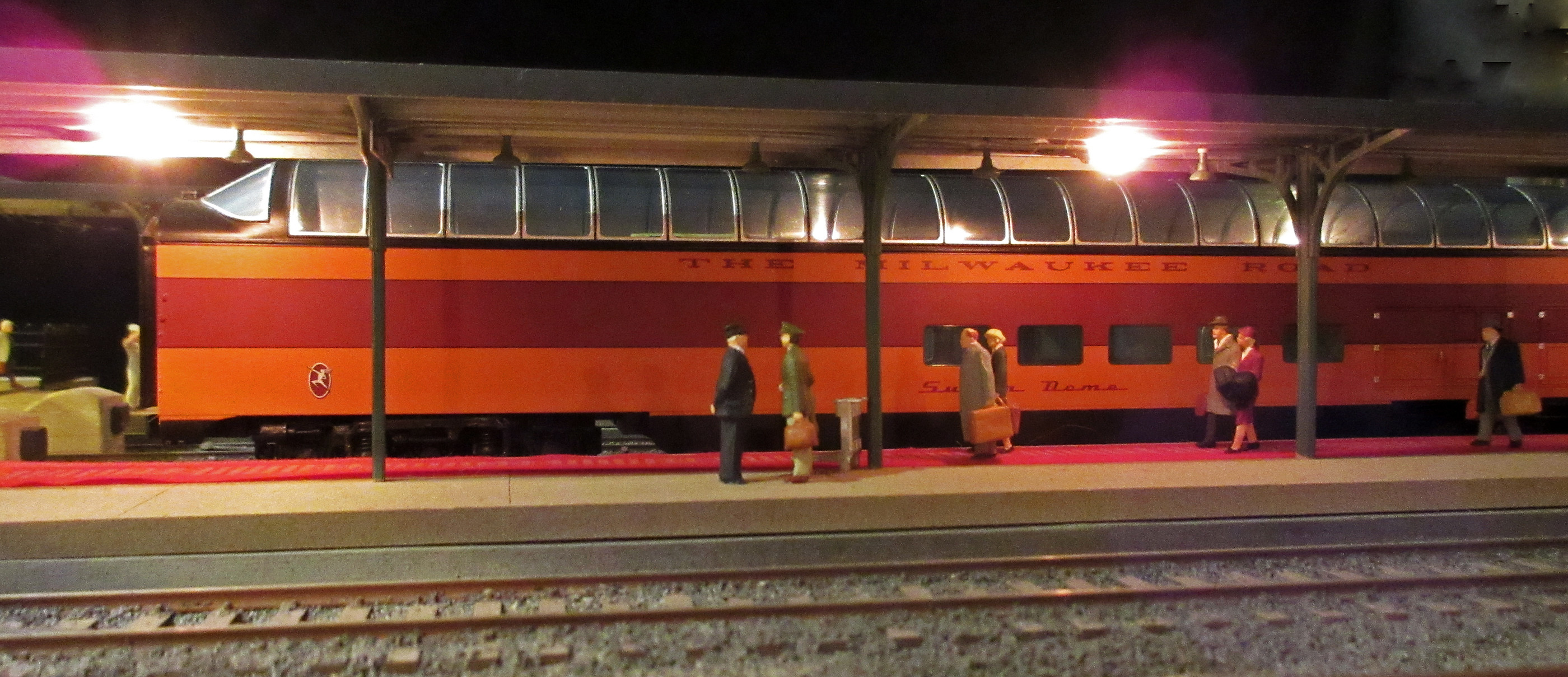
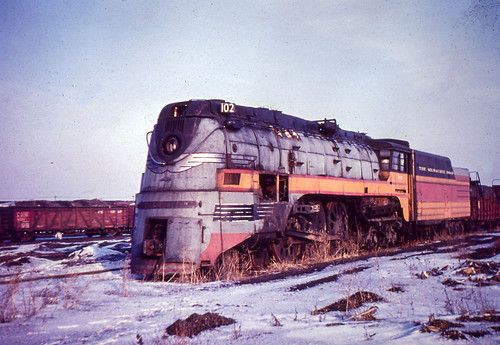
In my opinion, the Milwaukee Road is not all that well known to Chicagoans in spite of the fact that it was a Class I railroad from 1847 until 1986. Yet, the Chicago, Milwaukee, St. Paul and Pacific Railroad (CMStP&P), better known as the Milwaukee Road, was one of the three Railroads that built Chicago’s Union station along with the Pennsylvania Railroad and the Chicago, Burlington and Quincy Railroad.
There is a plaque in the mezzanine at Chicago Union Station that best describes the Milwaukee Road in its heyday, and the marker description reads as follows:
“The Milwaukee Road (Chicago Milwaukee St. Paul and Pacific Railroad) was one the three Railroads that built Chicago’s Union station. In 1956, the Milwaukee Road was the third largest railroad track mileage (15,846) and sixth largest in revenues ($254 million), and employed more than 27,400 people.
Famous Milwaukee trains included the Olympian Hiawatha and Columbian (Chicago to Seattle), Morning and Afternoon Hiawatha (Chicago to Minneapolis), Midwest Hiawatha (Chicago to Omaha), Southwest Limited (Milwaukee/Chicago/Kansas City) and the Copper Country Limited (Chicago to northwest Wisconsin/Michigan). The design and features of The Hiawatha trains made Milwaukee Road one of the few railroads to make a profit on passenger service during the 1930s. These same trains moved thousands of troops during World War II in the 1940s.
Autos, trucks, and airlines took away much of the passenger and freight service in the 1950s and 1960s, and by 1977 the railroad filed for bankruptcy. It was sold in 1985 to the Soo Line railroad and local lines to Metra. Metra’s Milwaukee-North and Milwaukee-West commuter lines were once lines to the northwest and midwest. The Chicago Transit authority’s Red line north of Wilson Avenue and Purple Line were also once a part of the Milwaukee Road.
Amtrak’s Hiawatha service between Milwaukee and Chicago continues The Milwaukee Road’s tradition of high speed train travel. This station is a reminder of this one great railroad’s presence”.
Brief History of the Milwaukee Road
The history of the Milwaukee Road is both colorful and checkered.
The Milwaukee & St. Paul acquired the St. Paul & Chicago in 1872. In 1873 the Milwaukee & St. Paul completed a line from Milwaukee south to Chicago and a year later added “Chicago” to its name.
In the next few years, the road built or bought lines from Racine, Wis., to Moline, Ill.; from Chicago to Savanna, Ill., and two lines west across southern Minnesota. The road reached Council Bluffs, Iowa, across the Missouri River from Omaha, in 1882, and reached Kansas City in 1887. In 1893 the Chicago, Milwaukee & St. Paul acquired the Milwaukee & Northern, which reached from Milwaukee into Michigan’s upper peninsula.
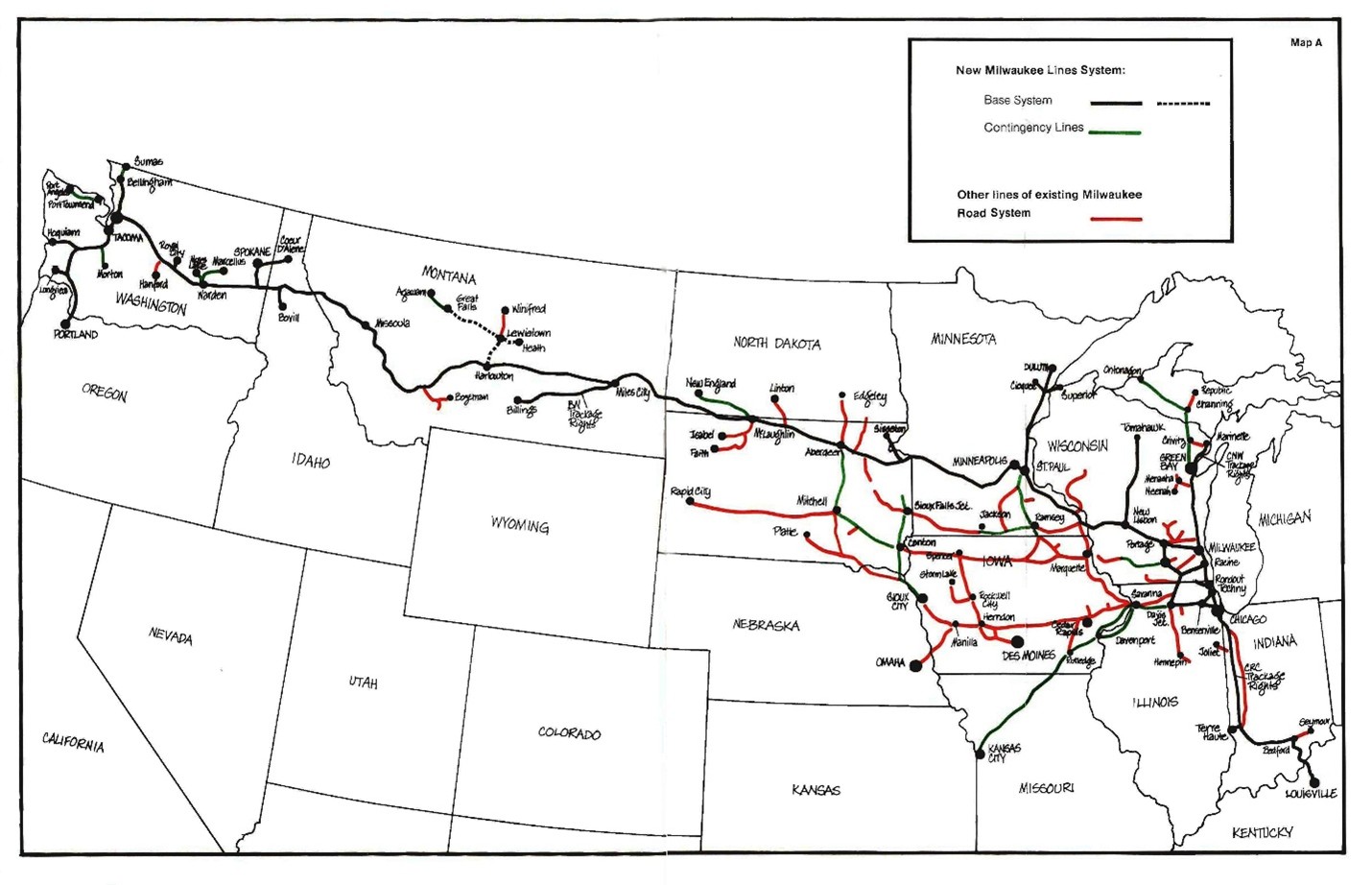
In 1900 the Chicago, Milwaukee & St. Paul was considered one of the most prosperous, progressive, and enterprising railroads in the U.S. Its lines reached from Chicago to Minneapolis, Omaha, and Kansas City. Secondary lines and branches covered most of the area between the Omaha and Minneapolis lines in Wisconsin, Iowa, and Minnesota. Lines covered much of eastern South Dakota and reached the Missouri River at three places in that state: Running Water, Chamberlain, and Evarts.
Source: railfanguides.us
Pacific Extension
By the 1880s the CM&StP had stretched to a more than 5,000-mile system reaching several Midwestern states. To effectively compete with rivals Northern Pacific and Great Northern Railways the CM&StP felt it needed its own line to the west coast instead of simply receiving interchange traffic.
In 1901, the first surveying work began and it was estimated the more than 1,400-mile western extension would cost the railroad around $45 million adding more than 25% to its total system mileage. However, four years later this number was readjusted to $60 million.
What made the extension so expensive was partly due to the right-of-way costs. Unlike the GN and NP, the CM&StP was not given free government land grants and had to purchase all of its land from private landowners.
In 1905 the railroad’s board approved the building of what would become known as the Pacific Coast, or Puget Sound, Extension.
A year later in 1906 the actual construction on the western extension commenced, eventually reaching more than 1,000 miles into western Montana.
The Milwaukee Road chose to electrify the part of its Chicago-Puget Sound line that crossed three mountain ranges in Montana and Idaho. By 1917, 440 miles of the Milwaukee’s transcontinental line between Harlowton, Montana and Avery, Idaho were under wires. Three years later, 210 miles in central and western Washington, crossing two mountain ranges, were also electrified. In the 1920s, the Milwaukee Road advertised that it operated “The World’s Longest Electrified Railroad.”
The Milwaukee Road continued electric operations two decades after most other electrified sections of railroads outside the northeast U.S. converted to diesel-electric engines. In 1973 Milwaukee management, faced with rising costs of using equipment many decades old, decided to end electric operations over the Rocky Mountains; the last such trains ran in June 1974.
For decades, the Milwaukee Road for decades suffered financial weakness and went through three bankruptcies. The first, 1925-1928, resulted in a change of name, to Chicago, Milwaukee, St. Paul & Pacific Railroad. The last, in 1977, resulted three years later in the end of rail service west of Miles City, Montana. Most of the tracks were removed in the early 1980s.
Chicago Switching District
Chicago was an important for the Milwaukee Road’s freight and passenger services. It operated 4 rail yards, three for freight and one for passenger services.
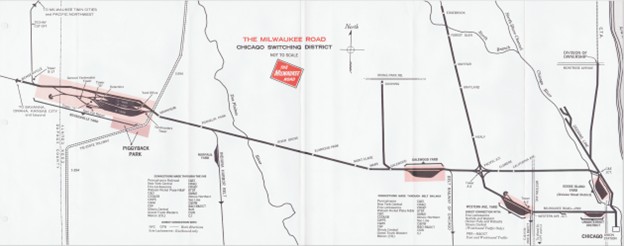
The Bensenville yard dates back to the first freight yard of the Milwaukee Road in 1916. By the early 1950s, it had grown into a large marshaling yard with 70 directional tracks. The Milwaukee Road was taken over by Canadian Pacific in the late 1980s, which rebuilt and modernized the facilities. Today, Bensenville Yard is CPKC’s largest freight and marshaling yard in the U.S., boasting 21 tracks on the western part and 34 on the eastern part of the yard. Bensenville yard is located just south of O’Hare Airport and begins at Mannheim Road on the east, extending all the way west to Bensenville.
Galewood Yard was the Milwaukee Road’s second largest yard in Chicago and is still in existence today, owned and operated by CPKC. It is located several miles east of Bensenville Yard between Narragansett and Laramie Streets on the west side of Chicago.
The Milwaukee Road’s Western Avenue yard was the location of its passenger car storage and servicing area. It still exists today, and it is operated by Metra as a commuter line servicing facility. It is located a few miles west of Chicago Union Station.
Goose Island at one time was a major hub of railroad activity for the Milwaukee Road with a yard on the north side of Division Street with more than two dozen parallel tracks and a full-time switcher. Transfer runs were made to the Division Street Yard by trains led by road units over the Bloomingdale Line from the Galewood Yard. During the 1970s Goose Island fell into decline as one by one industries relocated or went out of business.
The End of the Milwaukee Road
The company experienced financial difficulty through the 1970s and 1980s. In 1980, it abandoned its Pacific Extension, which included track in the states of Montana, Idaho, and Washington.
Eventually, three railroads vied for what remained of the Milwaukee: the Chicago & North Western, the Grand Trunk Western, and the Soo Line.
Soo Line, though not high bidder in the “auction,” was awarded the Milwaukee Road in February 1985 and merged it on January 1, 1986.