The Mobile Railroad!

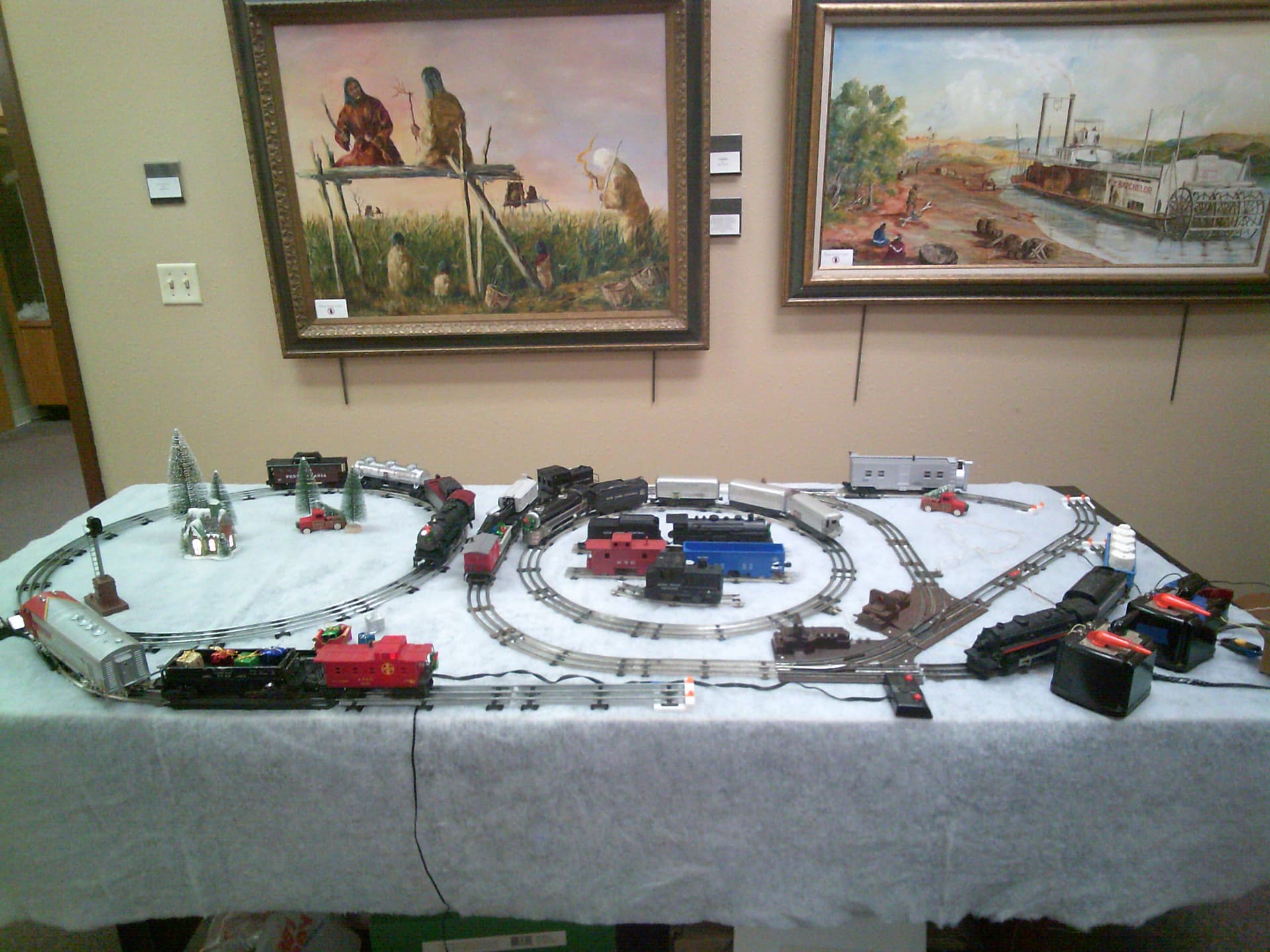
For the past three years now I’ve been bringing O Gauge model trains to the local museum. In addition, for the last year, I’ve been doing it as a member of the local railroad club. This will now be the fourth year. I discovered that setup is becoming quite a tremendous task, given the overall complexity of the display. For example, here’s this year’s display.

So, I came up with a new plan: build a fairly small railroad that can be carted out to any location and set up easily. Here is the track plan:
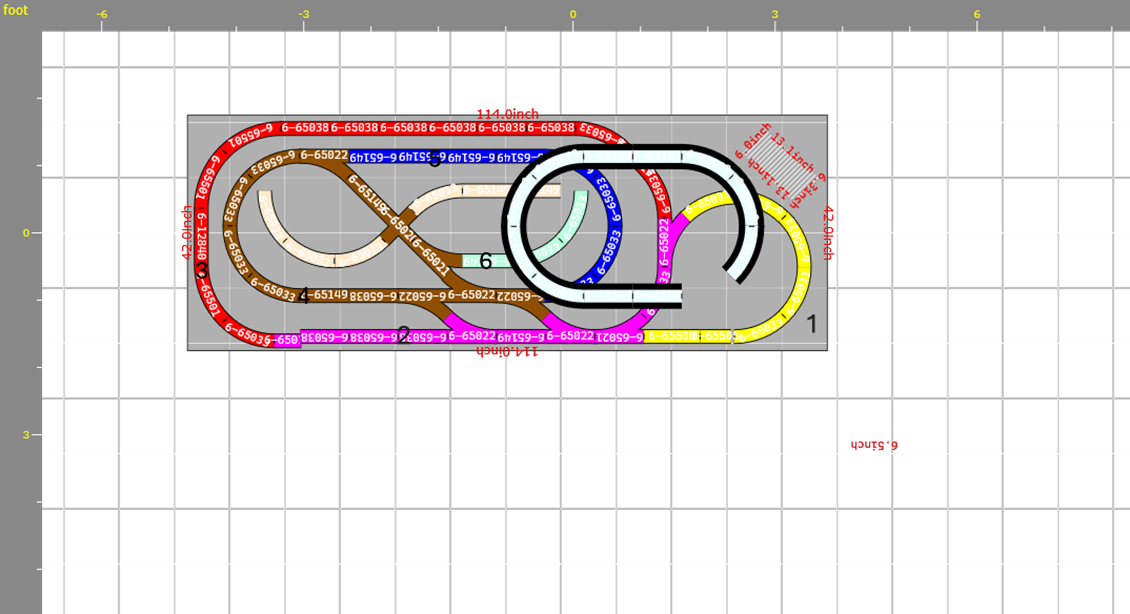
As you can see, I’ve managed to cram quite a bit into a small space. Note the overhead loop–that is missing a section because Trax is broken (still); it’s supposed to be complete. I have a somewhat complex method for wiring it that is largely designed to make it simple to operate. You see, the other day I found three real neat gang switches. They’re the kind with a mechanical label that declares whether they are on or off, and are set up so that when one is pushed down any others that are down go up, thus meaning that it can be in only one position at once. The tracks in the diagram are color-coded by blocks, and I suppose that you’ve immediately spotted an apparent flaw in my plan. If only one block can be selected at once, then a train won’t be able to make a seamless loop even before it runs into deselected trackage, causing it to stop and cycle its reverse unit. Ah, but I thought of that already! My system is that the individual switches select not blocks but instead routes. For example, one button will cause block 3 and block 2 to be controlled by the throttle, thus allowing a train to be run in that circle. This will simplify operation somewhat and is definitely not an excuse to let me use the super cool gang switches.
Anyway. One potential issue is if the same route or some of the same blocks are selected at once for two different throttles. At best, this leads to confusion, and at worst, it leads to short-circuits. Not good! Here’s my simple solution: wire it so that one throttle (the one of the left side of the Type VW) has priority over the other one. That way, when both are selected for the same block, then only the left throttle controls the block. In order to make it clear what throttle is actively controlling what block, indicator lights on the control panel will be color-coded. I’ll use bicolor LEDs: if the left throttle is on the block, they’ll be red, if the right throttle, they’re green (thus corresponding to the lights on the transformer itself), and if neither throttle is on the block then it will be off entirely. This has the convenient side-benefit of showing yellow if both blocks are selected.
The trolley line will be controlled by the thumb dial on the VW, as will the overhead line. I might hook them up to that 18B that I ordered, provided that it works and that I can find somewhere to fit it in. More details coming soon when reality kicks in and ice hits the snowblower (in other words, when I begin work).

4 Likes

Cool :smiling_face_with_sunglasses:

2 Likes

Thanks!

1 Like

Wow. My reaction to the photo of the first traveling roadshow layout: :face_with_spiral_eyes:
My reaction to your new track plan: :+1:
Looks good!

2 Likes

Thanks!
It still amazes me that, four years ago, all I had a was a beat-up Marx clockwork 591, an oddball Menards flatcar, and a mismatched circle of track!

2 Likes

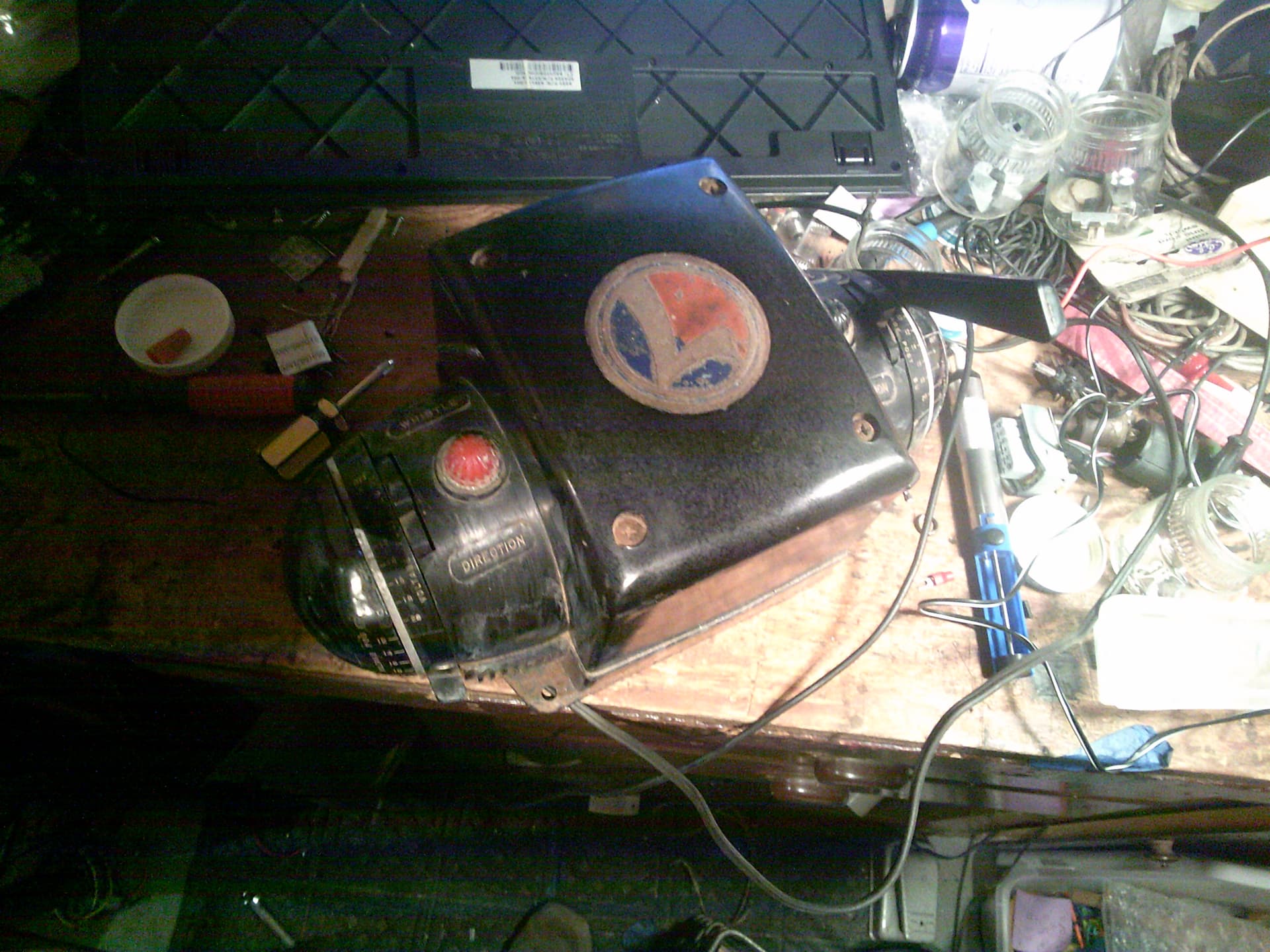
Well, my $70 Lionel Type VW has arrived ahead of schedule. Did I get my money’s worth?


Well, as promised, it does work and outputs a reasonable voltage. In fact, the voltage output is lower than a lot of other Type VW/ZW transformers I’ve seen–right around 18v instead of 20v–which is an advantage for me. Now, looking at the case, it’s pretty clear that it hasn’t exactly been pampered. In fact, my theory is that there was some water involved at some point, given the rust on the screws, post nuts, and the base plate. Surprisingly, it looks quite clean on the inside. Of course, the archetypal problem with Lionel transformers plagued this one also: the cord was pretty deteriorated. This I suspected from the listing. Anyway, I replaced the cord with little difficulty. So, it outputs voltage as it should, the direction buttons work, the whistle works (which surprised me–the seller thought that the diodes should be replaced), and the circuit breaker works. Some cleaning and it will probably be a pretty spiffy transformer for the DR&MR Club’s Mobile Railroad!
By the way, I know that it looks like the left handle is missing in the picture, but it’s completely intact. Must be some weird thingy with my cheap camera, coupled with the angle and the light.

3 Likes

Yeah, that’s how it all starts brother. A rediscovered childhood train set, an impulse buy at a flea market or an antique mall, and the next thing you know… :scream:

3 Likes

Yeah. If my parents had known, they probably would never have let the thing into the house!

2 Likes

That is essentially my story. Back in 2004, I got out a box of American Flyer trains stored away in my basement. Neither locomotive ran, so I decided to venture over to a LHS to see if I could find an HO scale version of my PRR steam engine and a C&NW diesel switcher. Came home with an HO scale PRR steamer and few pieces of sectional track. The old AF transformer still worked so I set up a simple oval. That’s all I wanted to do. :grimacing:

4 Likes

My parents didn’t even buy my first set, it was a gift from my half sister to my dad four years before I was born because he never had a toy train growing up.

In his defense he was born in April of 1902 on a farm where things were so bad he was sent to live with his aunt. But oh the trains that he could have had between 1902 and 1920 when he graduated from Alliance High School!

You may recall another similarly deprived child from his generation (born December 1901) who went out and bought himself a toy train set in 1947. :wink:

5 Likes

Actually, I can’t say that I recall this fellow.

1 Like

3 Likes

Boy, did HE make up for lost time! :rofl:

3 Likes

OH! Now I remember!

1 Like