I recently purchased the JL Innovative Design kit “STORM LAKE MOBIL”. It’s a very nice gas station and also my first wood kit. I have built many plastic kits in the past from Walthers but wanted a little bit more detail and challenge this time around. Anyways, here are some of my questions:
Do I need to prime the wood prior to painting? If so, what products should I look into?
Could I use water based spray paints?
Will my Elmer’s all purpose white glue work? This there a better wood glue?
Those are my main questions but please share whatever knowledge and experiences you have, thank you.
Lotta people ask about priming. In full sized carpentry we prime the wood to make the wood grain less noticable. The soft grain layers soak up paint faster than the harder layers and thus the grain shows thru the paint. Putting on a coat of something transparent, shellac, varnish, lacquer, whatever on the raw wood fills the soft grain and gives an even coat for the paint to stick to.
Models are usually basswood, which is so fine grained that the grain simply doesn’t show, and a prime coat is unneeded. I brush paint my wood structures with Floquil and it comes out fine.
Water based paint ought to work fine, the water should evaporate before it has time to warp the basswood.
Elmers white glue works fine on wood. The yellow carpenters glues are somewhat stronger and more waterproof, but the white glue is strong enough and you don’t plan on getting the model wet. Both are slow drying and the joints will come out better if clamped overnight. Cellulose cement (“Duco” cement) is faster drying and strong enough for all but the most important joints.
Painting BOTH sides of sheet basswood can prevent warping. If just one side is painted, the wood can absorb moisture on the unpainted side and warp. Shellac goes on quickly and is moisture prove.
If you plan to light the structure, a coat of paint on the inside will keep light from leaking out thru joints and cracks.
On multistory structures, it’s worth installing flooring, so the view in the second story windows shows a floor rather than a bottomless pit.
Fine black sandpaper makes a decent roofing material.
Some extra bracing of walls and corners may prevent ugly warping over the years.
I glue my wood structures with Tamiya paint when the structure is built. Next step is adding e.g. Grandt Line windows (also painted). If you first paint the wood and glue then, you can get color problems with the glue.
If I build a trestle, I paint , stain the wood and glue then. Here’s a HowTo example what I did with my station for Diamond Valley.
Very interesting stuff, just when I thought I knew a lot about building models. That’s why I love this hobby and this wed site, there’s always more to learn. Thanks for the reply to BOTH posters above, your time and shared knowledge is very much appreciated. Thanks again!
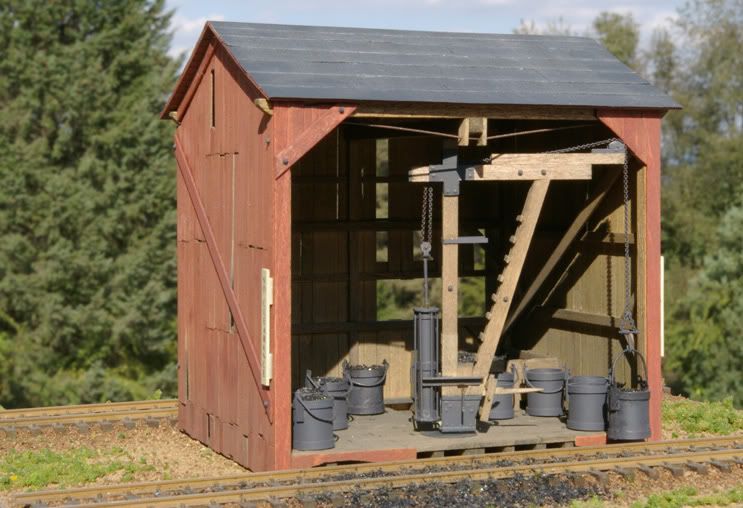
JG - I’ve got to take exception with some of the foregoing advice. I’ve been building and scratchbuilding with basswood for a long, long time and will offer the following. I always prime my wooden structure parts and this approach is also recommended by a number of the laser kit manufacturers as the first step in construction. And always paint both sides. The priming can be done with simple spray can auto primer, laid down in a couple of light coats. Water-based primers, or top-coat paints for that matter, applied to unprimed basswood have the potential to warp the walls and I’ve seen more structures with warped walls done by novices over the years than I’d ever care to relate. After they are primed, it’s also a good idea to press them between some books overnight. Doing so will insure their flatness for years to come. Likewise, bracing is highly important. Thoroughly brace any large, tall, or lengthy walls to insure their longterm stability. My advice for beginners is to over brace, as most novices often don’t add nearly enough. It’s a sad thing to spend 20-30 hours on construction only to see the building starting to deform after a few weeks, or months, of exposure to varying humidity. As to glues, I do often use white glue but most experienced builders employ yellow wood glue, which many hobbyists in my circle say is decidely stronger longterm. Of course, which ever type you use, apply it carefully. Nothing ruins the appearance of a wood structure quicker than glue lumps showing under the paint. Carefully apply glue with a toothpick, or similar applicator. Build any structure in subassemblies and then bring those together to finish the work. Work on several subassemblies at a time to allow the glue on the first to set up well while you work on the next. Never be in a hurry and allow large subassemblies to dry over night before going to the next step. Here are examples of some of my work over the years : [IMG]
 [IMG]
[IMG]