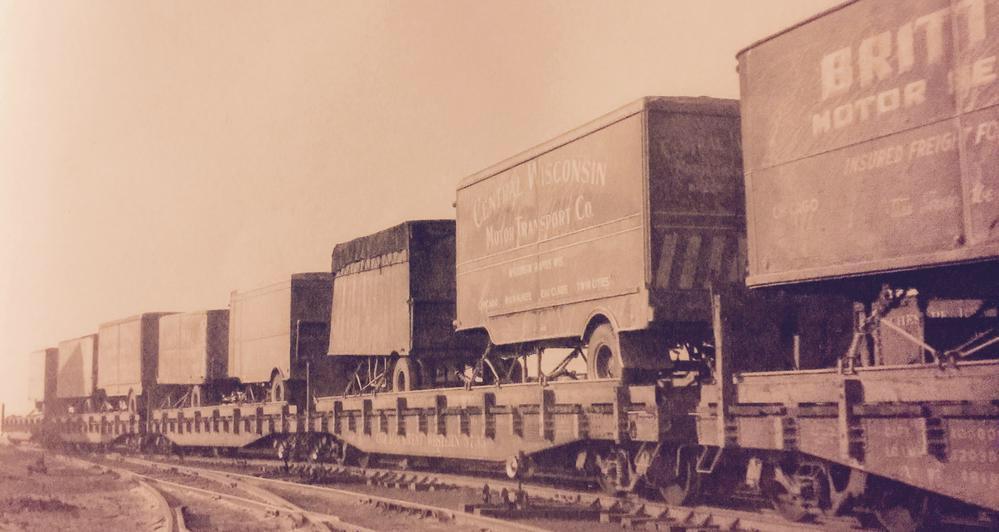
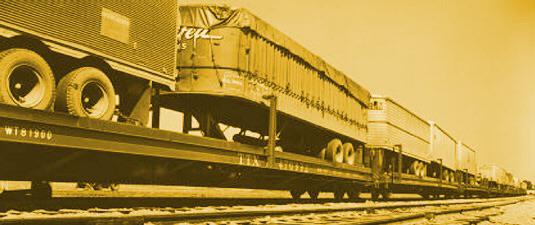
I stumbled upon this picture of tank trailers on a flatcar, how often were trailers of another type other than FlexiVans shipped via flatcar?
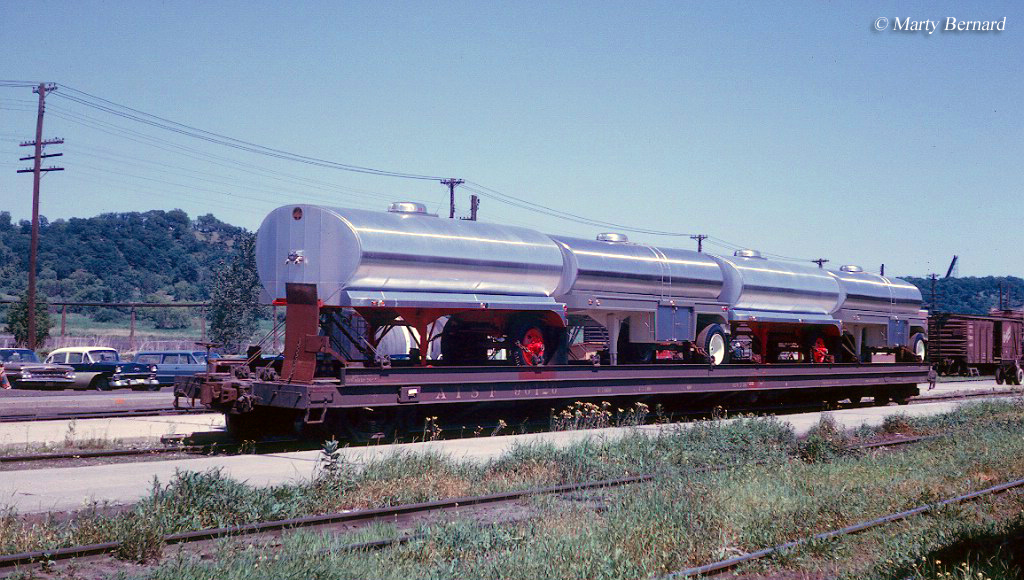
I stumbled upon this picture of tank trailers on a flatcar, how often were trailers of another type other than FlexiVans shipped via flatcar?
All the time. That’s because the original NYC Flexi Vans were just the container portion of the trailer which was slid off its chassi via a special loading device onto a flatcar.
Milk express cars:
http://www.canadasouthern.com/caso/non-nyc/images/picx-101.jpg
Note the steam line, buffers and safety chains for passenger service. These MDT cars also had turntables, similar to the Flexi-Van setup.
Ringling Brothers used to move a variety of trailers on flat cars occasionally, too.
Good Luck, Ed
Have you not seen the typical TOFC traffic? The Flexi van was by far the least common type. Most TOFC traffic has been standard trailers (and not Flexi van trailers) on standard TOFC flat cars.
The types of trailers were mostly dry vans but tank trailers and flat bed trailers were also on flat cars. The D&RGW regularly hauled flat bed trailers (usually loaded with pipe).
Quite apart from tank cars, I have seen flatbed trailers (loaded and empty) on TOFC flatcars, and have seen many photos of auto carrier trailers on flat cars, in the interim beween double door automobile boxcars and actual double or triple deck auto racks.
Dave Nelson
Please forgive me, I made a mistake in my terminology. I was meaning closed in trailers or vans, I did not realize FlexiVan was a different type of trailer.
Anyways, that’s what my question was, were flat trailers, tanks, etc… transported via flat, that’s what I wanted to know.
I saw a really weird site one day in the early 1990s when I was working in the old location for the Florida Rock limestone quarry off of Alico Road in Lee County, Florida.
.
There was a string of flatcars with open top dump trailers being loader by one of the elevators.
.
I have no idea where it was going or why it was being loaded this way. I wish I had a picture, but it was an opportunity forever lost.
.
-Kevin
.
Yes, bazillions. There are tons of photo’s of them in books and on the internet etc. Since you are young and maybe don’t live anywhere to see many freight trains, I’d guess that’s why the question about something which most of us have seen lots of for many years.
TOFC (Trailers on Flat Cars) traffic is far less common now than in the past as intermodal has evolved and changed to embrace containerized shipments, you still see some but typically they are more on spine cars and I have seen some passing through northern Virginia.
COFC, Containers on Flat Cars was also fairly common and evolved quite a bit in the 1960’s and 1970’s and in the late 1970’s when well cars began being developed to more efficiently handle containers:
http://www.railgoat.railfan.net/spcars/byclass/flat/f070-81.htm
Here is a history of the Trailer Train or TTX corporation which has pretty much been the primary rail company supplying flat cars to the carriers which have hauled trailers - the trailer on flat car traffic started to really boom in the 1960’s and evolved over the next several decades:
Yeah mainline freights aren’t in my rail fanning reach, the closest currently operating line is a short line between two plants and the traffic is mostly tank cars and covered hoppers, the other day though I saw a string of flats loaded with pipe, the power on this line is a ex-ConRail SW1500 that’s about it.
Google and Youtube are your friends. You should be able to find tons of info on TOFC and COFC freight trains there.
Since I am modeling the late 1970’s thru early 1980’s, I’ve been working on plenty of 85 and 89 foot long flat cars and 40 and 45’ trailers to go on them. I’ve gone a little nuts collecting the Athearn Fruehauf trailers which are very accurate for 1970’s trailers but getting hard to find and up up up in price. Trainworx has been recently producing 40 foot straight frame and drop frame trailers in HO as well - not cheap but very nice. Athearn’s used to come in 2-packs for around $22 to $24 but several years ago decided to sell singles for about the same price, effectively doubling the cost!
While 45’ trailers did exist in the 1970’s, they appeared to be relatively uncommon until about 1982 when changes occurred allowing them to become standardized on railroads. Companies began rapidly stretching existing 40’ trailers to 45’ long in 1982 and after and 89’ flat cars were rapidly modified to carry 2 45’ trailers. Prior to 1982, they could only carry 2 x 40’ trailers or 1 each 40’ and 45 trailers.
Here is some data you can read if you are having trouble sleeping at night:
Trailer Train reporting marks from RMC magazine article (August 1990):
(I noted that the 89’ flat car PTTX markings are not included but keep in mind the date of the article)
ATTX - 75’ all purpose flatcar (center a
I guess it depends on where you live but there is no shortage of trailers on flatcars or spine cars in southern California. Trains almost always have plenty of both style railcars mixed together. Every day several trains entirely of trailers leave here heading east. Most of the trailers are standard box style but an increasing number of them are refrigerated.
There are more trains full of trailers than there are containers but there are a lot of containers. Trailers and containers are the top two types of trains these days. Sometimes trains coming from the east will have both trailers and containers but almost all of the ones originating in California heading east are solid trailers or solid containers. Containers are not always on double stack well cars. Sometimes there are containers loaded on all purpose flatbed rail cars.
Once in a while I will see a few empty container chassis on flatbeds. It is very rare to see flatbed trailers and I never see tank trailers. Sometimes I see a trailer that the 5th wheel is on one flatbed railcar and the wheels are on another one. I guess there is no rule saying that a trailer has to be completely on one railcar only.
I live near an east-west N-S mainline west of Manassas VA and there is a lot of traffic but mostly here the intermodal are containers but there is a significant ammount of Trailers too, mostly really long trailers - nothing like what I remember from the olden days.
That would be a TTEX flat. They are two old flats connected with a drawbar. Thus, they officially ARE one railcar.
A regular 89’ flat can only carry one 53’ trailer. A TTEX flat can carry 3, with one bridging the two parts.
They seem to be in dramatic decline these days. Also 89’ flats, for that matter.
Ed
I realize it’s only ‘anecdata’ without real numbers, but judging from images of ‘early’ TOFC (say to the mid-1960s), there was a greater mix of non dry-van trailers (and refeers) vs. flatbeds, dump trailers, tank trailers etc., maybe more in line with their ratios on the road. By the early 1970s it seems van trailers greatly predominated.
Of course, by the start of this decade COFC outnumbered TOFC by a (IIRC) 9 or 10 to 1 ratio.
Will Stephen make the association with the music, or did he not see the movie? [}:)]
I’ll try to watch it in a little while, PTTX also could be a flat loaded with pipe, at least that’s what I saw the other day.
“Modern” TOFC started in 1936 on the CGW, where private trucking companies shipped on railroad-owned flats. The NH was the 2nd modern TOFC carrier in 1937 and used the CGW method. The NH was the #1 TOFC railroad in the USA until SP got into the act in the early 1950’s.
A common trailer-type hauled on these early railroads would have been “rag tops”. These looked like regular vans but they had a removable canvas roof. This allowed easy loading/unloading from above. See pics: https://ogrforum.ogaugerr.com/fileSendAction/fcType/0/fcOid/40145252483919200/filePointer/40849089162899856/fodoid/40849089162899852/imageType/LARGE/inlineImage/true/image.jpg
https://ogrforum.ogaugerr.com/fileSendAction/fcType/0/fcOid/40145252483919200/filePointer/40849089286875947/fodoid/40849089286875945/imageType/LARGE/inlineImage/true/image.jpg
I just found this post and wanted to add a few observations as a long time intermodal fan. There are quite a few pics out there as mentioned above, but some of the good sites I used to see them on aren’t around anymore. I know the railroads had plenty of types other than conventional vans in regular service. Flatbeds, both open and covered (wood sides and a tarp), as well as drop frame vans were most common behind regular vans.
Unusual trailer types (to intermodal) were more easily seen when I started railfanning and taking pictures in the mid-80’s (likely longer, just that I didnt see or photo them), while ramps for circus-style loading were still rather common, in addition to overhead lifting. I have pictures of shorty beverage trailers fitted with plywood padding to protect the trailer sills from the overhead lift clamps, as well as new Wabash, Great Dane, and Stoughton vans of various styles not set up for TOFC protected the same way on their journey to distant new owners. These were seen most frequently on BN trains between Chicago and the Pacific Northwest and included trailer styles which I dont see here in WI such as tri-axle vans with steerable tags used in that area of the country.
We (my employer, UPS Freight) currently have a very old (late 70’s) 40’x96" Strick trailer that was never set up for TOFC but had plywood installed to protect it during transport. The trailer spent years in service with Overnite Transportation, and is now semi-permanently attached to our dock in Milwaukee as a storage trailer. The plywood guards were never removed and are finally falling off on their own! Point being, many names or styles of vans not often seen on rails did turn up OFC during new delivery or in-service repositioning. We unloaded Keebler rail-gate pups a few years ago that had been loaded near their builder, shipped OFC, and we unloaded them before Keebler came and picked them up, a common way many companies recieve new trailers.
There at one time was a steel, tr
I’d add that you’ll want to consider the relative advantage TOFC offers for the ‘other’ types of trailer. I see relatively little benefit in sending much tank traffic that way, especially pre-Staggers, as between pipelines and tank cars there’s comparatively little advantage, and of course flexible load delivery wholly on-road is more direct and possibly more convenient. (That is different from logistics of ISO tank containers, as used for example when Europeans send tank loads by ship, but those too are relatively rare and I think usually seldom move in COFC, although still more frequently than loaded tank trailers would as TOFC.
When you saw the ‘rock train’ being loaded, was there something like an Interstate Highway construction project nearby? Or was it more specialized cargo like phosphate rock going to a user with limited or unavailable siding access?
.
If this is about my earlier post, I am sorry, but that was 20+ years ago, and I really have no idea what was going on locally at the time.
.
I used to do a lot of work in the Limestone Quarries in South Florida, and I saw all kinds of unusual things that only happened once or twice. I really do not know the stories around any of them.
.
I do know that these complanies would do all kinds of “outside of the normal” things to make a sale and meet a customer’s needs.
.
The tracks to Florida Rock’s Alico Road quary were removed in the mid 1990s.
.
-Kevin
.