After the post about soldering, the light bulb went off. How about a listing of your favorite tools you use for anything and everything on your layout. [?] What specifically do you use the tool for?
For example, a tool that I just love is a Phillips Head Screwdriver made in Germany. It is red and black and the top rotates such that I can keep good pressure on the screw as it is turned. I use this screwdriver to take apart engines and cars on both the O gauge and G gauge layouts.
The tool I use most frequently is the good old lineman’s pliers, wrapped in special insulation to prevent electrical shock (the insulation had to be heated in water to make them slip over). I find myself using these pliers for just about everything: spiking, bending metal, cutting nails (the cutters never seem to dull after years of cutting steel), holding metal that has been heated or needs grinding, hammering, etc etc.
When you first get a pair of these pliers, they are a bit tight and need breaking in. The best way I found to break them in is to heave them repeatedly from a 10 story building onto the pavement.
They are the pliers to the extreme left with the red handles. My friend, who is a telecommunications expert, first introduced me to these pliers. They are from Home Depot and were not cheap (forgot price). Had to purchase the slip over handle covers separately.
To me, the 2 most essential tools are knowledge and a sense of humor. All the conventional tools I’ve used have just been pulled from my tool box. And I really can’t pick any that were “essential” But knowledge is the one thing that moves me forward when I’m in a jam or can’t figure something out. I ask a question here and get the right answer much more often than not. When I can’t seem to do anything right, a strong sense of humor comes in handy. Otherwise, my train room would have a lot of holes in the walls from things being thrown at a high velocity.
A foam engine cradle. No need to buy a fancy one. Start with a cheap piece of 6" X 6" X 18" cushion foam. Just cut out a central channel roughly 3" X 3" X 14" with a sharp box knife. Neatness doesn’t count either, just as long as you don’t cut through the sides.
This jig comes in handy for any number of jobs. Soldering, disassembly, lubrication, etc. It holds the work steady and saves the finish.
For scratchbuilding structures from wood slatting - this is the cat’s butt:
The “Chopper” lets you set up and cut equal length slats at a number of different angles - really great for making loading docks or structures with slatted siding.
Mini needle-nosed vise grip pliers, long-nosed pliers, lineman’s pliers. diagonal pliers, umpteen scredrivers of all sizes, Weller soldering gun, 4 oz. ballpeen hammer, awl, wire stripper, many sizes of clamps and wooden spring-loaded clothespins, spray bottles, several drills, Moto Tool, spiral saw, allen wrenches, AC volt and amp meters, vise, table-mounted lighted magnifier, hot wire cutter,razor knives, hobby knife, razor saw, mini-files,metal straight edges, and asprin,etc, for “train-back” and “train-neck” (for after working under layout).
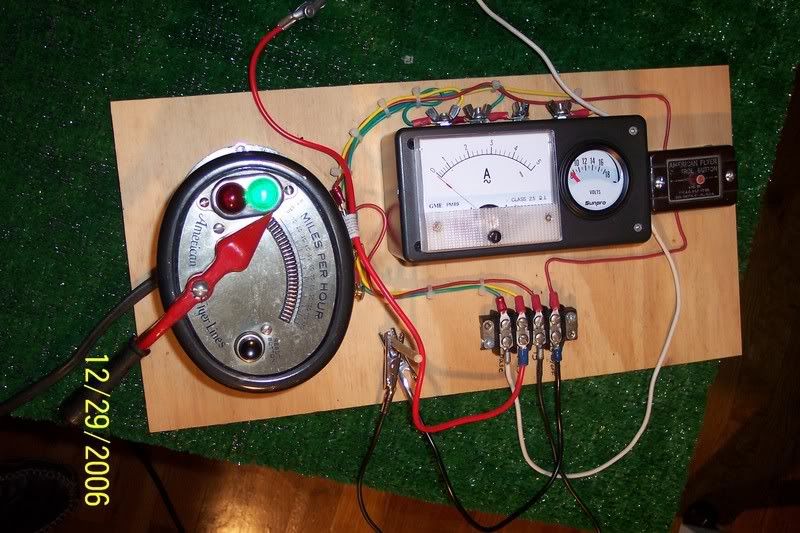
This is my power unit when working on trains or accesories. It is an 8B 100 watt transformer with built in breaker, with a voltmeter and ammeter on the track terminals. The power clips are color codeed and are base white, red track (variable) and two black 15volt, one is continious, the other black clip is 15volt connected to the pushbutton PBNO switch. There is a wooden dowel to hold the clips when not in use to prevent shorting things out. This is mounted on a piece of plywood so it is portable, so after working on a loco on the bench, I can move the rig to the test track an see how the loco works on the track with a load, if in spec. In the picture the rig is attached to my test track.
A great little screw driver that I got from The Train-Station. it has phillips head on one side, and slot on the other. The heads are made specifically for the Lionel screws and it fits about everything. Another must have is the Dremel Tool, great for cutting track and cleaning up some corrosion.
My wife thinks I use vise grips for everything. They’re great for holding a piece while I work on it, as a clamp in a pinch, for clamping onto the sides of stripped screws for removal, for yanking out track pins, and I’m sure I use them for at least 50 other things too.
Most of teh work I have done on my layout is either ascending or descending due to the small space I have to work with. I have to keep the trackside industries fully upright. I have no idea where my Dad got it, but I know it sat around his workbench for a long time.
It depends what phase of a project I’m in. If benchwork, a powered mitre saw, a cordless drill and level. For wiring I have a small pair of wire stripper/cutter than are invaluable and a VOM. With the current activity of redoing passenger cars, a good used tooth brush and an aluminum, through away, roasting pan.