There’s an interesting rig on the rails near our spur today. It looks like a Kenworth dump truck with a tow truck hook on the back. That hook is connected to a sting of about a dozen Santa Fe hoppers. It looks like a MOW crew is working on the ballast. I don’t recall seeing a truck pulling cars before. How would the brakes work in that situation?
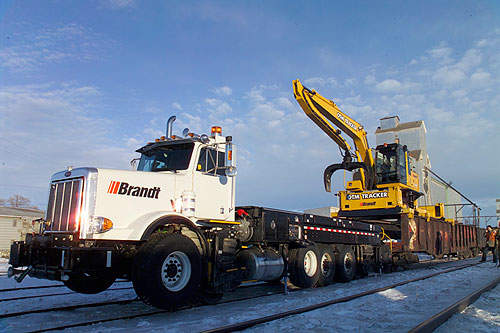
Brandt on track rail vehicles.
The larger hi-rail trucks I have seen have a brake pipe hose and coupler at the back end, so I imagine they can apply and release the car brakes. I don’t know if they have a locomotive style brake valve in the cab, but I imagine they can at least do an on/ off sort of application.
We have a Gradall with a coupler and requisite brake hose. It has been used to move cars a fair distance. I haven’t run it, so can’t comment on the specifics of the brake system.
I’ve watched a front end loader push a half dozen empty gondolas down an industrial track…no couplers!
Is this moved only by rubber against rails traction?
Brandt R4 Power Unit from Brandt Tractor Ltd. on Vimeo
At about 2 mins 25 seconds in the video we have the answer for the train brake for the Brandt truck.
It’s a 26L type valve.
Jeff
Jeff’s video show that a steel wheel is used to put tractive effort to the rail. Brandt claims 50000 pounds of tractive effort - max speed 40 MPH in forward and 25 MPH in reverse.
As info the B&O’s President class Pacifics were rated at 50000 pounds of tractive effort.
Thanks. That was interesting. I’m now convinced this work train was picking up the ties that got swapped out 3 or 4 years ago.
An imaginative railroad marketing person could do some clever work with this power. IF the stupid US Government bureaucrats weren’t in the way again. But then, their job is to delay progress and screw things up.
This Brandt power unit certainly does not belong on a high density, high speed main line. But that’s not where it’s useful. The video shows it being used in freight service. In Canada. Can’t do that in the US. Not allowed. It would take ten or so years of lawyer time to get it approved for freight service in the US. Why not allow it to be tried? It can be used for maintenance of way in the US, but not in freight service.
So, here’s an idea…
Tyson has a significant beef production facility at Joslin, IL. That’s near the Quad Cities and is about 180 miles on the Iowa Interstate to Chicago. The Iowa Interstate is not a high density, high speed railroad.
-
Circus load containers on chassis near the Joslin facility. (Cheap intermodal terminal.)
-
Move the short trains to a CSX terminal near Chicago using the Brandts. The beef plant will produce two shifts per day. So move a “Train” to a CSX IM terminal in Chicago after each shift. (The 3
What’s your source for the government prohibiting this style of truck from moving revenue freight in the U.S?
The trucks are obviously certified to move regular old cars in maintenance of way service.
As for using it to move even moderate numbers of containers, what is the truck’s top speed on rails with a heavy load? How much fuel does it burn compared to a small locomotive?
CN tried using a much earlier version of the truck-style power unit to haul roadrailers in Ontario and Quebec back in the 1990s. It broke down regularly and had to be rescued by conventional locomotives.
http://tracksidetreasure.blogspot.com/2012/04/cns-ecorail.html
It’s also worth noting that CN was able to negotiate a separate labour agreement that allowed the Ecorail ‘trains’ to bypass regular crew change points. Of course this was back before the Hunter Harrison era. Isn’t it amazing what can be accomplished when you actually try negotiating with your workforce instead of fighting them at every turn?
Those trucks aren’t cheap. I wonder if the intial cost + wear and tear on it in daily service would even be comparable in the long run.
That’s if they could handle customer work. It’s one thing to move a couple fo gons along the main. Another thing to start pulling/placing cars on a siding that’s on a 10% grade.
The wear and tear of using Brandt vehicles in place of locomotives in short haul and switching service would have them structurally battered beyond repair in relatively short order. The frames of highway type vehicles cannot withstand repeated buff and draft forces that are routinely generated in such service.
My source is a former editor of Trains who once posted on this site as “Railwayman.” His name is Mark Hemphill. (I am unsure of that spelling.) He’s very knowledge about railroading and is now heading up the project to build a railroad into an oil field in Utah.
In a previous discussion of this concept, he explained that the US FRA had different standards for locomotives and MofW equipment. In the US, the Brandt equipment meets the standards for MofW use but does not meet the standards for use as a locomotive on revenue freight trains.
The Brandt equipment does seem to work OK as freight train power in Canada.
In answer to your other questions, I said there should be an analysis. It’s an idea, a concept, a possibility. It’s not a proposal to move heavy trains anywhere. It’s a concept to move a few loads from one origin to an intermodal terminal in the Chicag
It seems to work OK in Canada.
Doubt they will make 70+ years in service like many SW-1’s have, both North and South of the border.
MOW equipment differs from locomotives in several important ways, including being designed to avoid tripping track circuits (signal and crossing), and not requiring PTC, and I suspect not requiring other important appliances (like alerters).
I wonder (and don’t know) if it would be possible to modify the Brandt truck design to comply with the requirements of a locomotive, at least as far as those requirements I just mentoned. Locomotives also have requirements to provide collision protection to crews that probably would not be possible with a truck, so would require an exemption if it were designed to act more like a locomotive.
Yes, regulations are probably standing in the way, but there are some good reasons we would not want a standard MOW truck making regular revenue runs. I do wonder if Canada has made special provisions for this, or if their operations still fall under track out-of-service rules like any typical MOW activity.
C’mon, if you can’t just blame the gov’t boogeyman - what fun is it?
Under the CROR a train may operate as a track unit when so designated, and if you are operating on non-main track or dark territory (OCS) where you only get a clearance the distinction is also blurred since foremen work under clearances just like trains. I suspect many shortlines fall into this sort of operation.
It is also worth noting that CN and CP have not attempted to use trucks to move revenue freight on rails, aside from the Ecorail example I mentioned earlier.
Futher to what I was getting at about top speed, the Canadian locomotive regulations make a distinction based on speed. If you will never exceed 25 mph a lot of our regulations don’t apply, but for higher speeds our locomotives must comply with the AAR S-580 standards, as must yours. I suspect the Brandt truck would also not qualify to be a locomotive up here if you were to operate it at a higher speed.
I skimmed the FRA locomotive regulations and noticed a few things that might become issues for the Brandt truck, some of which have already been mentioned.
-
It does not have a toilet.
-
Window glass strength.
-
Crashworthiness strength, though some of this does not apply if the unit does not have MU connections.
The issues around activating track circuits could be solved relatively easily, and would not be an issue at all if the truck were coupled to cars with regular rail wheelsets.
The initial cost of the truck will also be an issue, if they’re anything like trackmobiles they will be priced far higher than a small EMD locomotive, perhaps 2 or 3 times as high. And if you wan
IAIS experimented with a hi-rail tractor pulling trailers. Brian Hanel posted some pictures I took in a thread some years, probably more than I care to think, back. My pictures were taken out on the road. I have links to pictures of the equipment at the Iowa City terminal by another photographer. The caption date says 1985 in the early days of the IAIS.
IAIS Railfans Photo Gallery :: Road number 0001 and TOFC :: 0001_4
IAIS Railfans Photo Gallery :: Road number 0001 and TOFC :: 0001_3
IAIS Railfans Photo Gallery :: Road number 0001 and TOFC :: 0001_1
I recall the tractor was supposed to be able to dray the trailers to where ever they were going on the highways, as well as pull them down the tracks.
It didn’t work out. The experimentation didn’t last very long. I only saw the outfit once.
Jeff