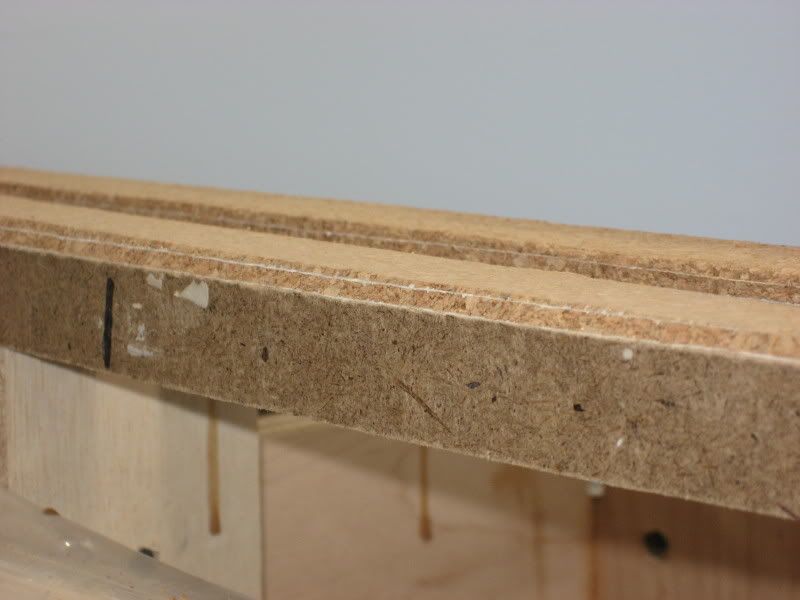
In order to get that prototypical look, I plan to put my “mainline” on a proper roadbed, i.e. the classic cork roadbed, which usually has a thickness of 3/16" .Sidings and yard trackage will be directly on the ground (also covered by cork sheets). Considering a grade not steeper than 3%, this means I need 6.5" of track to come down by 3/16".
Is my thinking correct? How should I make the transition from main line trackage to siding/yard trackage?
Your math sounds correct, remember to add a smooth vertical curve (transition from level to grade), which will make the actual drop a bit longer. If you’re also going to be using a different rail size in the yard trackage and spurs, also remember this will drop the overall height by the height of the rail and tie thickness.
I wouldn’t recommend the passing sidings be placed lower than the mainline, this will add an unnecessary dip for mainline trains passing one another.
Usually, there is a switch off the main, say to the yard, which is lower by 3/16". How to do that, when you don´t have 6.5" of track available for the grade?
It is always good to do the math, but there are other factors to keep in mind. If you are going to move longer cars such as centerbeam lumber flats, auto racks or high cube box cars into the yard, you not only have to consider their length but also the coupler droop that is common with longer cars. Trial and error is the best teacher in these situations. John Timm
while the bulk of my yard tracks are on bare plywood instead of cork this method would probably work for you. i just lay the cork roadbed where the lead track goes and taper it down with a Stanley Surform tool. they look like little graters and are sold in almost every hardware store in the country.
just make sure the contact cement or glue is set up before you start.
i usually spread the taper over about 12 inches of run but that is not critical as long as you make the change gradual when going to and from level. the trick is to avoid abrupt changes in the vertical grade. the point where the transition occurs can be a problem with long cars and long wheel base steam power. that is why i try to use a foot of grade in HO.
take care to keep the cross section level, especially on curves.
if you don’t get the cork down to zilch where it ends, not to worry. just let the track float and tamp ballast under it. i would not fasten it down tight at the bottom of the grade to avoid any vertical kinks in the rails.
take care not to install switches where the track changes from level to grade. all on the grade or all on the level but never where the rails of the switch have to bend.
some people use wooden shims to achieve the taper and i have in the past but find it much easier to get a gentle transition by tapering the cork roadbed
a short length of grade like that will not have much effect on performance. as a matter of fact my entire yard lead is on about 1/2 % downgrade to make for more dependability when shoving long cuts of cars
i do find that the MRPO cork is easier to work with than the Midwest roadbed since the Midwest is harder and tighter if you know what i mean. both kinds are ok but the Midwest takes a little more elbow grease.
I have not measured cork recently, but in years past HO commercial roadbed was 1/4" thick, not 3/16".
Based on what I have seen on the prototype, sidings are lower, but not by such a large amount. Even at only 3/16" that is 32 scale inches.
I use homabed roadbed and use the 1/4" for mainlines and 1/8" for sidings, with only a 1/8" transition being needed. That is about one scale foot and gives a good visual effect. On a well maintained line, while lower, the siding will still be above the surrounding grade.
I have known other modelers to use HO cork on the main and N scale cork on the sidings to the same effect.
In some places I do transition all the way down to the sub roadbed elevation, but not without lots of room, and definately not on a passing siding.
I have figured out how I can achieve the effect. I will use regular cork roadbed for the main, which has a thickness of 5 mm here in Germany. The yard and spurs will be laid on 3 mm cork sheet, that is a drop of 2 mm only which can be achieved in 70 mm length of track.
I think the one thing most of us have a hard time remembering while atempting to acurately reproduce the prototype is that we have to work within our space constraints. Sure it would be excellant to dupicate that grade percentage exactly as it is done on the real railroad but you have to do what you need to do to make your trains run correctly. After all without that we have nothing but a diarama and a lot of frustration
To duplicate the grade from main to yard as it is on the prototype, then you must do as the prototype. If you don’t have the 6.5" to meet a 3% grade, then use a shorter distance and a higher grade, just as the prototype would do. I’ve seen many transitions that were very steep, much more than 3%. It all depends on what the topography is that the railroad must use, the importance of the yard or siding, and financial constraints. Do what you must to make the track the way you want, that is what the prototype would do, that is the way the real 1:1 scale trains run. Last time I checked there was no rule, no law, no dictate that transitions or grades need to be 3% or less on our model railroads.
One needs to take great care to assure that the vertical curves (or worse yet, vertical kinks) on the changing grades can be handled by the locomotives and rolling stock.
I lay shorter and shorter lengths of 1/4" masking tape laid down one strip on top of another to build the ramp, including vertical curves at each end. Through the center of the ramp, where the grade is constant, the strips are each progressively 1/4" shorter than the one below (as laid from the high end to the low end). I lay two rows of tape - one under each rail, at least.
This works well even under turnouts (where I use more rows of tape). The picture is of a ramp into a two-track interchange yard. Even my 2-10-2 works its way through the turnout and down (and up) the ramp with ease.
Your thinking seems sound to me. I am doing pretty much the same thing on my N-scale layout and described my technique in an article about making homemade cork roadbed:
In this photo, the foreground track is the siding; you can see the transition down from the junction with the mainline (which is beyond the left edge of the photo):
Why is it unecessary? Trains entering a passing siding move at reduced speed, after all, they will be moving through the curve of a turnout and then stopping. Slower speeds place less demands on the track, so why would a railroad waste money constructing/maintaining a passing siding at the same level as the main track?
On model railroads, this is all for appearance. If you don’t care about it, just ignore the prototypical differences. After all, only a few citizens will notice the difference.
If we’re going to talk prototype, then we need to approach and exit our passing sidings with at least a #20 switch. A #6 or #8 that we might use is much sharper and the added sharpness, combined with the double vertical curves to drop the elevation add more possibilities for derailments, especially with longer cars or locomotives. Remember, there’s a lot of compromises in model railroads, including how we operate. More possibilities for headaches = unnecessary. Difference in ballast color or shade will give the visual difference in the class of track.
Yeah, I’m all for making the drop less pronounced, ballasting accordingly and using a lighter track code…You can definitely accomplish this without much fuss…
This works for me, based on SP practice in the ‘50’s: I use HO cork for main lines, For a siding or A/D track I come off the code 83 #8 or #10 turnout change to code 70, keeping the top of rails even, level for about 2". Then I taper down to N cork over about 14" to 16". For yard tracks I drop down again after about 2" level, to the deck top over 12" to 14". By the way the Main to siding/A/D track is about 16’ to 20’ centers to allow for crews and carmen. Another 16’ over to the first yard track, and they can be as little as 13’ centers. I hope this info helps. John