Anyone else had trouble putting a non-ESU decoder in the DC/Silent Rapido GE 44-Tonner that was released in September 2025? The page “Installing a DCC Decoder” page in the manual that comes with the loco warns against it, but I saw no warnings in the product descriptions when I ordered. Movement, horn, bell, cab chatter all worked with a Soundtraxx TSU2 N-18 installed, but I never could get the lights (that work fine on DC) to work. Nor could I change any CVs (other than the decoder’s address). A nightmare. Finally sent it to Soundtraxx who ripped out the ESU motherboard and replaced it with their N-18 Adapter. I’m waiting for it to be returned now.
3 Likes
It’s really annoying that some manufacturers are now going away from being able use the decoder of your choice rather than their’s. Scaletrains are a nightmare to change to a non-ESU decoder. I have heard that ESU is apparently offering to design the motherboards for free as long as a ESU decoder is the sound option. And surprise, surprise the motherboard only works with ESU decoders, so it just means yet again restricting choice.
1 Like
Thanks, Lee. This is definitely a BAD trend. The lesson I have learned — the HARD way — is that “DC/Silent” is definitely NOT the same as “DCC Ready.” As I wrote earlier, in fairness to customers the sales literature of DC/Silent should point out that that’s really how such locos are intended to be used — on DC and with no sound. They are NOT designed for the installation of a decoder other than the one the importer uses with its DCC/Sound version if you wish to put one in later. Caveat emptor!
2 Likes
Soundtraxx has a You Tube video for swapping out a factory installed decoder with a Tsunami.
Peter
4 Likes
He covers the light issue from 6:43 on.
1 Like
Thx, Guys — Yes, that’s the video I watched before ordering my DC/Silent 44-Tonner and TSU2 N-18 decoder last fall. It was made using the first release of that loco. (Norman has since departed Soundtraxx.) I carefully followed all the instructions after receiving the new (September ‘25) release in October.
It just doesn’t work — not for me using two different DCC Command Stations nor for Soundtraxx at their office in Durango where I shipped my loco when all else failed. We cannot change any CVs.
Best guess: Rapido/ESU have changed the motherboard so that non-ESU decoders don’t work when installed in place of the dummy/DC plug that comes with the DC/Silent version of this loco.
To wit: Here is the page from the manual which you get when the loco is delivered to you:
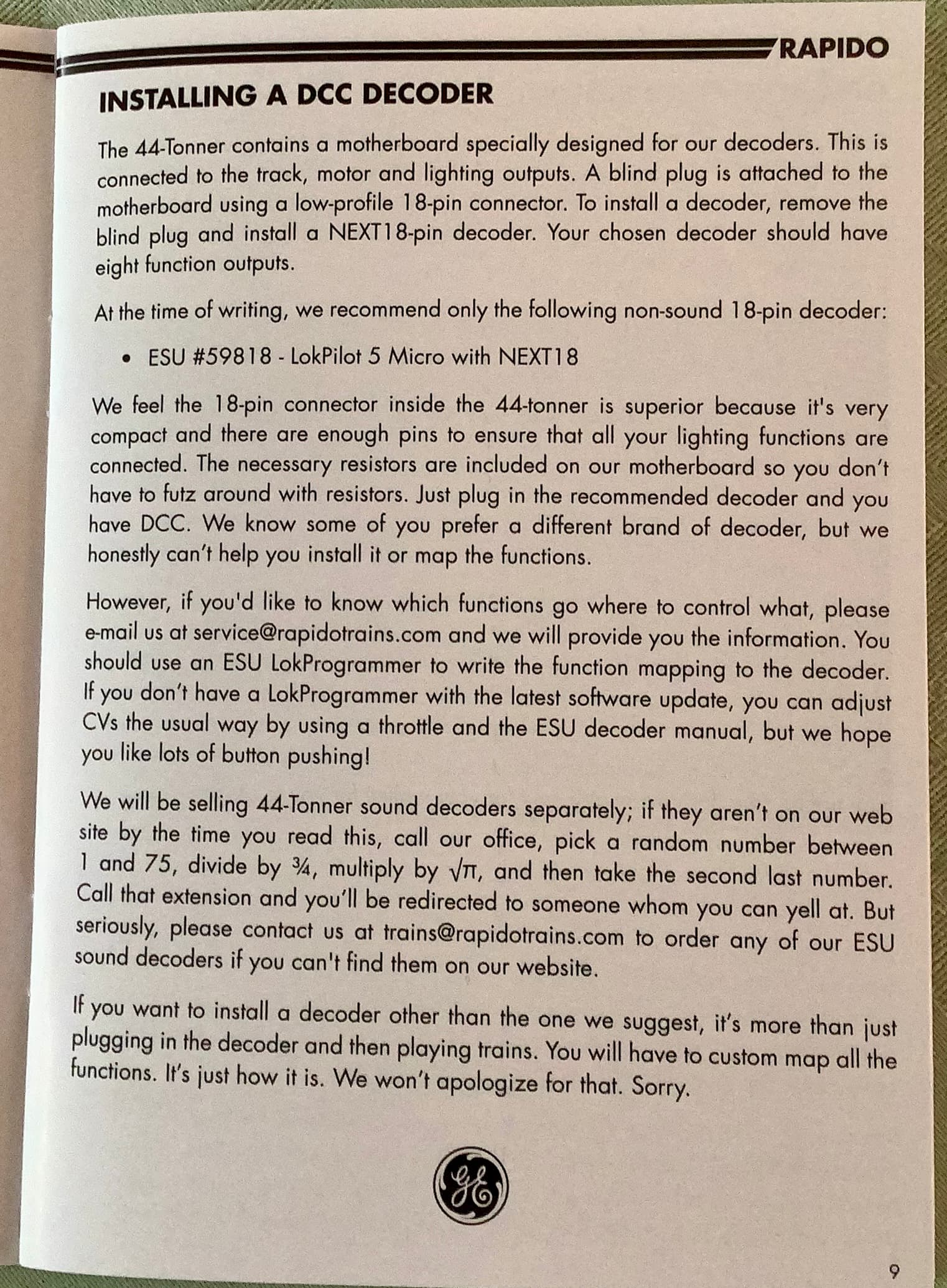
Lesson learned — the hard way.
“We won’t apologize for that.”
“Sorry.”
Did Rapido just contradict themselves?
The phone number “equation” was funny, though.
This has been a problem - particularly with Rapido - since the first release of their E8s several years ago. My understanding is that there is an NMRA compliant serial control that can be used to control more lighting with any decoder, but ESU purposely chose not to use it and make the motherboard proprietary, instead.
It’s a hard-ball business decision. I don’t blame them, if they can do it, but it sucks for us customers.
The problem is not limited to ESU. Broadway’s Stealth models are not really compatible with TSC decoders and there are troubles with others besides ESU. In their defense, the Paragon decoder design in their locomotives doesn’t lend itself to cross-compatibility with many decoders. Many decoders don’t do smoke and Broadway also depends heavily on a daughter-board in the locomotive to minimize that giant wiring harness between loco and tender.
Bottom line, we should all expect some degree of difficulty when using a decoder that wasn’t designed-in by the loco mfr.
VERY GOOD, HELPFUL RESPONSE! Thank you, IC_Tom.
Potential customers should be warned before buying a loco version that can (supposedly) accommodate a different decoder than the one the importer includes with their “fully loaded” model.
Has MR mag done an article about this?