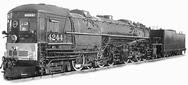
Hi, everybody, I have one very nice experience to share related to Tsunami 1 sound decoder.
For 12 years, since I bought my first Tsunami 1 decoder I believed that this sound decoder cannot provide decent motor control. I tried all kinds of methods to achieve at least some acceptable running, especially in slow speed range, but without any stable success. This effort was not restricted on just one locomotive, but several (diesel and steam), and the result was always the same – no smooth start and stop. With sound was a different story, especially steam – despite some objections from others, I was very satisfied. The same experience related to motor control I followed here in forum and elsewhere from other colleagues. So, verdict was final – Tsunami 1 has bad motor control and nothing can be done about it except replacing it with another brand.
Then, a few days ago I decided to replace original Roco motor from my Proto 2000 Y3 2-8-8-2. This locomotive was running better than any other with Tsunami 1 decoder I have, but as I had coreless Maxon motor at hand, and replacement was very easy to complete, I did it.
The result really amazed me. Locomotive was moving like ESU 4.0 or even 5.0 is inside, or any other new decoder with superior motor control compared to old Tsunami 1.
I very quickly found optimal CV values:
CV 209 = 45
CV 210 = 3 (or 4)
CV 212 = 150 – 170
CV 213 = 3 or 4 (finally 3)
CV 214 = 3 or 4 (finally 3)
CV 2 was set to 1.
Coreless motors have been da bomb since I first saw them used in model railroading circa 1970. They are even better now that high-strength magnets give the smaller sizes better torque.
Be aware that you may need caution running some of these motors on the ‘wrong’ kind of non-DCC powerpack. As this thread does not involve straight DC response I won’t discuss that any further.
Coreless motors does not like low frequency PWM (pulse width modulation) - their rotor consists just of wire, no iron core - therefore they cannot dissipate heat quickly. Low frequency PWM destroys them. Therefore now all DCC decoders work with at least 20 kHz, ESU/ZIMO with 40 - 50 kHz. Tsunami 1 offers 22 kHz, which is excellent considered when this decoder was launched on the market.
I have had very good luck with the Faulhaber 2224RS motors. They perform extremely well on either DC or DCC. I have 6 Rivarossi articulated locomotives with the 2224RS motors and two tenders equipped with decoders, one WOW and one Tsunami. I swap the around the DCC equipped tenders as well as DC only tenders depending on which locomotive and mode I want to run at the moment.
You are correct both decoders have excellent motor control. The Faulhaber motors do very well on either decoder or on DC.
Before I bought the WOW I used an MRC 1731 and it also worked very good, the Tsunami and WOW have much more realistic SP Cab Forward and AC-9 sound.
Since Randy walked me through the BEMF setup all my decoders and motors work great.
I performed this very series of adjustments on a BLI BlueLine DC Class J 4-8-4 back about 2010 into which I placed a Tsunami 1. The instructions were provided on another forum, and I felt anything was better than what the basic CV’s were able to provide. I’m happy to say that the J ran silky smooth, right from speed step 1 through to the top of its range.
Actually, the Tsunami 1 has VERY good motor control with Back EMF.
Unfortunately, the default is OFF, they don’t call it “Back EMF”, they call it something else, it’s buried deep in the technical manual, and it has something like 4 or 5 CVs that need to be adjusted.
I’ll dig around and try to find the excellent web page that talks about how to do the adjustment.
I have read that back EMF should not be used for loco mu’d to other locos, you know, like the Rio Grande did being a mountain RR. Reason being the locos in mu with back EMF fight each other. So that solution may not work in those common instance but only for locos running alone like switchers. None of my switchers have Tsunami 1. But my GP40-2 does, but it would run my with other diesels. Oh well.
Never had a problem with BEMF and consists, but I don’t use any Soundtraxx decoders. That “they will fight each other” I think is rumormongering from the early days of DCC when most decoders didn;t have BEMF and everyone equated it to ‘cruise control’ where it would make your loco runt he exact same speed no matter what.
If the locos fight one another - then it’s either a poor BEMF implementation, or some parameters are way out of whack. I’ve had no problems running multiple TCS decoders together, or TCS and QSI even, all with BEMF turned on. Even my first two P2K locos that I put Digitrax decoders in, ran fine together with BEMF on.
I could be wrong but thought I read the EMF mu issue from Mr Fugate, from that which shall not be spoken. Not a rumor thing at the time.
So many have complained about Tsunami 1 motor control, why has so much time gone by with no mention of a magic fix? Just complaining about motor control so steer clear of Tsu1 as been a mantra.
Anyway, if the masses reporting poor motor control are wrong, then that is better news for me as I do have a Tsunami 1 Genesis GP40-2.
That may or may not have started there, not sure anymore as it was back in the dark ages of DCC. What MIGHT have been confusing people is that Digitrax decoders with BEMF have 2 settings - one for running normally and one for when running in a consist - caveat, by in consist they mean a CV29 consists, so the setting actually is meaningless to Digitrax users - whatever the BEMF setting is for running alone is what it will use in a Digitrax consist. But for Joe and other NCE users - if you make no changes, BEMF will be completely off when the loco is added to a consist. It MAY be a case of the resulting poor(er) running, or another loco with a different decoder that has BEMF regardless of consist status, coupled to a Digitrax one which runs fine alone, now gets erratic. The issue actually is because BEMF is turned off, not be cause it is on in a consist. Maybe that’s how it all got started.