I’ve noticed quite a few locomotives from several different roads have this kind of paint damage. Is this caused by turbo failure? Seems to be quite common. Sure ruins the paint job.
Here’s a photo I took today.

I’ve noticed quite a few locomotives from several different roads have this kind of paint damage. Is this caused by turbo failure? Seems to be quite common. Sure ruins the paint job.
Here’s a photo I took today.
Nope, turbo is on the other end. That’s the alternator end.
Airbox fire
So, what is it about the GE design that causes this? It’s not an uncommon sight.
Bad power assemblys, injector pumps, engine timing and or adjustments. The airboxes are light aluminum and the seals are rubber O rings, it doesn’t take much to melt them off .
If that photo has been a UP engine I would have suggested flamers from this forum;)
dd
Most locomotives you see with this kind of fire damage is on G.E. locomotives. G.E.s have external fuel lines going to the injector pumps on each cylinder. The fuel in these lines is under 50-80 lbs of pressure. A leak in any of these lines sprays fuel up and around the hot exhaust manifold and ignites. They look pretty bad coming into the shop but we just replace the damaged parts and get them back out on the road without repainting them. If you see an EMD locomotive with the paint burned off ike that, Its usually caused by an oil fire or a bad exhaust leak since most of the fuel lines are inside the engine and any leaking fuel is just drains into the crankcase. This will dilute the oil but oil sampling and analysis will pick it up.
That make sense. Thank you for the explanation.
Really? I always thought it was caused by stack fires due to poor internal planning. This problem is more common with GE roadswitchers, mainly the U-boat series and some AC4400CW’s (unsure about AC6000CW’s). Usually the hood section would need repainting which means one end could be a different shade than the other. Some Class-1 railroads repaint the entire locomotive which is costly ($5000 per loco?).
Of course, it is interesting to see.
The stack is on the OTHER end.
this one burned as well , it also burned up when it was painted Conrail.
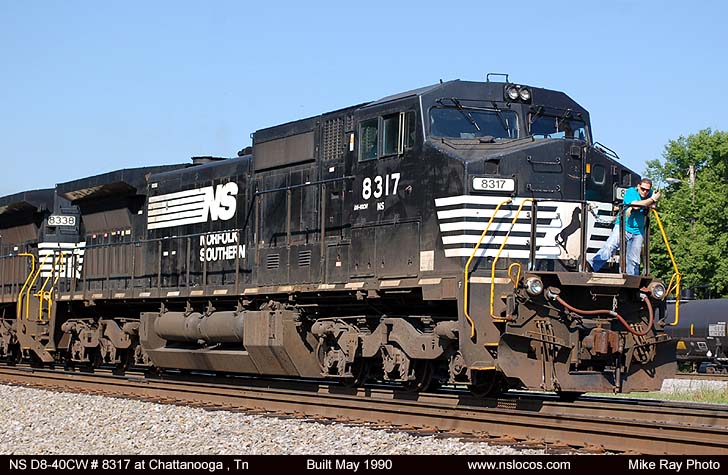
I’ve seen the burn marks at various locations along the prime mover compartment: the generator end, the middle, and the exhaust end. The picture I included was just one example, which showed damage at the generator end. The reason I asked about turbo failure is that I have seen it first hand. One evening I was trackside on the Conrail (NS) Chicago Main. As a westbound approached, a HUGE fireball erupted out of the exhaust stack. It sure got my attention! I thought, perhaps, if a locomotive was traveling backward, the flames could damage the paint on the generator end.
I work in nuclear power. At my plant, we have four big Worthington diesels that are used for emergency backup. Knowing what I know about those, I think Clash and Randy gave us a good explanation. Because this seems so common, it would seem to me that the locomotive builders would want to rectify this. It doesn’t speak well of that particular aspect of the design. I wonder if this kind of damage is covered under warranty.
By the way, nice picture. It would be interesting to see more photos that others have taken as well.
Regards
That’s a pretty normal thing for GE’s to do. Especially Dash -8’s. I could probably make that happen on demand about 50% of the time. There have been numerous discussions w/pictures about this on several forums. It is a spectacular sight, eh?
When the SP AC4400CWs were still fairly new, just after UP took over, one of them was leading a train on the Phoenix line. At the Dobson crossing, I was watching it proceed eastward, when a huge, bright fireball (perhaps 20 feet tall!) erupted out of the stack and proceeded to burn for about 2-3 seconds. It was pretty spectacular as it was during night time when I saw it. I figured it was just the GE “trying to show who’s boss”.
I’d imagine that it would be at least $20K with all the pain that goes on those things.
After seeing these pictures I sure wouldn’t want to walk through the engine room on one of the “Cowl Body” Dash 8s like CN runs. Especially if the engine was working hard!
So when the fire ball comes out of the stack is it because of the same reason as burn marks on the side(leaking fuel lines) or is it a diffrent reason.
Also BigJim you say you can make this happen on demand about 50% of the time, what type of locomotive can you do it on, and how do you do it?
Thanks
Joe
mj,
This is most prevalent on Dash-8’s. It has to do with the GE’s being a true turbocharged 4 stroke engine. The 4 stroker can suck air into the cylinders and the turbo doesn’t really start working until about the fifth notch. So on the change from forth to fifth notch the fuel gets dumped into the cylinders when the turbo hasn’t caught up and pushed enough air for the proper air/fuel ratio. So you get a bunch of black smoke (unburned fuel) and after the mixture gets right it all catches fire outside the stack.
This is not the reason for the burn marks. Those burn marks, as pictured above, are caused by an internal fire of some sort.
Thanks BigJim, so what your saying is that its as simple as going from 4th to 5th notch. Also why is this more common on the Dash 8’s?
Thanks
Joe
You’ll have to ask the shop guys on this forum about that. I just run 'em.
If you don’t mind doing some research on the TRAINS forums, there has been quite a lot posted about this exact phenom in the past year or so.