[Split from “Bachmann DCC-equipped Berkshire question”]
Hi, if I may borrow this thread to a limited degree, I just bought a used one of these Pere Marquette Berkshires. I run DC only and the box says this is compatable with a regular DC analog layout and power pack. It did not come with instructions, so my question is how do I get it to run on my DC layout? (I don’t have any DCC power packs, etc.) It ran on the DCC test track where I bought it, but won’t on my DC layout. I looked up the instructions on Bachmann’s site, and it said you could install a dummy plug in place of a decoder. As I have no experience with “un-DCCing” anything, (this is my first DCC equipped loco) would it be better for me as a novice to go with the dummy plug (and where I can buy one), or go Sheldon’s route? Also, if I went with Sheldon’s method, what is involved and how hard is it to do? Any help is greatly appreciated. Thank you.
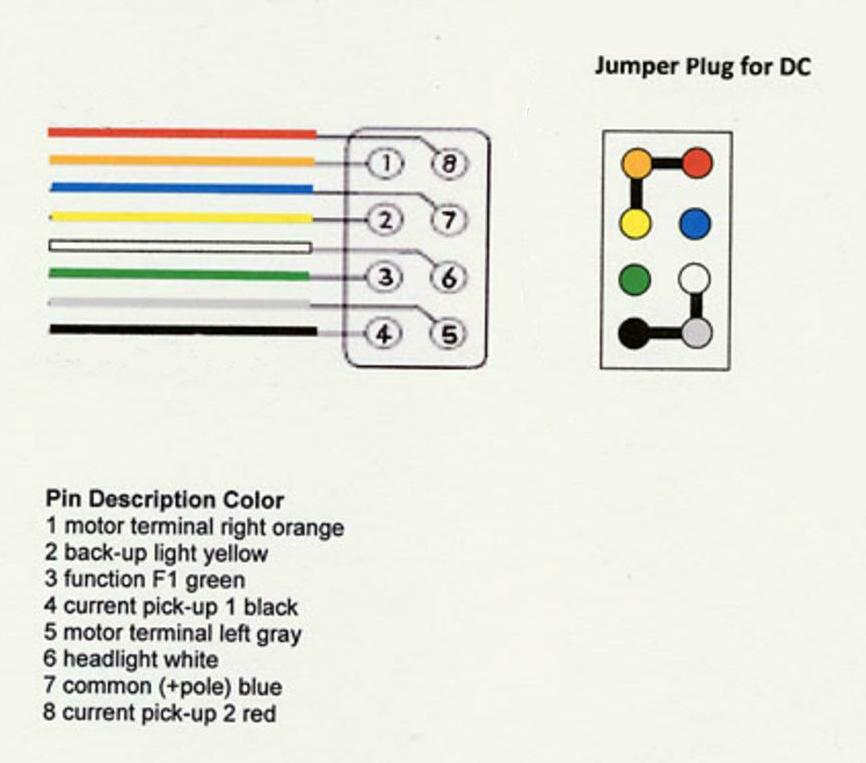
if you have a plug (possibly the one below), you could simply bend some wires and insert them into the plug. connect pins 1&8 and pins 2&7. if you want lights, you would have to solder little wyes.
I would never solder directly to the factory DCC connector. Personally I stock the micro connectors off eBay, they can be cut to any number of contacts and are compatible with the NMRA 8 pin connector.
They come in dual row 2x40 male and female (the round pin connectors are compatible with the DCC NMRA connector) header strips as well as single row 40 pin male and female.
Most if not all decoders made in the last 10-15 years are ‘dual mode’ meaning they will work on DC or DCC, so if your used engine has a DCC decoder installed, it will work on DC. However, there is a CV (control value) setting on decoders that allow you to set the decoder to not operate on DC. If the prior owner did that, you would need to find someone who can program decoders and they can adjust it for you.
If what you’re saying is you bought a used engine that doesn’t have a decoder, but also doesn’t have the dummy plug installed, then as noted above you’ll need to either get a dummy plug, or take out the light board and re-wire the engine. Given that dummy plugs can be found online for a dollar or two, I’d just buy a new dummy plug and plug it in.
Could you repost what you did in the original thread?
The Katos I have came with plugs in place for DC, and the plugs are like a 3 legged staple, one plug connecting 4,5 and 6, the other plug connecting 1,2 and 8.
Athearns RTR come with a jumper plug that plugs into the wire harness that comes off the light board.
I have a couple of Bachmann Spectrum dash8-40cw that came with DCC on board, I’ll look and see what they are about as far as going to DC.
Respectfully, your information is not completely correct.
First, the OP explained that the loco has a decoder, was tested on a DCC SYSTEM, but will not run on DC.
Second, dual mode decoders will not work on ALL DC systems, their performance on DC is usually poor at best, with high starting voltages and poor throttle control.
Third, any DC system that uses pulse width modulation speed control will set a dual mode decoder crazy and the loco will not run correctly if at all.
That includes a number of the better DC throttles including the Aristo Craft Train Engineer.
The best DC performance is only possible with the decoders removed.
I don’t see the 2 plugs in the list of availiable parts for that locomotive, but they are kind of a generic thing that would work with any loco that comes DCC equiped, so you should be able to contact Bachmann about purchasing them.
As far as how the plugs go into the socket, it’s the same arrangement that I talk about in my previous post about my Kato locomotives.
I agree with Sheldon: remove the decoder completely, as operation with it in place is unacceptable, with poor throttle response on DC.
Basically, you need to connect the wipers on the drivers to one of the contacts on the motor, and connect the uninsulated wheels on the tender, using wire running from contacts inside the tender, to the other. I can’t help you with headlight connections, though, as I don’t use them.