I would like to remove the rubber band drive motor in an old Athearn GP9 Milwaukee Road engine and replace it with something else. Can anyone suggest an appropriate motor to use in its place?
Also, how do I get the power from the rails to the motor as there is no connection there right now.
The easiest thing to do would be to get a Blue Box Athearn GP-9, and swap the chassis to your shell. There will be no easy way to convert a rubber band drive to a gear drive.
I think Ernst used to have a conversion, but it was more money than a new BB kit.
Try looking on eBay or the Athearn/Walthers sites to see if you can pick up a decent flywheel motor. Some kits come with the right kind of trucks, some don’t, so you’ll have to look closely.
Remove the motor and driveshafts from the rubber-band drive engine.
Replace the shell on the rubber-band drive engine.
Buy a new engine with the same colors. Run the 2 as a powered/dummy consist.
I was faced with exactly the same problem. I found new-in-the-box Proto 2000 GP-9’s at M.B. Klein (www.modeltrainstuff.com) and Trainworld (www.trainworld.com) for $40. Klein’s had Milwaukees, so they got my business that day. That’s cheaper than a new motor, gears and wheels would have cost, and I ended up with a modern DCC-ready engine and a dummy for less than I would have spent for what would have been a marginal performer with poor detailing.
This was a couple of years back. You probably won’t find that price, but keep looking. Have patience. I found a Proto SW8 with QSI sound for $100, too, from Walthers.
Athearn ‘Hi-F’ (rubber band) drives used to ‘scoot’, jerk to a start/stop, and consume 1-1.5 amps to run. The shell was oversuzed to accomodate the motor. Most have been replaced by something better.
Atlas (kato drive)GP-7 and Proto 2000 (GP-9) are FAR superior, and gear driven BB are available - with the oversized shell - from the used market. They, at least nun @ .75 amps.
The ‘Hi-F’ drive got it’s power from the wheels and metal sideframes.
A much superior drop-on chassis ($99) to fit the old body is available from A-Line and you still have Athearn’s lighting. http://ppw-aline.com/re-power.htm Don’t buy unless you’re ready to be spoiled. It runs on nearly 0 amps.
Thanks for all the help. I believe I’ll try to locate a Blue Box GP9 and just swap the hoods. Sounds so much easier than trying to find a motor and all the other parts. This engine was mine when I was a kid so it will be nice to see it running again.
The Ernst drive has nothing to do with remotoring an Athearn engine. It was a series of gears you placed in the trucks to reduce the wheel RPMs in relation to the motor and the entire speed range of the engine. Most of my Blue Box engines have them as they make control very smooth.
That’s what I did with an second generation Athearn GP-9. It wasn’t the rubber band drive one but it was the older shaft drive type but it ran like crap was louder than it’s prototype. So now the chasis is in the bottom of a box somewhere and at last winters train show I found a athearn dummy, in conrail non the less. Now I have two powered GP-9s in CR paint and a PC Shell on the dummy chasis. And I love it. Yes, do that.
Why in God’s name not buy a new one in that roadname, and save the rb drive one on the shelf as an example of “what we used to put up with”? As said before, the hood’s are oversize and the detailing is atrocious compared to today’s offerings. Let the poor bugger rest in peace. [:)]
The other feature about the old Athearn rubber band drive engines was how funny they sounded – a little like a New Year’s Eve noisemaker (if you remember those). Other than for pure nostalgia not many people would want that noise on the layout. I remember buying an Athearn Hi-F drive F7 in Pennsylanvia RR colors as the second locomotive for my first layout (first engine was a Penn Line F7). I think I swapped the shells at some point. Back in those days America’s Hobby Center wanted something like $3.98 for a Hi-F F7 and being a kid, I could not resist the price. It was my passenger power so I never minded that it had poor slow speed characteristics.
If you are determined to re-equip your Geep with rubber band drive as a curiosity, it might be OK to run it in tandem with a more conventional gear driven blue box GP 9 or 35. That way the overly wide hood won’t be noticed. THe gear driven engine will help smooth out some of the jerky characteristics of the old Hi-F drive. Actually running two Hi-F drive engines together also tended to smooth out the jerkiness but the noise was like standing in a Swiss clock shop! Given the rubber band drive they were surprisingly decent pullers as I recall.
Some folks used to put rubber tubing over the thin steel drive shaft in an effect to get better traction with the rubber bands and also to slow the thing down a little bit.
The parts diagram from the wonderful HO Seeker website will show the wire that got power to the motor.
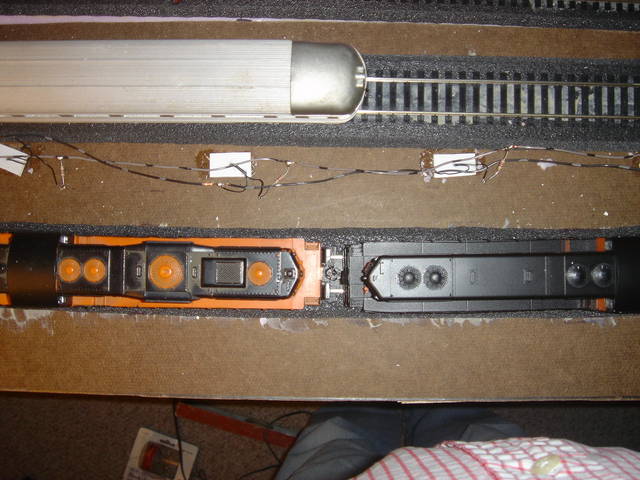
Just to let people see the difference, here’s a picture I took of a pair of Geeps. On the right is a new Proto 2000, and on the left is an ancient (1960’s) Athearn.
Another good use for a “gelding” like this would be as a sound unit. Plenty of room inside for a decoder and speaker, and you could wire up headlights, too, with the right decoder.
[bow] j-w, I’m still in awe of your correctly spelled “DITTO” smilie! Is there any possibility of getting the forum bosses to use yours to replace the now-defunct “DITO?”
Back to topic: if we had a good “DITTO,” I’d slip one in here. I remember the replacement gadget, a double-ended motor with a reduction gearbox on each end and larger diameter “wire”–actually a rigid rod without the neoprene tubing couplings. It was simple to convert the old “Hi-F” rubber band drive to the new one, but why would you want to at this late date? If you love the shell, decide which way you want to go, dummy or powered, and follow the excellent advice the others have given!