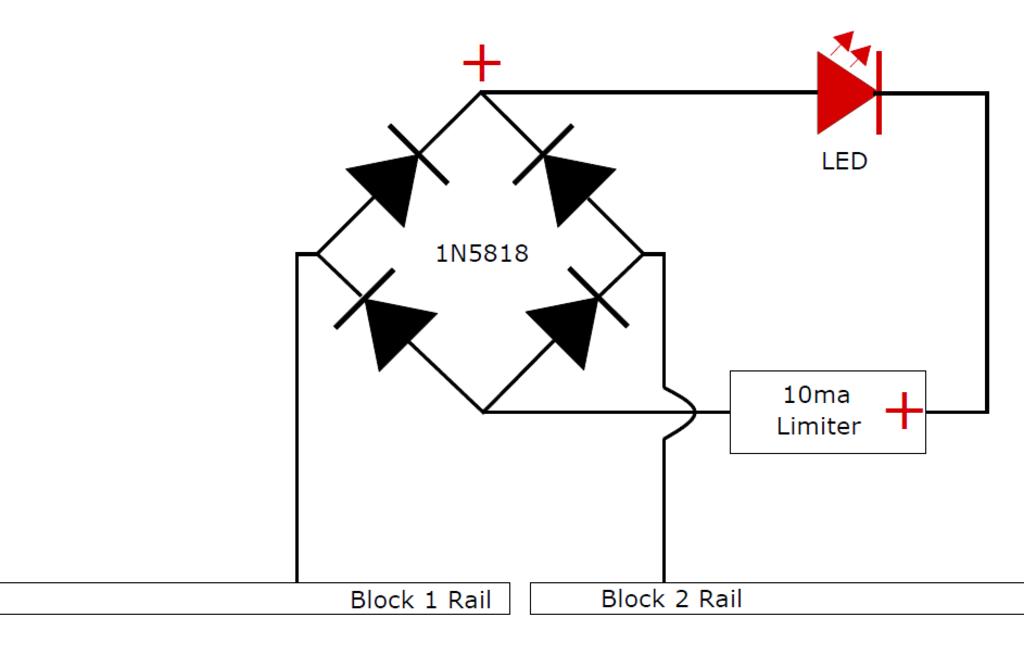
I can’t quite figure out how this addresses your situation, but I couldn’t see the point of DC into a Wheatstone bridge either…
…so, to make one, you carefully file two packaged "LED"s down so that most of the package on one side is removed, and then cement them together (be sure they’re opposite polarity as needed when joined). Join or solder the leads or pads. Then use clear epoxy or similar material to cast a lens around them if needed.
There have been posts here about reducing LED size to close to the actual device size (which is tiny even in older LEDs) for use in scale signal heads – the ‘community search’ should find some.
When you switch control of the block to the appropriate cab it is the cab that sets track polarity. Each block switch controls which cab is connected to that block, or should. The cab indicates the polarity of the blocks it is powering. Put another way, the controlling cab should always automatically deliver correct polarity to all blocks it controls if you wire Block control correctly. There should be no need for any separate polarity change switch for each block.
The only exception is when two adjoining blocks include one reversing section. For that block it might be handy to have a light indicator. However, the simple on off binary of one LED should be enough for anyone. Light off means polarity is aligned. Light on means polarity is incorrect. Surely having two lights tells you nothing more useful than the position of the toggle switch itself. If you want a light for each direction you need different coloured lights or the lights aren’t giving you any information, you just think they are.
Put another way, if light on means incorrect polarity and light off means correct polarity and the lights are the same colour then light on doesn’t tell you which direction is incorrect. You look at the relative position of each light to inform you which cab is in control just as you would if looking only at the physical switch.
I run a three cab system with two reversing sections. I use the physical position of the block control switch to inform me what the polarity of that block is. Only when I use the reversing section does the main line direction switch point in the opposite direction to that controlling polarity in the reversing section. As the locomotive traverses the reversing section the mainline direction switch is changed to align again with the main line block control switch. Cab direction switched aren’t used on my layout. I use Atlas common rail wiring and switches. I’ve never seen the need for lights as well.
Or put another way, how do you switch cabs for any given block?
The output terminals of each DPDT connect the switch to the block. The two sets of input terminals connect the switch to the power outputs of each of two cabs. Center off. Throw the switch one direction and the block is controlled by cab A and it’s c direction switch. Throw the switch the other way and cab B is in control of that block.
How do you both select cabs and reverse polarity, do you have two sets of DPDT between your power output and your rails? What are you trying to achieve with the capacity to have two blocks powered by one cab but with opposing polarity?
Are you actually seeking indicator lights to show which cab is controlling any particular block? That has nothing to do with polarity.
From my understanding of the OPs wiring and their comment…
It seems that they are not using “Common Rail” wiring.
They seem to have come up with a non-standard, Franken-bashed method of direction control based on a single cab, and DPDT center off switches, using the switches to control direction rather than the direction controller on the single cab.
When installing the Atlas Block Selectors the direction switch on the cabs are used.
If using the Atlas Controllers they do have direction switches built-in to them and the direction switches on the cabs are not use.
Perhaps this is where the OP got the idea of not using the direction switch on the cab.
Unfortunately, this seems to be the latest development on the forum. An OP starts a thread, gets lots of replies filled with suggestions and advise, then resorts to a PM with one guy.
I can see announcing that a PM has been sent to another forum member if someone truly needs to communicate something of a private, personal nature. But, otherwise, it seems a bit offensive to just go silent on the forum.
So, hopefully, the OP or the other guy in this instance will come back to publicly discuss the OP’s issue.
I’ll first start by saying that I really like this forum and have learned a lot from the different topics discussed here.
However, I’m going to have to disagree with you about the responses to my post here being suggestions and advice. From my viewpoint, most of them were along the lines of “you are doing it wrong” and “why on earth would you do it that way when everyone else is doing it another way”. Being put on the defensive trying to explain my decisions didn’t seem very worthwhile to pursue. A lot of these threads have gone south and I didn’t want to be part of the problem. I had a question, I posted it, got an answer that I think will work and that’s it.
But in the spirit of not being offensive I’ll give it another go.
I am a DC operator. I decided to wire all the blocks as stand alone so there are no common wires on the layout. I have DPDT center off switches controling these blocks and I have one throttle powering all of them.
I have one throttle and yes, I sometimes run two trains at once although not for any extended period of time. An example - running a train around the mainline while running a train on a spur for a short distance. Not a big deal and I am certainly not claiming that one throttle can run a complex railroad. Far from it.
The idea of polarity indicator lights comes straight from p. 28 of my Andy Sperandeo’s 1990 edition of Easy Model Railroad Wiring when he offers this technique as a visual solution to remembering to switch polarity on reverse loops. I wanted to explore that technique on the whole layout as it is easy to forget the polarity of a block when there are so many. Onc
Charles, thanks for that message. I have to say, I was looking for a word other than “offensive”. I should have looked harder. I have followed this thread with interest, but I have not contributed since I am not a DC guy. So, when I saw your PM comment, I was disappointed that a solution to your issue might not become public. I do understand how you felt about the nature of the responses that you were getting.
One cab DC layouts running two or more trains are pretty rare beasts. Had this information been included in the first post the bulk of the responses would not have been posted. Your proposed solution to your perceived problem is unlikely to be as effective as you might at first think. You are also considering implementing the more difficult of the available solutions.
Using a light indicator will show you which block boundary has a polarity problem but I don’t see how it can also tell you which way to throw the DPDT and for which block. If instead the DPDT were just all lined up in a row a glance at the direction of the toggle switches would deliver the same information plus indicate which block required the toggle to be thrown.
That’s how we operate our three cab setup. Because we use common rail we only need Atlas SPDT block selectors except for the reversing sections. The cab direction switches all stay to the right (or left, it is only necessary they are oriented in the same direction). The Atlas controller conveniently controls the reversing direction polarity with an identical switch to the one that controls main polarity. When the grey switch and red switch are lined up polarity is “correct” for entry into the reversing section. While the locomotive is within the reversing section the main polarity switch is “misaligned” with the reversing section switch to ensure the main is reversed for exit from the reversing section. To enter the reversing section from the other direction the direction switches are again realigned and so on. This eyeball method works the same way for our reversing wye as well.
The up/down position of the block selectors tells us which cab controls the block. The third cab is a separate yard cab controlled by a separate set of Atlas selectors wired as a downstream set from one block selector switch on the main set of block selectors. The yard tracks are all Block 5 on the main set, then we have 7 more yard selector
However, I’m going to have to disagree with you about the responses to my post here being suggestions and advice. From my viewpoint, most of them were along the lines of “you are doing it wrong” and “why on earth would you do it that way when everyone else is doing it another way”. Being put on the defensive trying to explain my decisions didn’t seem very worthwhile to pursue. A lot of these threads have gone south and I didn’t want to be part of the problem. I had a question, I posted it, got an answer that I think will work and that’s it.
But in the spirit of not being offensive I’ll give it another go.
I am a DC operator. I decided to wire all the blocks as stand alone so there are no common wires on the layout. I have DPDT center off switches controling these blocks and I have one throttle powering all of them.
I have one throttle and yes, I sometimes run two trains at once although not for any extended period of time. An example - running a train around the mainline while running a train on a spur for a short distance. Not a big deal and I am certainly not claiming that one throttle can run a complex railroad. Far from it.
The idea of polarity indicator lights comes straight from p. 28 of my Andy Sperandeo’s 1990 edition of Easy Model Railroad Wiring when he offers this technique as a visual solution to remembering to switch polarity on reverse loops. I wanted to explore that technique on the whole layout as it is easy to forget the polarity of a block when there are so many. Once again, a light is a nice visual cue instead of looking at the label on the switch.
Why the DPDT switches - remember, this is DC not DCC. I want the ability to have trains be able to go in different directions on different blocks at the same time. Also, with stand alone blocks, if there is a
Thanks for your response. As with jjdamnit and Rich, I enjoy reading your posts too!
My mistake was thinking what I was doing was commonplace, hence my surprise when I was getting the responses I was getting.
To me, it seemed very logical that if you are going to do DC and have stand alone block wiring, why would you not want the ability to have multiple trains go in different directions at the same time.
This method of course is not without its own problems. It was noted by a poster that when a train crosses from one block into another it will temporarily energize that block even if it was switched off. Very true and it is a bit of a bummer but I can live with it.