Hi friends: I live in a very far country fron USA and I have 2 N scale locomotives from “eastern railroads”, New Haven and Delaware & Hudson.
I want to make a small layout inspired in the east coast (New England region?), in the middle 20 Century (1945-1950). I know that this region have some particular buildings, bridges (Madison Bridges… like the movie) and landscapes.
Could someone suggest what an east coast layout must have? What are the landmarks that must be included.
The NH and D&H would both have been seen in New York and Connecticut, from New York City northwards, generally. This part of the country is very old, geologically, some of the oldest surface granite rocks on the planet. The landscape is generally low rolling hills, no high mountains and not a lot of flat plains, either. Roads and railroads generally followed rivers, because much of the land is hilly and it’s just easier to follow the flat course, even though it winds around. So, you will not find towns with streets laid out in nice, even grids.
This region would have had dairy farming and some textile industry, which developed in New England to take advantage of the abundant water power during the Industrial Revolution. Coal and other raw materials would have been brought in from Pennsylvania on the D&H.
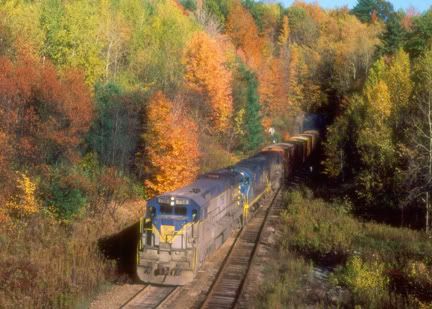
The New England landscape is known for “fall color,” the very bright orange, yellow and red shades that the leaves turn as winter approaches. So, if you’ve ever wanted to model this, it’s the perfect location for an autumn layout with lots of colorful foliage.
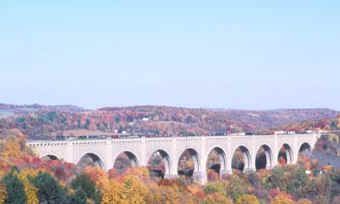
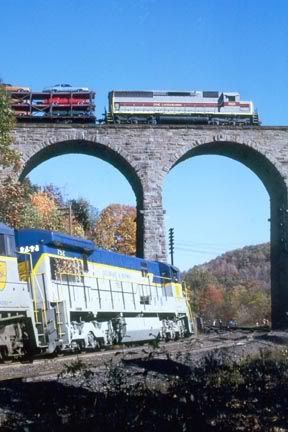
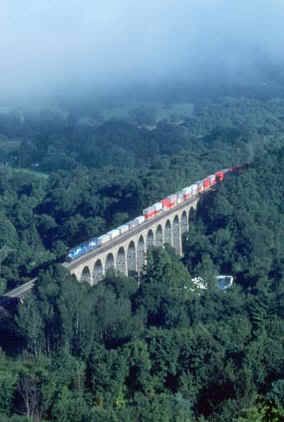
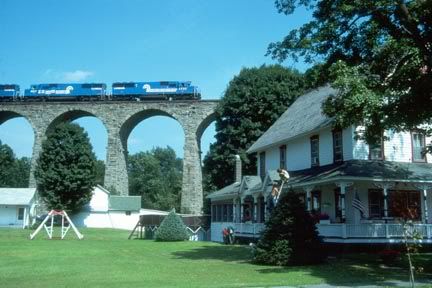
The low rolling hills of the Catskills and the Poconos and the higher mountains of the Adirondacks. Lots of small lakes. Canals. Ski resorts. Dairy and Apple farming. Grapes and wine in the Finger Lakes region. Railroads frequently following rivers. Lots of tunnels and long high masonry bridges.
If you are interested in “urban” type buildings might I suggest my “prototypes” web page from my layout web site.
While most of New England (CT, RI, VT, NH, ME, MA) doesn’t have mountains, it is rather hilly once you leave the various river valleys. Even then you can go from 1,000 foot elevation to 50 in a span of just a few miles as is the case here in Enfield (north central CT).
There are a lot of abandoned rail lines, which in the 40s and 50s would have been active with traffic from a number of regional lines.
The “road names” and don’t overlook “Fallen Flags” as not everyone survived like today’s CSX and Norfolk Southern - And, did I mention many railroads?
Geographic location (+) year (i.e. circa 1956) has rolling stock impact…
Just a handful of the Class I major roads (in alpha-order) in the Mid-Atlantic states were Baltimore & Ohio, Chesapeake & Ohio, New York Central, Norfolk & Western, Pennsylvania, Reading, etc.
While you will have your primary railroad – The train consists were full of colorful paint schemes of road names. It was not uncommon to see long coal drags, or (TOFC) Trailer Train, TTX Company, for the roots of what is today’s (container-only) Intermodal. Also see Railway Express Agency.
If you are into electrification, there is the Northeast Corridor, and; for example, Kato makes a nice Pennsylvania GG1 for both HO Scale and N Scale:
Covered bridges aren’t that rare in some parts of New England, there are probably a dozen within 20 miles of my house, for instance.
And we do have mountains, DocinCT. They maybe smaller than the 10,000+ foot peaks out west, but at 3 & 4000 feet, they still classify as mountains here in NH, ME, VT, & upstate NY. In fact, as most people can’t really model the western mountain ranges to scale, the Eastern ranges maybe a better match for the hobby in some ways.
To the original poster, with the exception of desert, the Eastern part of the US has lots of things you can model. Other posters have included iconic things like covered bridges, but a gritty urban environment is right at home on an NE layout if that appeals to you, especially if you’re interested in modeling the New Haven, as that road served some very large markets in the North East.
There is also a large coal mining industry in Pennsylvania and West Virginia.
And, of course, snow.
It is not readily apparent, but the third image in my first post shows a Delaware and Hudson train emerging from a tunnel. It is just hard to see the portal through the trees.
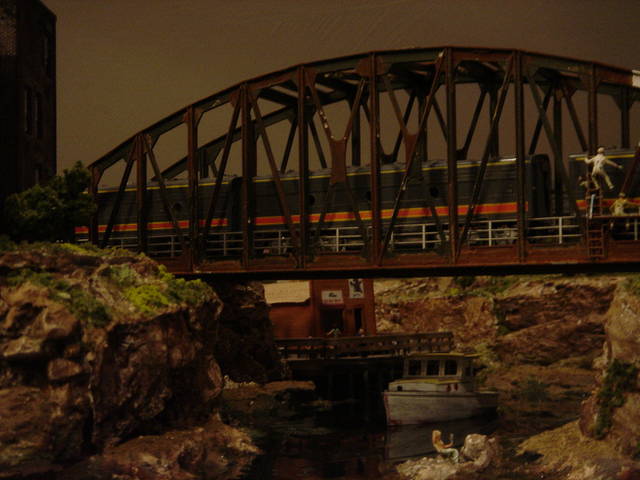
Another “Classic New England” scene is the rocky coastline, with small fishing boats and perhaps a lighthouse. Again, this would be appropriate for the New Haven running along the Connecticut shore.
(Mermaids are optional, depending on your chosen prototype.)
If you dip down into the Mid Atlantic (PA, NJ, WV, Maryland, Delaware)… You could get the steel and coal and the beginning of the Chemical industries… 40’S 50’S would have a large amount of passenger traffic…
I’d highly recommend 2 Kalmbach books by Iain Rice: Small, Smarat & Practical Track Plans Mid-sized & Managable Track Plans Whatever size layout you want to do, get both of these books. Iain is British, but visits over here frequently and does a very good treatment of each region. He has a number of eastern layouts in these books, and as a native, I’ll vouch that the New England ones are quite well done. each track plan is accompanied by photos of the area and watercolour paintings of the layout. These will give you a lot of inspiration. If you narrow down to any specific city or town you would like to include, then go peak at Google Maps and check out both the street and satellite views, and the photos options under the More menu. For example, Iain’s mid-sized trackplan, the Milltown Switcher, is inspired by Pawtuxet, Rhode Island (New Haven RR territory), to get lot’s more inspiration and maybe even specific scenes to model, check out: http://maps.google.com/maps?hl=en&tab=wl
You should check the Rensselaer Railroad Heritage Website also. Pay for one month and get lots of info on steam era modeling. Also the D&H and the NH do not interchange directly. The NH is a real New England railroad, serving Connecticut, Massachusetts, and New York, the D&H was in New York, Pennsylvania, and went to Canada. I’m not sure,but it may have had a line into Vermont.
Had to be said. Not to be taken lightly but if you are modeling a coastal scene then a fishing industry of some sort would be important. This could be anything from a cannery or packing plant to a small lobster boat in a calm bay with bouy marked lobster traps to large ocean going trawlers heading out to sea.