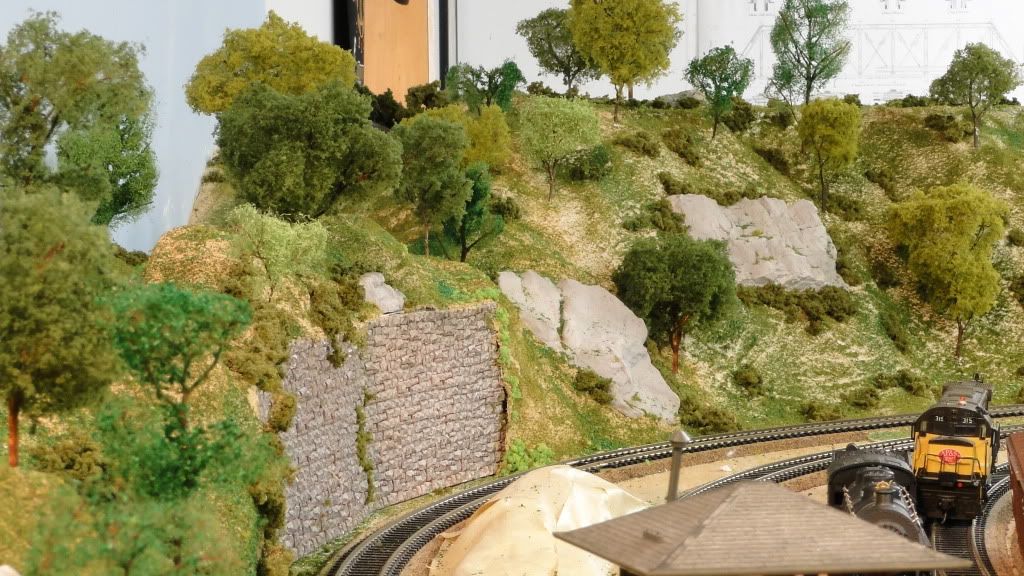
Can anyone give any ideas on what to use here in the midwest for natural tree armatures? We dont have many of the natural things up here that grow common in other parts of the country that work so well for this. I have never seen sedum (I think) and its not easily found everywhere in this part of the country. Tried looking for some small sticks and twigs but there just isnt enough branch structure for a good start in tree making. Any tips for those in the midwest (which im in Minnesota).
It will be interesting to see what the replies are.
I’m in the east so I can’t be too much help, however from what I’ve seen out here there are several potential choices for canopy trees, but for stand-alone trees or those in small groups, most natural armatures such as sedum make a tree that is too “Y” shaped and there isn’t enough roundness to it. For those it seems either sage armatures (as offered by several vendors such as Timberline Scenery and Scenic Express) or some select armatures out of a box of SuperTrees.
Thanks Grampy. Thats about where I have settled into. Just twisting and making them out of wire. Since I am an auto tech by trade, I have plenty of access to wire and both the electrical kind and welding kind. But it would be nice to go into the woods around here and grab some things like sage and sedum to try out. Occasionally, ill find a twig on the ground with a good branch structure for this but they arent very easy to find.
I have always used the wire armatures–oil-free modeling clay–lichen technique for my trees. I will admit to it being just a little tedious but it does allow a great deal of flexibility in tree structure.
I have about six rolls of different gauge wire; the higher the gauge the longer the strands I use. I chuck everything in a vise leaving about an inch of wire protruding which I grab with a pair of vise grips and twist creating the trunk. I then chuck the trunk in the vise and twist out six or eight branches of varying lengths and thicknesses. I add water to some of the modeling clay creating a thin gruel into which I dip my tree armature and hang up with a clothes pin until the clay is hardened. It may take an additional dipping to get the trunk looking right. When it is to my liking I score the trunk with one of those wire toothbrushes and spray the whole armature with roof brown paint. I give the branches a liberal application of lichen and sprinkle with foilage. Until recently I was using dried sawdust for this but I am now using ground foam.
As I stated earlier this method is perhaps just a little tedious but I used to sit in front of the TV and in a three hour time span could twist 15-20 armatures. When I had a box of these–say about a hundred–I would go through the clay-scoring-armature routine which would take about two to three times as long to do as the twisting had. Doing it in batches this way did allow me to maximize use of my modeling clay. I’m certain that neighbors looking at me over my back fence seeing a half-a-dozen or so clotheslines strung across the back patio with these ieeny-tiny things hanging down probably reach the conclusion that there was a certified nut residing in the neighborhood but my immediate next-door neighbor who hailed from West Virginia exclaimed, the first time she vie
I saw somethiing on a cooking show that has promise. They made a tree by dipping a grape cluster stem in chocolate. No reason why plaster coudn,t be substituted while eating the grapes.
Queen of the Praire makes great Birch and Poplar. I have a bunch I don’t need this year. Some Astilbe make great Pine trees. Spirea makes good small trees. This is the time look in gardens. There are others that I don’t know the name, but use. We can talk more if this is of interest. I live in New Brighton
I’ve been working with grapevine. It is pretty much two dimensional so you would have to combines a couple stems. Works well for N. For backgrounds though, that combinig isn’t needed. They are especially good for winter scenes.
Visiting a layout last weekend, also N, the host was showing me his trees t hat used blueberry bush limbs for the frame of the tree.
Sedum is a plant you can grow in your garden. One plant will yeild more and more trees as it grows each year. If you don’t have a garden it will grow in a large pot, but I’m not sure how large it will grow when confined. You should be able to get a plant or two at your local plant nursery. A neighbor may also have some growing in their garden and be very happy to have you take away the dead stuff in the fall.
Doesn’t goldenrod grow in MN? I thought that darn stuff grew most everywhere. Some nice photos of trees made from that in previous threads.
There was also a recent thread on making trees from stranded 12 ga wire.
Crandell. Im not sure if those plants grow in this part of the country though but I appreciate the input. The top picture looks like some of the sticks and twigs I see on the ground here though.
As for grape vines. That thought has crossed my mind before but they just dont seem to have the branch structure im looking for.
Arthill. Im not far from you actually. Just up 694 in Brooklyn Park actually. Small world.
I dont have a garden personally but I have family members that do. I have heard of people growing it though. Im sure about goldenrod. I think I know what that stuff is. But if its what im thinking of, it would seem just plain too thin to look right in my scale, HO.
Goldenrod surely grows in your area, and has been recommended by several people over the years as the basis for model trees. Goldenrod even grows here in the desert Southwest and I remember lots of it growing in Illinois.
You don’t need to be a gardener to grow the stuff. I had no time with milking and haying to take care of it in the summer when I planted it, just watered it a couple of times. It is doing fine (did have a little local fertilizer in the dirt I used) The tr\hreee plants have filled a tractor tire with no help from me except pulling out things that don’t look like it.
As for looking small, some have used floral wire to wrap several plants together.
An outdoor nursuery should have them. Usually you will find them as started plants (harder to kill). The place I got mine had small ones for $5 @ and large ones for $10. For the money the two will yield you more trees faster. Will also give you a plant for each side of your walkway or whatever.
Has anyone ever put together a booklet that covers what to use for making trees? I know over the years there have been threads and magazine articles on how to make a tree from this or that but as far as I know there isn’t any one comprehensive resource for this. I think something especially useful would be color pictures of what these various “weeds” look like ins spring, sumer and fall. Maybe include things like: where it grows, best time to pick. and what scales it would be most appropriate for though that is highly subjective.
I live in a rural area and there are lots of things that could be made into trees but knowing what to look for and when to pick would be a huge help.
Well I don’t know about Minnesota, but here in Indiana I use the blooms from a Spirea bush in my front yard.
They have a decent tree-like structure. I harvest them in December - one bush gives me a winter’s worth of tree projects. The price is certainly right, and all you need to do is squeeze off the seed pods, trim with some scissors, then add polyfiber and coarse ground foam.
They’re not exactly Supertree-level quality, but they’re a heck of a lot cheaper and very passable.