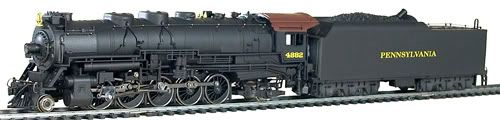
Hi, My 6 year old son is fascinated by model trains. For Christmas, we purchased the Life Like HO freight set. We also want to purchase an inexpensive steam engine for him, but I don’t know what all the numbers mean (ie. 2-6-0). Can anyone help me?
I’m sure someone is busy typing a reply but I’ll test my own newbie knowledge. It refers to the number of wheels on the engine. First number is leading wheels, second (and sometimes third) are the driver wheels, and third (or fourth) are trailing wheels.
So, I think, 2-6-0 would have one axle in front and two axles with large wheels at the center connected to the drive train and no axles in back.
Now, someone can correct me I’m sure I’ve missed some nuance.
This loco is a 2-10-2. It has 2 small pilot wheels up front. It has 10 large drivers in the middle. And it has 2 small trailing wheels at the rear. The animated loco at the bottom of my post is a 4-4-0. 4 pilot wheels up front. 4 large drivers and no(zero) trailing wheels.
On piece of advice - stay away from the steam engine for your 6 y.o. First, too many wheels for him to put on the track by himself. Second, when he grabs it wrong and bends a siderod and the engine is broke there will be too many tears to deal with, and the engine may unreapirable. Stick with 4 axle diesels like F units. No handrails to break.
“C” means a six wheel truck, all three axles powered.
“D” (rarely used) means an eight wheel truck, all 4 axles powered.
“A” would mean one axle, powered.
A number like “1” means one axle, unpowered.
B and C are the most commonly used. A GP-9 would be described as “B-B” - two four wheel trucks with both axles powered. An SD-70 is “C-C” (two six wheel trucks, all axles powered.)
(In Europe they add an “o” so it would be “Bo-Bo” or “Co-co”)
“A” comes in most often in passenger engines like GM E-units, whose trucks are A-1-A…the outside axles are powered, the middle one isn’t. Also, some diesels designed to run on poor or light track had A-1-A trucks instead of B-B trucks as a way to spread out the weight of the engine. So these engines would be “A-1-A - A-1-A” rather than “C-C”. Unless you know whether the axles are powered or not, it’s pretty hard to tell the difference just by looking at the engines. [%-)]
So, a large electic engine might be a 2-D-D-2, which would have a similar wheel arrangement to a steam 4-8-8-4 Big Boy - 2 unpowered axles, two “D” trucks (four axles, all powered on each) and 2 more unpowered axles at the rear.
BTW Kalmbach for a while tried to designate articulated steam engines with a plus sign…“2-6+6-2” rather than “2-6-6-2” with dashes…but it never really caught on.
Thanks sooo much for all the great advice. We purchased the Life Like Freight Runner Train Set for him. It has a GP38-2 High Nose Diesel Locomotive. What my son really wanted was a green steam engine, so we were going to give him this locomotive also. I was looking at an IHC 2-6-0 MOGUL. Any thoughts?
I think you made a typo but the first axle is correct (1 axle / two wheels, the second has 3 axles / 6 wheels (not two) and the third is correct 0 or no trailing wheels
by the way, i really like your dog in the picture. i have a husky also. she has one blue eye and one brown eye but that’s common for huskies…chuck
You can’t go wrong with a mogul…that’s one of my favorite steamers. (I run strictly diesel on my layout but if i did run steam, i’d choose a MOGUL (or the challenger, or the big boy, or the allegany)
As a side note for the color, the only RR to run Green locomotives (that I know of) was the PRR. So you should go with a PRR locomotive to get the green, all of the other major roadnames used a combination of blacks and greys.
Also, the Brunswick Green of the PRR locos was very dark, almost bordering on black so it might be hard to find one with a real “green” color (a la the Lily Belle from the WDW RR, or Henry from Thomas). For reference, here’s a pretty close approximation of what the PRR’s Brunswick Green looked like (Bowser K4 Pacific):
These numbers are called the Whyte classification system or simply the Whyte system. Although originally designed for steam engines - it dates from 1899 if I recall correctly - it has been modified to render classifications for diesel and electric locomotives as well. Google either ‘Whyte classification system’ or ‘Whyte system’ and you will find a rather impressive table of wheel arrangements for steam engines, not only 2-8-0 Consolidations and 2-8-2 Mikados - the most popular wheel arrangements - but one-offs like 4-10-0s - a Central Pacific design of the 1880s - and 4-14-4s - one of Uncle Joe’s fiascos dating in the 1930s.
A blanket statement that does not hold true in many cases. Steam locomotives were painted in a great variety of colors during the 19th century. Olive green was a standard Baldwin locomotive color into the beginning of the 20th Century; railroads would specify the color if they wanted somethng different from the factory standard. It wasn’t until into the 20th Century that black became more or less universal with the NYC being one of the leaders in black locomotives in the 1890s; even then there were exceptions.
…modeling coastal Oregon where it’s always 1900…
…featuring late 19th Century railroading, where the dreams and visions were bigger than the locomotives…
The Great Northen’s GS-2 4-8-4 had green cladding, and I recall that a very popular Pacific, perhaps the SP’s, has bright green cladding. Some were actually blue.
A few other railroads that I can think of which ran green boilers at one time or another are GN’s Glacier scheme, D&RGW, and Southern’s Crescent (this was a bright green).
 I’m sure I’ve missed some nuance.