I would say that it is exactly that!
[:D]
Matte medium is matte medium, it is available from Scenic Express in modellers quality at a good price.
I would say that it is exactly that!
[:D]
Matte medium is matte medium, it is available from Scenic Express in modellers quality at a good price.
Using matte-medium to secure ballast isn’t a good idea. It dries rock hard and is water-proof. If you ever have to pull the track up you won’t be able to re-use it because you’ll wreck it. I suggest using a 50/50 mix of white glue and water. Wet the ballast with alcohol or water with a couple of drops of dishwashing liquid then add the water/glue mix. This will dry hard but the track can be reclaimed in the future by simply wetting ballast and pulling the track up.
Thanks thats exactly what I need to know. [:D]
If you’re still curious here’s the link
Matt-medium is an add too that was invented to extend acrylic artist paints and give a more matt (non-glossy) finish. If you water it down some it will tend to grab all the ballast particles and lock them down but remain somewhat flexible so it shouldn’t cake like dried out white glue will over long periods of time. It is insoluble once dry though but you can remove it by scraping.
Matte is French for a dull finish. They do a lot of artsy stuff over in France and have a corner on some of the words. I think that the original meaning of the word was something like “floor mat”. When we want to sound artsy we like to use French words. This is as opposed to a glossy or shiny finish.
This stuff is a fixitive or glue which is usually milky in appearance but which dries generally clear. It is available from most any art supply store. It is also used to create a protective finish for a painting, and so is available in matte or gloss (I forgot the French word for that…). It can be useful for securing ground foam or other ground-covers, and is usually sprayed on with a hand-pump bottle. One should be sure to mask or otherwise protect structures and rail when applying it, unless it is wiped off of the rail immediately.
I would agree with the earlier comment that Elmer’s Glue works at least as well for securing ballast. To help prevent the fine ballast from bunching up due to water’s surface tension, the drop of dish detergent in with the glue/water mix is used. I have also had good luck lightly spraying the ballast I’m about to glue with a spray of Windex glass cleaner before dropping on the glue/water mix.
Au Revoir, Bill
Lustre.
Excuse me, but that is so on edge with what almost all others (including me) says. My experience is that it is when you glue the ballast with white glue (PVA), that it dries hard and transfers sound to the base.
Have you any Empiric data that proves that Matte medium is “Rock-hard” when dry?
BTW, have the model railroad literature been wrong regarding Matte-medium all these years?
Excuse me, I did not say that it transfers noise. I said that it dries hard and is hard to get up. What’s more the ballast will not come off the track easily and in many cases the track gets wrecked in the process. As for white glue transferring noise I have yet to hear it on my layout. I have EZ-Track on top of white foam on plywood with WS fine ballast held in place with white glue and all I can hear is the wheels hitting the rail joints. There’s no rumble or any other noise. As for empiric data I don’t have to supply any. I have 20 years experience with matte medium and wrecked track that tells me it’s the wrong choice and I’ve talked with master modelers who agree and recommend the white glue themselves. Have you found an easy way to get matte medium and ballast off the track without wrecking it? If so, please tell me about it. If I want to get a section of my track up I just wet the ballast and wait about ten minutes then pull it up. Can you do that with matte medium? I don’t think so.
It has been my experience that matte medium does not dry hard, reduces the noise transfer possibility, but is difficult to remove when replacing or repairing track.
To help settle the argument let me tell you both that you are talking apples and oranges here! And I was referring to a permanent layout. If you are talking about temporary layouts then I would advise against matt-medium but if you are taking about long term viability, you will find that over time white glue becomes brittle, like 10 years. Same goes for cork, if you leave it exposed to the air long enough, it will become brittle. Matt-medium dose not become brittle (at least in the time we have).
I have also been using matte medium for over 20 years and it does not get “hard as a rock” unlike woodglue (Elmers). You may not notice a difference, but those of us who actually use flex or handlaid track definitely do notice a difference in sound level. Matte medium will dissolve if you use alcohol to soak it instead of water. Matte medium should be dilutted 30-50% for securing ballast, this also makes it easier to dissolve if you have to remove track.
Another alternative is Aleene’s Tacky Glue, it also stays flexible and is water soluable.
Matte Medium is essentially a clear latex varnish. There is both matte and gloss versions. Modge Podge is a version of it found in many craft stores.
Many people advise to use matte medium instead of white glue because it doesn’t dry as hard as white glue. Obviously from the comments here YMMV.
I would never spray matte medium or white glue on scenery, way too messy. I put ithe glue/medium mix in a squeeze bottle (like a diner ketchup bottle) and “dribble” it on the scenery after I wet it with a spray of water (with a few drops of dish detergent).
And don’t use ‘School Glue’. That would be a bad mistake as it turns to powder after a time. And don’t mistake Mod-Podge for Matte Medium. It looks like the same thing but isn’t.
I’ve used both matte medium and white glue to affix ballast and can notice no difference in the noise transmission with flex track on cork, or directly on 1"x3" lumber, plywood, or plaster. As noted, it’s easier to remove track when the ballast has been put down with white glue and this can be an important consideration even on a permanent layout: after about five years of service, I decided to remove the pair of Shinohara curved #7 turnouts that formed a crossover on this curve.
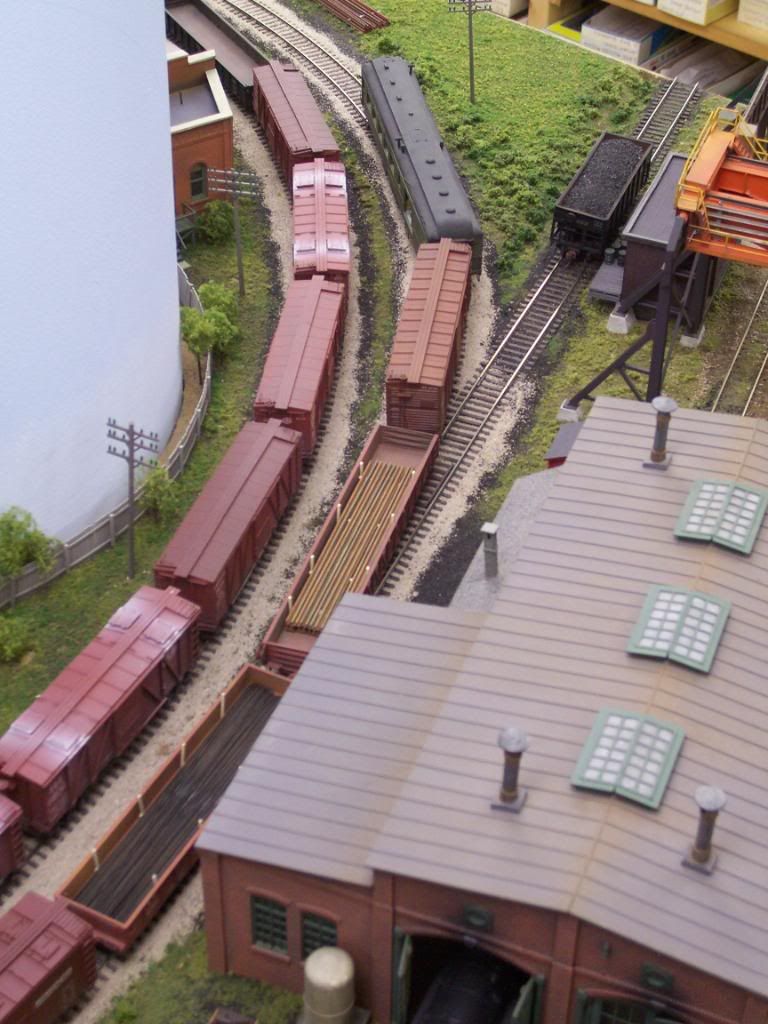
After unsoldering the railjoiners, I soaked the area, then let it sit for a while - with the help of a scraper, both came up with no damage.
My layout has been in place now for over 15 years, but I see no evidence of the cork crumbling or the white glue becoming brittle. Often, those who complain of brittle ballast have this problem because they’ve not properly pre-wet the area to be ballasted and/or they’ve not used enough white glue.
The performance of both white glue and matte medium on the layout is quite satisfactory when properly applied, but I prefer white glue due to the lower cost: around here, roughly $1.00/oz. for matte medium as opposed to under $20.00 for a gallon of white glue.
Don’t skimp on the pre-wetting:
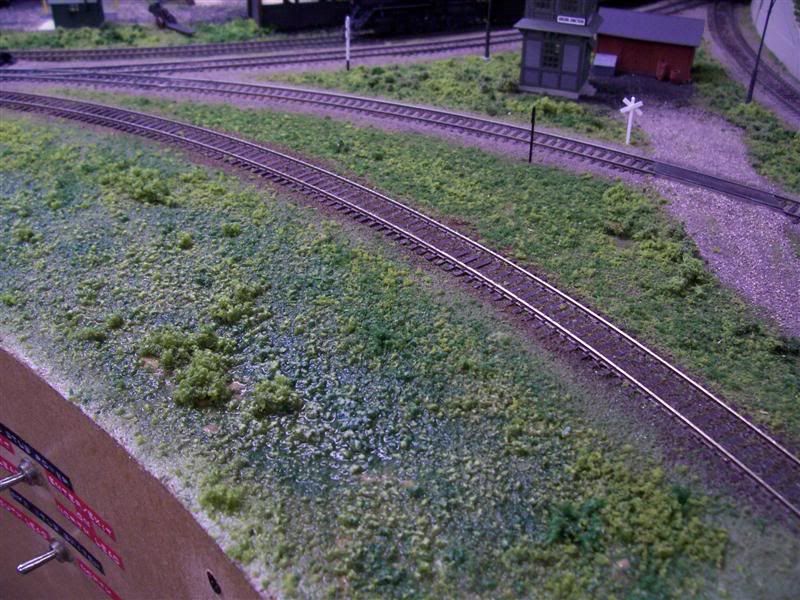
As also mentioned, don’t spray the matte medium or white glue mixture: not only will you get it all over anything nearby, making a mess and wasting the glue, but you’ll also ruin the sprayer. Better to use a squeeze-type bottle:
[IMG]http://i23.photobucket.com/albums/b399/doctorwayne/Some%20scenery%20stuff/GERNTurfM
Thank you Wayne. Now I don’t feel like I’m throwing the wash water against the wind.
Lots of arguments for both camps here…
I don´t fold that easy [:D]
Here is what Scenic Express says:
It is often asked “Why use ONLY MATTE MEDIUM?..” Why not thinned white glue or hair spray? For years, MATTE MEDIUM has been used extensively by professional model designers as a general all-purpose adhesive for foams, ground covers, ballast and scenic textures. Consider its many qualities:
1: MATTE MEDIUM is a synthetic acrylic-based adhesive. Acrylics are very flexible and transparent air-curing polymers. Unlike hairspray, MATTE MEDIUM will never dry out or deteriorate, will never yellow and will always remain flexible.
2: As its name implies, it has a matte or flat finish when dry. When diluted to the proper consistency, it is nearly invisible unlike white glue which leaves a stiff “waxy” appearance over the tree; and
I have been using diluted white glue with a drop of detergent added for over 30 years now for ballasting and ground cover. I do, however, use a more elastic glue to glue down my cork roadbed and track - works nicely.
Graffen - the glue I use for my cork roadbed is ordinary Pattex from Henkel, which you should also be able to get in Sweden. It is a bit smelly, but sets slow enough to adjust both roadbed and track and fast enough for efficient work.
I started to use this technique for ballasting my switches when I was constructing my last–and now defunct–layout about eleven or so years ago. I can’t remember just where I had heard about using white glue instead of matte medium but a relocation had just forced me to deconstruct my last layout and I decided to give it a whirl. When circumstances forced me to junk that layout a couple of years back I was amazed at how easy my switchwork came up. It might even drive me out of the frog building business.
However it was brought up on one of these forums that this white glue ballasting technique might be a little suspect in super-humid environments something I don’t have to worry about here in the desert southwest where 10% humility is “muggy.”