I have been working on my track plan a little while I am on vacation, and I’m not exactly happy with what I am coming up with. One of the main features will be a HEAVILY condensed version of the Frankfort, Indiana yards. I am basing the overall yard length on the arrival/departure tracks, and have come up with overall yards lengths based on how long the trains running on the main lines will be. So what kind of train length do most people run and find as a reasonable compromise? My initial thought was to have 30 car trains, but I’m afraid the lengths will be a bit much. I would love to be able to run 50 car trains, but my space constraints just won’t allow that, so let’s hear what the majority runs.
I think this highly depends on the space available and operating philosophy - “Givens and Druthers” in other words. As far as train length goes, the longer the better but there is a point where absurdity is reached - think a 4’x8’ oval running a 35 or 40 car train where the engine would be chasing the caboose. My new layout is about 14’x22’, or about half the size of the old one. Main yard tracks are constrained to about 8-9’ or so I will be happy to run 12-15 car freights and 6-8 car passenger trains (on the old layout I ran trains up to about 20 cars, constrained by the approx. 12’ long staging tracks). There is also some consideration of ruling grade - mine is about 2.8% on the mainline, and the better pulling locos can do this, whereas longer trains might be problematic. The line down to the port branch is 4%, but there it will entail pulling small (max 4-5) cuts of cars up the hill. That all being said, if I had 1000 sq. ft. and unlimited funds for my layout, running 30-50 car trains would be an awful lot of fun!
My plan has lots of staging, but none of it very long, even though the room is 22 feet long. I mocked up all the staging, and the longest tracks will hold trains with two locomotives, 12 freight cars, and a caboose. I have two tracks planned that will just hold a doodlebog or a single RDC. Other very short tracks will hold a ten-wheeler and two passenger cars or a pair of RDCs.

The outer loop tracks are a bit longer. These will accomodate 9 car passenger trains with a pair of PAs, or a 16 car freight train pulled by an EM-1 2-8-8-4.
The Manchester/Great Divide staging tracks will only hold a five car train. This is the longest train that will climb the 5.5% grade.
So, it might not be prototypical, but I like 10 car freight trains with double headed diesels or Heavy Mikados. That length can be managed in a small yard, and is plenty fun for me.
-Kevin
My HO layout is designed to comfortably run 36 car iron ore trains, and up to 7 car long passenger trains. My layout contains four towns, and each town is served by a separate freight train, so those are generally only 8-10 cars at most.
On my layout, ten to twenty freight cars would be normal, but I have run trains of over 70 cars, just to see if it could be done.
Wayne
What is interesting – well OK, I find it interesting – is that regardless of scale it seems trains of about the same actual length tend to look satisfying to our (again, MY) eyes. By which I mean on an O scale layout a five or six car freight train seems like a decent length for realism; on HO a 10 or 12 car train ditto; for N a 20 car train.
I do not know why this is so but it might have something to do with just how much our eyes (and therefore mind) can take it at a glance. We know a three car freight is a three car freight just by glancing at it. A ten car freight? We probably have to count the cars.
This is not to say that a 25 car freight train in O scale or an 80 car unit coal train in N scale are not darned impressive. But it is possible to be happy with a train length that the prototype would regard as rather short. And it stands to reason that you might want your “local” to be shorter than your manifest through freight, even if just by a few cars.
If prototypical operations are important then it seems to be thinking about what length of train your yard can comfortably be used to create, what length of passing siding your space can permit, and what kind of curves you have, all play a role in deciding what the ideal “normal” train length is. No doubt about it however it makes sense to think about it first before having your layout make the decision for you.
Dave Nelson
I only have a few modules at home so trains a just a few cars with no continuous running. The old club layout I have run up to eighty cars. Most of the time around forty was normal. It depended on what I felt like carrying. My passenger trains were limited to thirteen cars because that is all I have.
When (more like if.) I get control of the upstairs of the house, my layout construction will continue anew. Gosh darn boomerang kids.
Pete.
Remember N Scale. Hope it helps.
With my Amtrak passenger train set length is 5’9". Two F40 or P42, baggage car, and 8 Superliners. If I want 2-4 MHC cars it will be over 6’.
Freight trains were length to 6’8"to 7’2" long to have 2 diesel or 3 depending on the cars. 18-24 cars a nice amount.
Minimum size or correct 3’3" that holds 2 diesels and 8-9 cars. This is the current setup on my layout. It’s a nice balance of a long train without being too long, it’s a stretch if I place a third engine on. Passenger train is down to 4 coaches and locomotive, Amfleet or Superliners doesn’t matter.
Locals are usually 2-4 cars I find it underwhelming. It gets the job done but 6 or more is way too much to switch 2 industries.
If wanted to model Amtrak in HO I would need a little over 13 feet for the same normal consist.
One of the reasons I chose to model a local short line in the 1950’s was that it would be realistic to run short trains of 10 to 12 40’ cars. An HO scale train of that size with two locos and a caboose can be between 6 and 7 feet long. Unless you have a large layout, it can be difficult to run much longer trains without stretching reality. Shorter trains also allow your track plan to include passing sidings. On my own layout, it was actually the length of the passing sidings I could fit into my track plan that dictated the typical train length.
Hello All,
My pike has only approximately 18-feet of mainline in an oval in a 4’x8’ space.
I’ve run thirty-two, 34-foot hoppers with a consist of 4 GP40s. It was practically nose-to-tail running and looked ridiculous.
On average I run a 16-car coal drag of 34-foot hoppers powered by a 4-unit consist of GP40s.
I also limit the length of rolling stock to no longer than 60-feet, with the exception of 85-foot passenger cars for the Royal Gorge Excursion train.
Hope this helps.
My Hudson will pull a 30-car freight up the pass so generally, that is what I have going. A fifteen-car passenger train pulled by three FP-7s is also in the mix. I like really long trains as well but they need to be built on the main and there is nowhere to park them past about 35 cars.
Shortline Local service. 3 cars to about 9 cars, calibrated to factor in car length.
More precise, 68 inch length maximum, which fits nicely into the two runarounds at each end of the layout.
I designed my layout to accomodate 50 car freights (HO). I found that running train that long dwarfed the layout and led to operational issues. I now try to limit my trains to a maximum of 25 cars but 15 is more a more typical length. My fictional layout is based loosely on the New York, Ontario, and Western and in its final years, freight trains of that length were very common. That’s probably why it went belly up.
I run HO in the late Transition Era. I normally run freights of 8 to 10 cars, mostly 40-foot boxcars. I have a few longer gons and flats, but the boxcars dominate. Passenger trains can be 4 or 5 coaches and a couple of Railway Express high-speed reefers.
My layout was large enough to run two of these trains in opposite directions with passing sidings so this could be done carefully even though the main line is single track. My relatively short trains make this possible.
I usually pulled each train with a pair of diesels.
My new layout, and my previous layout, designed for transition era freight trains in the 35 to 50 car range. The visible freight yard and most of the staging tracks are over 22’-24’ long.
The main passenger terminal is desigened to handle passenger trains in the 12-15 car range.
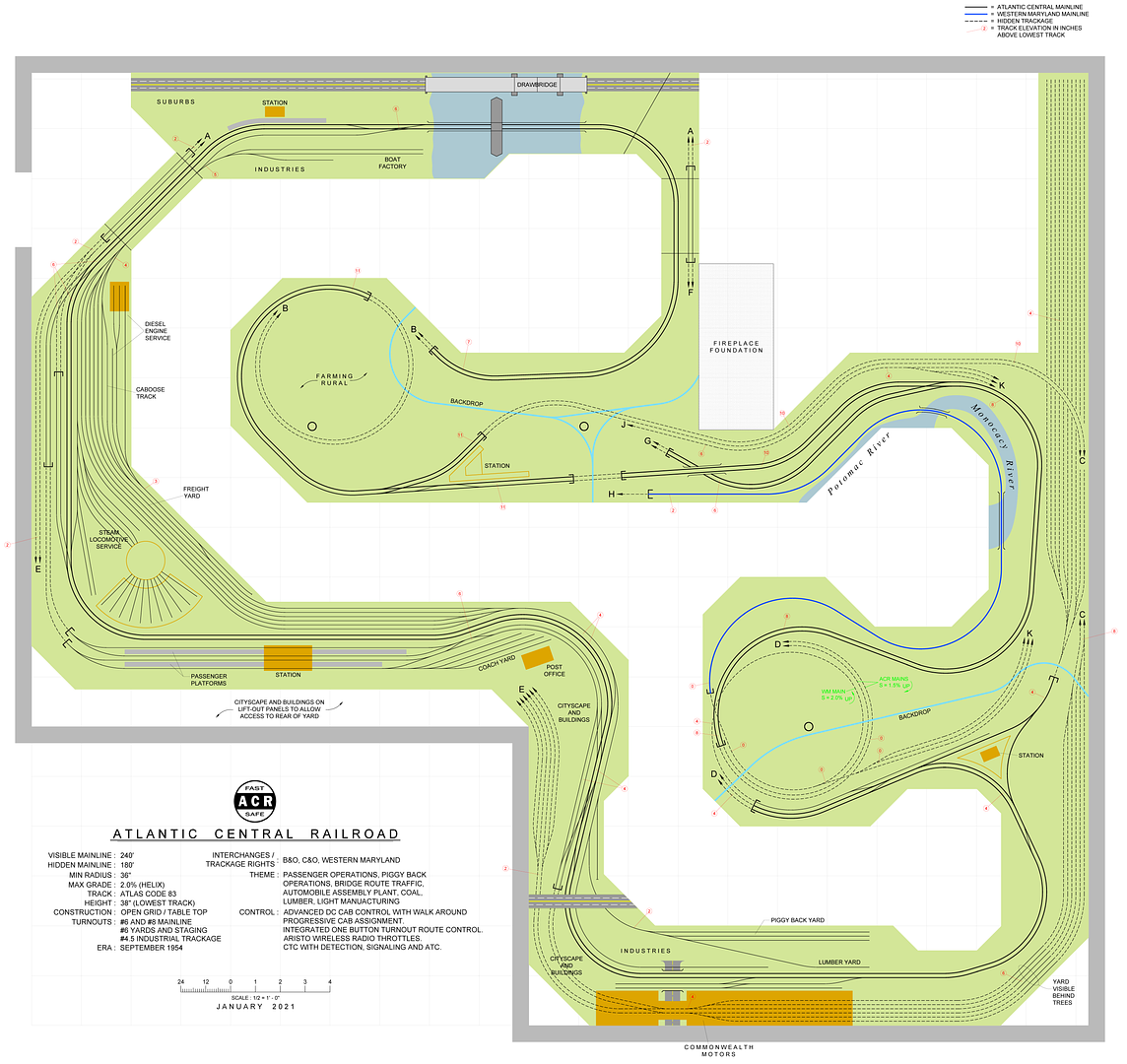
The layout was purposely designed to only depict one small city and the rural areas on either side of it with the specific goal of making longer trains look more realistic.
I gave up on the idea of trying to model an “origin” and “destination” decades ago in favor of the single stage with trains coming and going.
It allows you to model only one of each major feature, and make those features bigger, more realistic, and less “compressed”.
Sheldon
As others mentioned, there are plenty of factors to consider for train length. Mine is prob 15-20 cars in the a layout from the early 1980s. That comes out to about nine feet on the layout. It’s 12x8 in an “E” shape with a 5x6’ peninsula in the middle.
Transition era, multple types of steam and diesel for the 1940-1960 time-frame. My layout is a folded loop design with double tracks running a total of about 45’ each. I tend to simulate a ‘limited’ run like the Broadway Limited or the 20th Century Limited with up to six pax cars, mostly heavyweights, and at least two reefers rearward of the tender. This makes my total train length about 9-10’. My coal drags, headed by a BLI Y6b, run 22 cars plus a caboose up my nealry 3% grades. I’m not sure the Y knows they’re there, but that’s another discussion. [8D] Smaller workhorses, like a Mike or a Mountain class, an RS-18, go between five cars and a caboose on the small side, to about 10 cars or more and a caboose, depending on the oomph of the locomotive.
I typically run between 10 and 15 cars on my layout, set in 1903. The cars are mostly in the 34-36 ft range, so that gives trains between 6 and 8 ft long.
A sensible approach. Mine is similar in that I have one major city and yard although the east end staging yard is immediately beyond the city so there is no rural area to that side and I do have two small towns before reaching the west end staging yard. I did that because I wanted to run a peddler freight with switching along the line. The destinations are represented by the staging yards.
PS. I haven’t forgetten the RDCs I’m going to send you. I have them packed up but I only go into town once or twice a week and I keep forgetting to bring them along so I can deliver them to the post office.
I recall once reading the calculations for the length of a train that could be seen at one time. A straight shelf, normal viewing distance of 3ft eye to track at center, and a 110 degree field of vision gives a visible actual train length of 8.5ft (doesn’t matter what scale). Any train that can’t be seen all at once appears long, and the eye can’t really tell how long without moving the head. So trains of 9+ actual ft are going to appear long from a 3ft eyeball to track, and it really doesn’t how much longer the train really is - unless you back up or swivel your head.
Passing siding length becomes another limiting factor, especially if runaround movements are needed for switching. At 6 scale MPH switching speed in HO, you take 60 seconds to go 10ft. So with a 10ft passing siding a runaround move takes 2 full minutes. No wonder realistic scale speeds are usually exceeded on large layouts.
At the same time, switching with too short a train and very short passing sidings loses realism quickly. I find that 8 cars is about minimum for enjoyable way freight switching operations.
In my modular operations planning (where passing track lengths are essentially unlimited) for 1900 era in HO, my preference would be for 8ft passing sidings which equals 15 36ft cars max plus engine and caboose. On the narrow gauge side, 6ft sidings gives 12 32ft cars max plus engine and caboose. The narrow gauge train length is quite realistic, the standard gauge is a little on the short side, but probably OK for short lines with light power.
Those are just my ideas and ideals, spatial realities interfere.
Fred W