Don’t be daft! It’s the distance BETWEEN the rails (inner face to inner face at 90deg to the running surface), a platelayer friend informs me that in actual fact the UK true gauge is 4ft-8 3/4inches. As a qualified draughtsman of the old school all distances between cylindrical objects and holes are centre to centre, rarely tangential.
I am going ahead and going to add to “How many times can the same bit of information be posted in response to the OP’s question?”. I suppose that the below drawing should be it, but it won’t.
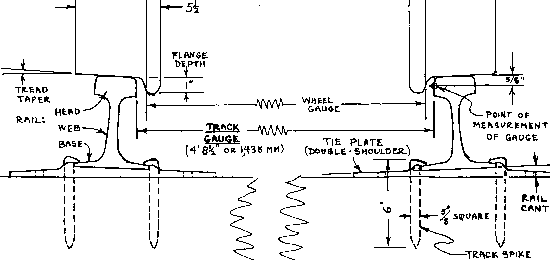
I do wan’t to quote the source of the drawing:
The Railroad: What It Is, What It Does by John Armstrong
A book long used as a reference by professional railroaders, which includes the diagram shown by the San Diego Railroad Museum
I do realize this was posted in another response earlier in this thread.
I supppose it depends on how many times people post complete and utter nonsense - that track gauge is measured from the centre of the rail head. Or that other bonehead favourite, the standard gauge/Roman Chariot myth. (I can never understand why people repeatedly post on subjects they clearly know absolutely nothing about.) Cheers, Mark.
What I meant was that ole R.T. was fishing for controversy by baiting us with the inside to outside gauge thing and everybody bit. Fish are caught by the lips and are often torn by the hooks. A plug is a wooden lure used primarily for bass or on the coaast certain types of salmon will hit such a lure.
P.S. I always thought gauge waas inside to inside and don’t quite understand the controversy .For a buch of detail nuts such as modelrailroaders are want to be has someone gone out and actually put a tape on the tracks in various locations? Think I’ll do that today.
So you are saying that rtpoteet is a pain in the patoot?
Well said Smiffy! That dos it for me, my copy of Kemps Engineering Year Book for 1915 shows roughly the same dimensions as applied to British Standard Bull Head Rail set in cast steel chairs. This system allowed the rail to be turned laterally and longtitudinally many times in order to even out wear, the need to grind the head never happened with this type, however as this was labour intensive (also CWR is not possible) flat bottom rail is now the norm on main lines here in the UK.
Just scanned through the link I posted above, and found something very interesting.
Seems that an Italian law passed in 1879 specified that only three track gauges would be legal in that country: 750mm, 1000mm and 1500mm - measured at the center of the rails!
Depend on a bunch of technologically challenged politicians to screw things up!
Chuck (who models 1067mm gauge prototypes on 16.5mm gauge track - measured between the inside faces of the railheads in both cases)
"I supppose it depends on how many times people post complete and utter nonsense - that track gauge is measured from the centre of the rail head. Or that other bonehead favourite, the standard gauge/Roman Chariot myth.
(I can never understand why people repeatedly post on subjects they clearly know absolutely nothing about.)
Cheers,
Mark. "
That’s a pretty nasty post. For someone like me who didn’t know where the measurement was taken from, I assumed it was from the rail center. Instead of being ugly about it, you could have presented your point in a positive way. Not everyone knows all that stuff.
Hi Robert:
There are several problems with defining the rail gauge as a center to center distance. (This assumes that we are starting at the very beginning of railroading, and can therefore define things, rather than adhere to an already established standard.)
The first problem is that the center to center distance isn’t relevant to our purpose. In keeping the wheels on the rails, you’re concerned with two things:
prevent the wheels from falling into the gap between both rails, and
prevent the wheels from climbing either of the rails.
(We’re ignoring turnouts, since such consideration would unnecessarily complicate the discussion.)
The center to center distance won’t NECESSARILY achieve either of those two goals. Because, as has been stated in other posts, the railhead may not be the same width. Different weights of rail had more or less proportional cross sections, so a heavier grade rail would have a wider railhead. If you define the track gauge as a center to center distance, the actual distance between the two rails will VARY when you use different rail weights, which is not a desirable thing.
It’s the distance BETWEEN the rails, which in combination with the wheel gauge and a few other factors, keeps the wheels on the tracks. We’re using the term wheel gauge in the sense of the drawing shown here:
http://www.sdrm.org/faqs/gauge/track-lg.gif

If you use “wheel gauge” as a search term these days, you turn up a lot of references to devices which measure wheel profile, ie, mechanical or optical gauges to measure a wheel’s profile. That’s one of the problems with trying to search for something that was originally recommended by the ARA in October of 1896.
Anywa
GearDrivenSteam,
You have to consider where Mark is coming from. Both he and I have been on the 'net for years talking model trains, starting with newsgroups. And the “standard gauge/Roman Chariot” myth has come up so many times that it’s practically a running gag over on rec.models.railroad. It gets to the point that we think everyone has heard it & knows how guage is measured, and that after the first rebuttle is given and still folks are arguing, it gets frustrating.
Mark’s post really isn’t that nasty. “Complete and utter nonsense” isn’t that bad a description of what’s been going on here by a certain poster (not you). That person is trolling for replies, and is therefore a Troll. As the saying goes, “Please don’t feed the Trolls.” They crave attention like a 4-year-old craves a lollypop.
Mark is just less tolerant of “cow manure” than others, and tends to call people on it. I’m glad he does because if he didn’t, people would be getting bad info constantly.
Paul A. Cutler III
Weather Or No Go New Haven
If it wasn’t directed towards me, then I recant my reply. I wasn’t aware of anyone trolling.
I agree. Mark’s delivery can be excoriating (a combination, we have agreed, of personality and cultural differences), but you can generally take what he asserts to the bank. I have been spanked a couple of times. [ ] I take him as a gate-keeper, of sorts, and that is okay by me.
I thought it was 3’ 6" from inside to inside…or is that just here?
There, here (I model a 1067mm gauge prototype) and a lot of other places, notably in Japan and Africa - which is why it’s widely referred to as “Cape gauge.”
Of course your neighbors to the Southeast (aka NZ) use it, too.
Quick test to see if the Brits got there before the French - is the track gauge 1m or 1067mm? No mater which, it’s still measured from the inside faces of the railheads.
Chuck
didn’t know it was so popular, we have 3 gauges in Qld…
1067mm - QR network
1485mm - interstate standard gauge from Brisbane port south
610mm - the sugarcan train network
someone didn’t know what they were doing way back [;)]
james saunders wrote: <“didn’t know it was so popular, we have 3 gauges in Qld… 1067mm - QR network 1485mm - interstate standard gauge from Brisbane port south 610mm - the sugarcan train network someone didn’t know what they were doing way back”> Why do you reckon that? The reasons for choosing 1067mm as the gauge for the infant QGR system were perfectly valid at the time. The colony had a pressing need for rail transport, but not much money. The standard gauge extension to Yeerongpilly was a logical contination of the NSWGR network, and provided a strategic transport link on the east coast during WW2. As for the cane network being 610mm, there was no requirement for interchange with the QGR system, and rollingstock and track in that gauge was readily available from suppliers like Hudsons and Decauville. I’d say various “someones” knew exactly what they were doing! Cheers, Mark.
james saunders wrote: <“I thought it was 3’ 6” from inside to inside…or is that just here?"> Here being Queensland, right? What about NSW, Victoria, SA, WA, the Northern Territory, the ACT, and Tasmania? Every state and territory in Australia has had, or has 3’6’ gauge railways. And, as Chuck notes, New Zealand, Japan, Africa, as well as many other countries. Cheers, Mark.
tomikawaTT wrote: <“Just scanned through the link I posted above, and found something very interesting. Seems that an Italian law passed in 1879 specified that only three track gauges would be legal in that country: 750mm, 1000mm and 1500mm - measured at the center of the rails!”> Yes Chuck, very interesting! That would go a long way towards explaining the numerous 950mm gauge light railways in Italy and their former colonies and possessions. Cheers, Mark.
GearDrivenSteam wrote: <“That’s a pretty nasty post. For someone like me who didn’t know where the measurement was taken from, I assumed it was from the rail center. Instead of being ugly about it, you could have presented your point in a positive way.”> Meaning what? My post wasn’t addressed to you specifically, nor did it insult or denigrate you specifically, so I don’t know why you’ve decided to take offence at it. At any rate, I reserve the right to be “ugly” towards those who keep posting this sort of nonsense. <“Not everyone knows all that stuff.”> Granted, not everyone does. But when there are repeated posts that correctly describe how gauge is measured, and why, there is no excuse for not knowing, is there? All the best, Mark.
selector wrote: <“Mark’s delivery can be excoriating (a combination, we have agreed, of personality and cultural differences), but you can generally take what he asserts to the bank.”> Mate, thanks for the compliment! But I’d like to be the first to point out that I’ve been wrong on many occasions… <“I have been spanked a couple of times…”> Fwoar!!! Seriously, no offence meant, and none taken, I hope? Mark.